
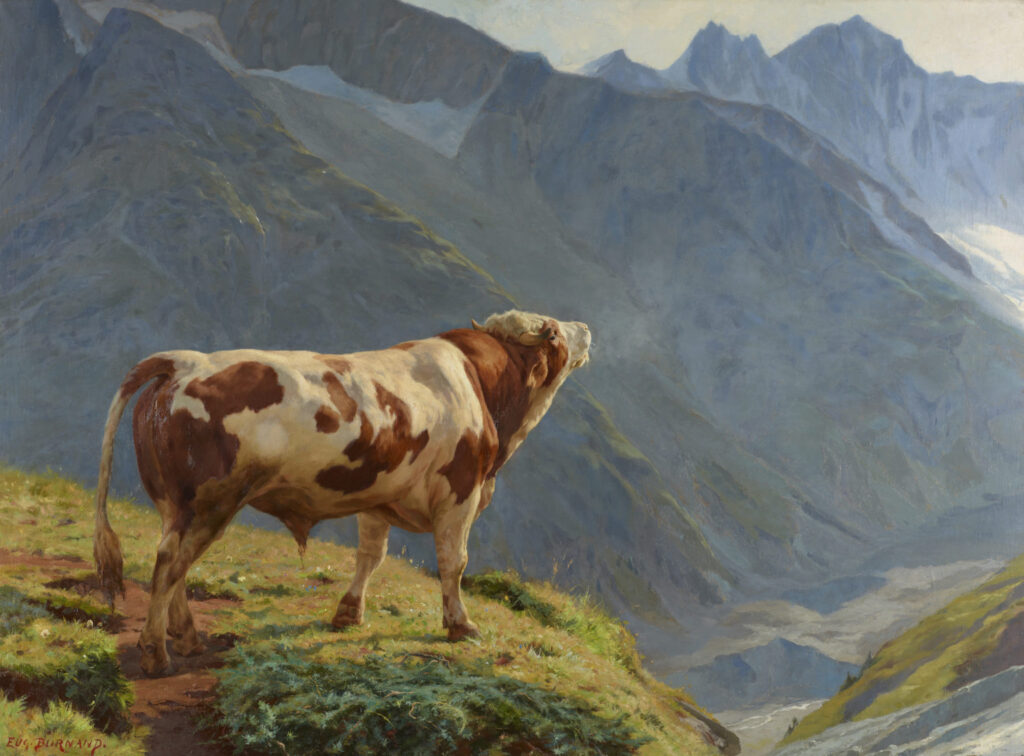
For many years I have been drawn to using works of art during my prayer. When I made my annual retreat in the past, I would be sure to pack a couple of books of paintings and photography to take with me. Now I take my ipad and go online. I figure, during the year, I almost always pray with words–scripture (of course) and poetry and songs. So focusing on the visual arts during my retreat was a refreshing change for me.
Recently I came across a Swiss artist I had never heard of before although I was familiar with one of his best-known paintings, “Running to the Tomb on Easter Morning.” (More about that later.) The artist is Eugene Burnand (1850-1921), a man with incredible talent who is well-known in Switzerland and France, but little appreciated outside these areas. He was a realist painter of nature. “The Bull in the Alps” (featured above) is a fine example of his nature work. I love this painting! I am drawn by the bull’s colorful coat. I want to reach out and feel its texture. (But of course I don’t dare!) I marvel at his massive neck and chest, his strong leg muscles, his horns–all revealing the colossal power of this singular animal. And in the background, I glimpse the deep, deep valley below. This bull is up really high–and he’s standing right on the edge too! How daring he is! I wonder: is he bellowing? There’s breath coming from his muzzle. Is he calling to the mountains–or does he see a small herd of lady cows across the great divide? Is he lonely? Triumphant? Regal? Despite all his power, does he long for something beyond himself? For me, there’s so much beauty here–in the grassy pasture on which he stands (there are some bright colored flowers easily seen in the huge original painting). The deep valley with a river running through it, the towering mountains–some snow-capped–all compliment the beauty of this amazing bull! What must the bull’s Creator be like to have fashioned him.
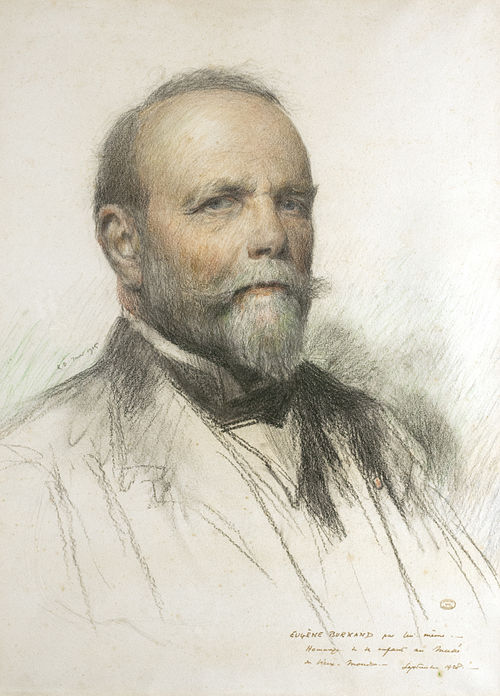

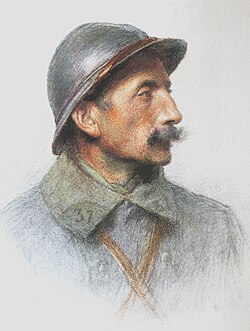
As Burnand grew older, he became increasingly interested in painting human beings. A deeply religious Protestant, he looked to the Bible for inspiration. He was dissatisfied with traditional illustrations of the Bible. He believed the people in the Bible should be depicted as real everyday people. In his own illustrations he often used his neighbors and ordinary people as his models. One of his major religious works was an illustration of 32 parables of Jesus consisting of 76 paintings, drawings, and sketches. That endeavor took him four years to complete. Burnand was also deeply affected by World War I. He was amazed at the wide range of people who had been drawn into the conflict. As a result, he did a series of 104 pastel portraits of participants in the war, focusing not on the leaders, but on “the lowly.”
So now, let’s reflect on Burnand’s painting of St. Peter and St. John running to the tomb on Easter morning. Some people say this is “the greatest Easter painting ever,” and yet it doesn’t even show the Risen Jesus! We begin by putting the painting within a context. Some women have been to the tomb on Easter morning to anoint the body of Jesus. But when they get there, they find the stone rolled back and the tomb empty. What’s more, they see an angel who tells them Jesus is risen–and they should go tell the disciples. Terrified, the women run like heck to tell the disciples.
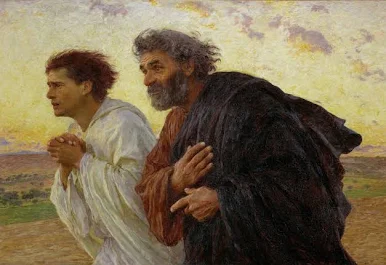
This painting shows St. John and St. Peter running to the tomb to see for themselves. We begin by simply gazing at the painting… slowly.. and for however long it takes. You can do this on your own, or these words might help you: Notice what you notice… the faces of each man… their hair, eyes, mouth, facial expression… notice their clothing, colors and textures… their hands… what do the clasped hands of John say to you? what about Peter’s hands? notice their posture, their leaning forward… how do we know these men are running?… Then raise a few questions for yourself: what do you detect in their facial expressions? fear? anxiousness? hope? disbelief? joy? What do you notice about the background… the sky?… These men have not seen the Risen Jesus. That will come later. They only have the story of the women. Are those women delirious and hysterical? The men want to see for themselves… I ask myself: what do these men and I have in common? Can I relate to them and their experience? Why do some people say this painting is such a great Easter painting? Does it capture all of us who have not seen the Risen Lord but want desperately to believe the story is true? Does this painting lead you to prayer… to the Risen Jesus?
I will leave you with a few more paintings by Burnand:
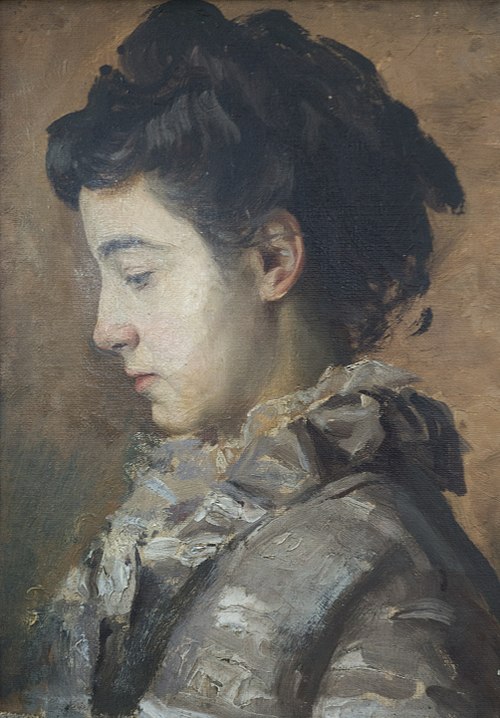
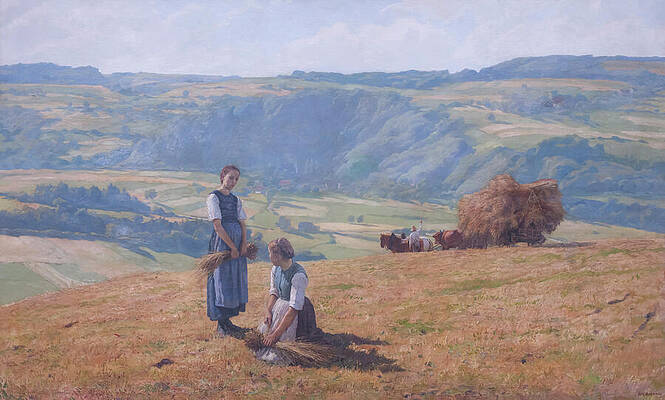
For reflection:
What did you notice in Burnand’s painting “Running to the Tomb on Easter Morning?” Would you like to share with us anything about this painting in the comments below?
Do any of you use the arts–visual, musical, literary, dance, or others–for your prayer? If so, would you like to share some of the things you have used?
Are you involved with the arts–as creators, teachers, lovers? Would you like to share some of your experiences with us?
Do any of Burnand’s other paintings speak to you here?
Our video is a short (8 min.) commentary on Burnand’s painting. Two individuals share their thoughts on the painting. The video also includes some close-ups of the painting and additional information you might find interesting. I did!
(Disclaimer: As I mentioned before, I have no control over the videos that appear after the one I’ve selected ends. Some are fine. But others I certainly would NOT recommend. As they say, discretion is advised.)
Please feel free to jot down a comment below. We all love hearing from you!



25 Responses
I have LOVED this painting since I first saw a print of it, hanging in the home of my husband’s aunt and uncle. It is my ultimate favorite Easter depiction – the hope, faith, anticipation of these two men. Thank you for giving more information about this special artist.
Good Morning – I’ve been a long time reader of your blog and so very grateful and happy to see it every Monday morning. This is one of my very favorite paintings. I worked for a congregation of sisters originating in Paris. After one of their trips to their Mother House, a person on that trip brought back a print of this painting. I looked at it every time I was in his office. What do I see? Such intensity of purpose escalating with every step. Speed! We must go faster! Hurry, hurry, hurry!! I see some fear and some hope and confusion in their faces. The rising sun in the background gives a touch of splendor and more hope. This is a painting you can feel in your very core. Another painting I loved to view was one the Sisters had in a hallway of Mary and Elizabeth. I always felt their presence, their connection when a would pause by it. The sculpture of Mary and Elizabeth at the Church of the Visitation also gives me that same feeling of their depth of connection. It was not until I worked for the Sisters that I began to appreciate art as a way to connect with the Divine.
Thank you for this beautiful reflection today. I have a friend who was an art professor and I know she has talked about praying with art pieces. I haven’t done this much myself but this was a wonderful introduction. Thanks again Melanie.
I like the longing in Peter and John’s faces as they run to the tomb on Easter morning. The uncertainty is also present.
I love this concept of praying with art and have never really done it before! I honestly have not seen this painting or heard of this artist. His paintings are beautiful and inspiring. Thank you for opening my eyes and heart!
Our Catholic Archdiocese of Cincinnati, Ohio, published an introductory article about Visio Divina a while back, and, since then, offers a reflection article each issue of The Catholic Telegraph with an accompanying artwork. https://www.thecatholictelegraph.com/where-secular-meets-sacred/101645
I have used The Call of St. Matthew by Caravaggio. And Storm st Sea by Rembrandt, in homilies. The congregation really related.
Good morning, Sr. Melannie…
Good morning, all…
Ever since seeing Sr. Wendy Becket on PBS, I have drawn to just looking at works of art, slowing down and really looking. It takes practice and patience, for sure. Years ago, I attended a retreat that focused on Thomas Merton and Henri Nouwen. The presenter said that Nouwen was a great admirer of Rembrandt’s “The Prodigal Son,” traveling all the way to a museum in Russia just sit and stare at it for hours. Mary Oliver equates “paying attention” to prayer, and so thank you for reminding us of this valuable spiritual practice.
PS: During the video, there’s a closeup of John’s brow. Did I spy what looks like a cross on that brow, or am I trying too hard!
Good Morning Sister Melannie,
Your blog opened many doors for the meaning of this artist and this particular work of art. Thank you for presenting this so we may “see” more.
Thank you for this gift that I will save and treasure forever.
The Good Samaritan touched me deeply and is now my favorite of all others seen before.
God bless you sister for sharing this today on Labor Day!
Marilyn Woidat
I too have never heard of this painter, but love his style and particularly the one we are focused on today. The sense that came through so clearly for me was the difference in age….John looked anxious with his hands clasped and his worried eyes, while Peter certainly looked perplexed and anxious to find out what is going on, but has a more solid appearance.
It is a picture that can captivate for a long time.
I remember reading an account of one of Henri Nouwen’s friends accompanying him to view a painting he was so eager to see. I don’t even remember what it was, but he sat for 4 hours in near silence. He told her that he enters the scene which keeps him spellbound for such a long time….and that is part of the beauty of visio divina, I think, to be part of the painting.
The last visio I did was as a group….it was a charming picture, but what I got caught up on was what was missing….there was a group of people ascending a mountain, but they were all white faces and that was disturbing to me….but the experience still had a powerful message for me!
Thank you S. Melannie,
Mary
In praying with Rosary in a Year, we are taught to reflect on certain paintings in our
prayer. I find myself going back to those sections often. I’ve just begun reading
Mona’s Eyes by Thomas Schlesser. A grandfather takes his granddaughter to see
a painting each week. He wants her to have beauty to remember. She may or may not
be losing her sight. Thank you for sharing.
I have a copy of Peter and John running to the tomb on Easter morning. It is my favorite Easter picture.
The Good Samaritan provided much different imagery for me: more personal and more giving. Are the disciples leaning into a Divine Wind, the Holy Spirit?
Thank you for giving a guide to contemplate Eugene Burnand’s gift!
Giddy up & God Bless!
Lovely discussion of the painting and the whole idea of art and prayer. Especially for me as this is a big art weekend in my town. And because our Bible study group did a whole session on Henri Nouwen’s book.of the prodigal son.
Hello,
Thank you for this beautiful reminder to use art in contemplation.
The picture shows how human the apostles were.
Beautiful.
Thank you for today’s meditation. I was not familiar with this painting/artist. The explanations were just wonderful and made the work “come alive” in so very many ways. If I never saw the painting again, I will always hold it in my memory as part of Easter. It is so powerful. That power – a painting that doesn’t even show the Resurrection, may be my favorite Easter work. I love the idea of taking even my phone with me to the chapel and meditating on good art — I’ve actually done it but didn’t really realize it as a form of prayer and how much it does influence me. I appreciate, so much more, what God made for us in our world when I can contemplate it. A favorite way I do that is to look closely and be amazed at every tiny detail is so perfect and yet so unique…especially each flower and each person. We all have the same features but the way God “put them together” in unlimited variety is intriguing to me. Thank you for opening my eyes to so much.
Thank you for this beautiful reflection.
Both the art work and the commentaries were so powerful.
Peace to you.
~Bernadette
A number of years ago I started looking for images of the mysteries of the Rosary online to look at while saying the Rosary. I now feel like I need to really look at them more carefully and maybe do more research about the paintings and images that I have found. Thank you for helping realize that there is more to the paintings and images than what is on the surface.
Thank you, Sr. Menannie for this selection of Eugene Burnand. I too had not heard of him till
seeing the painting of John and Peter used recently on the cover of a magazine. It inspired me to look him up, and view other works as well. So much to learn from unsung artists!
I am using one of his watercolor paintings now as a reference for an oil painting I am doing
in Sr. Maresa’s oil painting class. I really appreciate the video, as this provides in greater insight into Burnand as a person.
Thank you, Sr. Melannie, for the concept of using works of art during prayer. I loved all of Burnand’s paintings that you included. When I look at Peter and John running to the tomb I see great intensity, both of them absorbed in their own thoughts of what they would find. The video gave a wonderful commentary and many insights into the painting. I hope to try this new, to me, way of praying.
Blessings to you!
Melannie: One of my favorite paintings of many years. Notice the wind against the two apostles. A sign f more to come but with the enthusiasm for the mystery on their faces.
Thank you Melannie fr a beautiful reflection.
Mary Ann Flannery
Years ago, I was on a three day Jesuit retreat. The reflector of the retreat was a Jesuit priest, and the entire retreat was based on art in scripture. His talks specifically centered on the color red. It was fascinating to pray this way. I had never thought about the use of the color red in religious art and here we were gaining knowledge through art and prayer. It was an imaginative prayer experience. What a gift. I enjoy your blog every week and I’m astounded by your creativity. Thank you for sharing your creative ways. God bless.
Thank you so much for once again opening our eyes to another way of praying. I had not heard of this artist but will definitely be looking to view some of his work. Pictures can say so much, but many times we don’t make the time to really look at them and to see what message it brings to us. Hope you have a wonderful week!
This painting is unique in that it actually draws me into the event to actually participate and to share the anxiety of Peter and John
A wonderful experience. Thank you Sr. Melanie
Arthur Bates