
20 Short, Short Quotes about God

One of the most important questions we can ask in life is this: Is there a God? But another more important question is this: What is God like? These are two questions we have to ponder for a lifetime as life presents new experiences for us that can deepen, challenge, modify, or radically alter our previous answers. Fortunately we are not alone in our quest to know God. We can get help from countless individuals–living now and living long ago–who pondered these same questions. So, today I reached into my vast collection of quotes and looked under the heading “God.” It’s by far one of the topics that has the most entries. (Some of the other topics are love, Jesus, adversity, and humor) One criteron for choosing these quotes about God was brevity. Only one sentence… or two max.
I suggest you resist the temptation to read these quickly. Maybe you’d like to read them aloud and pause for a few moments. When you’re finished with all of them, you might want to go back and read again the ones that consoled you, disturbed you, or found you saying, “I really agree with that!” or “I never looked at God that way before.”

1) The door to God, the door to any grace is very little, very ordinary. Jessica Powers, Carmelite poet
2) Pray to God, but row for shore. Russian proverb
3) I used to ask God to help me. Then I asked if I might help Him. Hudson Taylor
4) There is no way to find God apart from real life in the real world. Barbara Brown Taylor
5) My concern is not whether God is on our side; my greatest concern is to be on God’s side. Abraham Lincoln

6) If God is dead, all things are permitted. Dostoevsky, Russian Novelist
7) If you are seeking after God, you may be sure of this: God is seeking you much more. St. John of the Cross
8) God is of no importance, unless He is of supreme importance. Rabbi Abraham Heschel
9) Be a part of the evidence of God’s love in the world. Brennan Manning
10) God speaks to us in a thousand clear voices, each with the same clear message: “I love you. Please trust me on this one.” Hugh Prather

11) When I asked my God if I could stay with him for awhile, she said, “Yes, but don’t bring your god with you.” Edwina Gately
12) God almost never does things exactly as we expect. Demetrius Dumm, OSB
13) God hugs you. You are encircled by the arms of the mystery of God. Hildegard of Bingen, 12th Century German Abbess
14) God does not have problems. Only plans. Corrie ten Boom, Holocaust survivor
15) God works in strange ways, permitting an infinite number of itineraries on the way to Him. Doris Grumbach
16) We turn to God when our foundations are shaking, only to find that it is God who is shaking them. Charles West
17) God always throws a better party. Anonymous
18) Is your love for God secure enough that you can rage against him? Anthony deMello, SJ
19) There is no such thing as an expert on God. Leen E. Goodman, Jewish Theologian
20) We ask God, “What are you like?” and God gives us the story of Jesus. Jesus is the parable of God. James Martin, SJ

Did any of these quotes stand out for you? If so, let us know below. You don’t even have to say why they stood out for you–unless you want to.
Did any of these quotes console, encourage, puzzle, disturb, or stretch you? Which one(s)?
Did any of the pictures get your attention?
Would you like to share a quote below about God that is only one or two sentences? It could be from someone else or your own quote.
PS: I’m giving a retreat on hope at Our Lady of the Snows Shrine in Belleville, Illinois (near St. Louis) from July 13-19. I’d love to see some of you there! Check their website for details: https://snows.org.
For our video I chose this haunting song by Barbara Bridge, sung here by the Sunday 7 pm Choir. It is called “Be Still and Know,” and is based on a single line from Psalm 46, verse 11. I thought this song was especially appropriate for Lent, a time we may be focusing on unhurrying our lives… on renewing our prayer… and on deepening our trust in our Beloved God….
I look forward to reading your comments below…
“The Ruthless Elimination of Hurry” Part II

Last week I presented a summary of the first part of John Mark Comer’s book, The Ruthless Elimination of Hurry. Comer maintains that our current frenetic pace of daily living is having a detrimental effect on our physical, emotional and spiritual well-being. Continual busyness and hurry can harm our health, destroy relationships, and kill joy. He goes so far as to say, constant hurry is unchristian. Jesus’ basic message was love, and “love is painfully time-consuming.”
In the second half of Comer’s book, he suggests four practices or spiritual disciplines for “unhurrying your life.” Jesus himself not only taught these practices, he lived them.
Silence and Solitude: What’s the first thing Jesus does to launch his public ministry? He goes into the desert where he was tempted by the devil. That word “desert” doesn’t necessarily mean endless sand and boiling heat. It can also mean a deserted place, a solitary place, a wilderness, or even a quiet place. It was in this place that Jesus received the strength “to take on the devil.” What’s more, again and again in the Gospels we see Jesus, amid all his busyness, seeking quiet places to be alone, to pray, to renew his strength. Do we follow his example?

We don’t have to book a flight to the Majove Desert to do this. Instead we can find or (more accurately) create pockets of solitude and silence even in the midst of our busy lives. These pockets will be different at different stages of our lives. Finding solitide and silence for parents with three small children might mean walking the dog in the evening or soaking in the tub while your partner watches the kids. Or sitting quietly after the kids are in bed. A retiree may make time to pray in the morning, go to Mass during the week, crochet a baby blanket for Birthright, or putter in the yard. Says Comer, “Your relationship to God is no different than any other relationship–it takes time alone together.”
The Sabbath tradition: The tradition of keeping the Sabbath is rooted in God. After creating the world, God rests. He stops working. “He sets aside an entire day just to delight in his world.” Later, when God gives Moses the Ten Commandments, we notice that the third commandment is longer than all the others. It begins: “Remember the Sabbath day by keeping it holy.” When Jesus “breaks” the Sabbath law by curing on the Sabbath, he is reminding us that no law or tradition is greater than God’s primarly law: love God, love others, love yourself.

Simplicity: The French sociologist Jean Baudrillard says that, in the Western World, “materialism has become the new, dominant system of meaning.” He maintains “atheism hasn’t replaced cultural Christianity; shopping has.” Comer adds these sobering statements: ” Shopping is the number one leisire activity in the U.S.”… Most of us believe the lie: the more money and stuff we have, the happier we will be. But Jesus said things like this: “It is more blessed to give than to receive… You cannot serve both God and money… Do not store up for yourselves treasure on earth.”

Comer gives 12 ways to simplify our lives. Here are four: 1) Before you buy, ask: by buying this, am I oppressing the poor or harming the earth? 2) Recognize advertising for what it is–propaganda. Call out the lie. 3) Get in the habit of giving things away. 4) Learn to enjoy things without owning them.
Slowing: Mahatma Ghandi said, “There is more to life than increasing its speed.” Comer suggests twenty ways to slow down. I’ll list six. 1) Drive the speed limit. 2) Show up ten minutes early for an appointment, and don’t use your phone during that time. 3) Get in the longest line at the checkout in the grocery store. 4) Set times for email and social media. Refuse to be available 24/7. (I regularly turn the volume off on my cellphone, landline, and laptop for an hour or so, figuring that the world should be able to get along without me for at least one hour…) 5) Walk slower. 6) single-task.
Comer concludes his book with the question he raised at the beginning. “How will you live?” Chances are, our world will go from fast to faster. Will you choose that road? Or will you remember, there’s another road. “Will you off-ramp onto the narrow path? Will you radically alter the pace of your life to take up the easy yoke of Jesus?”

For reflection:
On a scale of 1 to 10, 1 meaning “not hurried at all” and 10 meaning “extremely hurried life,” where do YOU fall?
Are there any words or phrases or pictures that touched your heart in today’s reflection?
Which of these spiritual disciplines do you already practice OR would you consider practicing to unhurry your life?
I chose two short videos today. The first is a short, short story (2 mins, 44 seconds) entitled “God is Speaking.” The second is a 5-minute walk through a Vermont forest.
After viewing “God Is Speaking,” let me know what you think about it. What did it say to you? Are you anything like the man in the story? Did any of “God’s post-it notes” speak to you?
Here is your 5-minute walk through a Vermont forest. No music, just the natural sounds of the forest and your own feet. After viewing it, did you find it beautiful? relaxing? magical? boring? Did you watch the entire video or did you fast forward it or cut it short?
I invite you to leave a comment below. We all love reading the comments!
“The Ruthless Elimination of Hurry” by John Mark Comer – part I

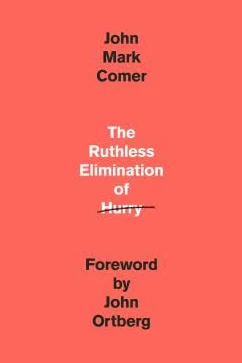
I just finished reading a fascinating book entitled “The Ruthless Elimination of Hurry.” (I want to thank Jen for her enthusiastic recommendation.) The book was so good, I had to exert great self-control NOT to hurry through it! The author, John Mark Comer, was the pastor of a huge mega-church in the suburbs of Portland, Oregon. By most metrics, he was highly successful: church size, book sales, speaking invitations, social status. But his marriage was more “duty than delight.” His kids avoided him, because they knew he was “wedded” to his job, his church. And at age 30, he was always “stressed out, on edge, and quick to snap at people.”
One day he paused long enough to ask himself these two questions: “Is this the way of Jesus?” And, “Who am I becoming?” He sought advice from wise people who were “emotionally alive and spiritually healthy” amid the “chaos of the modern world.” What was their secret, he wondered? One of the wise persons was Dallas Willard, a philosopher at the University of Southern California. When Willard was asked, “What must I do to become the person I want to be?” he replied, “You must ruthlessly eliminate hurry from your life.”
Corrie ten Boom, a holocaust survivor and Christian writer, said that if the devil can’t make you sin, he’ll make you busy. Says Comer, hurry, sin, and busyness all have the same effect–they can “cut you off from connection to God, to other people, and even to your own soul.” That doesn’t mean all busyness is bad. Jesus himself was busy. But the problem is when you have too much to do and “the only way to keep up the quota is to hurry.” Comer believes our constant hurriedness is “anti-Christ.” Why? Because the highest value in God’s kingdom is love. And as all parents, lovers, and friends know, “love is painfully time consuming.”
Comer sought counseling and eventually resigned as the CEO of that mega-church. He then became pastor of a single church in the inner city. That drastic change, he says, saved his marriage, helped him to establish a real relationship with his kids, and restored his energy to serve the members of his church with love, enthusiasm, and joy. The first step in eliminating the hurry in our lives is to acknowledge that there is a problem. One chapter that helped me to see the problem more clearly was entitled “A Brief History of Speed.”

Humans did not always live at our current frenetic pace. In 200 B.C. the sundial was invented. People complained about this “new technology.” (People tend to complain about any new technology.) They said the sundial cut the day “wretchedly into small portions” (later called hours.) Then, in the sixth Century, St. Benedict organized the monastery around seven times of prayer each day. By the 12th Century, the monks invented a mechanical clock to call the monastery to prayer at specific times. The year 1370 ushered in the first public clock tower in Cologne, Germany. Before that, time was more natural. When the sun came up, you got out of bed. When the sun went down, you went to bed. Now the tower clock bonged every hour of the day. Then in 1879 Thomas Edison invented the light bulb which made it possible to stay up past sunset–and to get up long before dawn. Here’s a shocking fact: Before the light bulb, the average person slept eleven hours a night!
Then came all our “labor saving devices” such as toasters, washing machines, microwaves, and fast food that were supposed to save us time. So what did we do with all that time we saved? Says Comer: “we spent it on other things.” But the epitome of labor saving devices came into being in 2007, the year Steven Jobs introduced the iPhone to the world. The iPhone put the internet into our pockets! Recent studies show that the average smartphone user touches his or her phone 2,617 times a day and is on that phone 2 1/2 hours over 66 sessions a day. Another study showed that younger users are on their phones twice that amount. Other studies have revealed these alarming trends. In 2000 our human attention span was 12 seconds. Now it’s dropped to nine. Adult humans, however, are still capable of “sustained focus” for about 60 minutes in certain contexts. Another alarming trend: Psychologists tell us that the vast majority of Americans’ relationship to their phones falls under the categories of “compulsion” or “full-addiction.”

So, how do you know if you have the so-called “hurry sickness,” that is, a malaise identified by cardiologists in which a person feels chronically anxious, continuously rushed, and short of time. Comer gives 10 signs. Here are 5 of them: Irritability: You get annoyed, frustrated, and mad very easily. Daily things irk you. People have to tiptoe around you. You live with an ongoing low-grade anger. Restlessness: When you try to slow down and rest, you can’t relax. If you go to bed early, you toss and turn. If you watch TV, you are simultaneously checking your phone or folding the laundry. Your mind is always hyped up. Workaholism or nonstop activity: You don’t know when to stop–or worse yet, you can’t stop. You have an obsession with getting things done. By day’s end you have nothing left to give your loved ones. Emotional numbness. You don’t have the capacity to feel another’s pain. Or even your own pain. Empathy is a rare feeling for you. When you’re too exhausted to do what’s really life-giving for you, you turn to “distractions of choice”: overeating, overdrinking, binge-watching, gambling, surfing the net, browsing social media.” Isolation: You feel disconected from everyone; yourself, others, God. Even if you try to sit with God or to be with friends, you’re also on your phone or a million miles away in your mind.
So what is the solution to the problem of trying to live our lives at such a frenetic pace? Does our Christian faith offer us any help? The answers to those two questions will be explored in next week’s blog. Until then, have an unhurried week!
For reflection:
Do you ever feel you are being asked to do more and more things with less time?
Do you have a smartphone? How would you describe your relationship with your phone: compulsive, an addiction, other? How often do you touch your phone on a given day? Why not keep track for a day? Have you ever “fasted” from your phone for a period of time? Explain the circumstances. How did it make you feel?
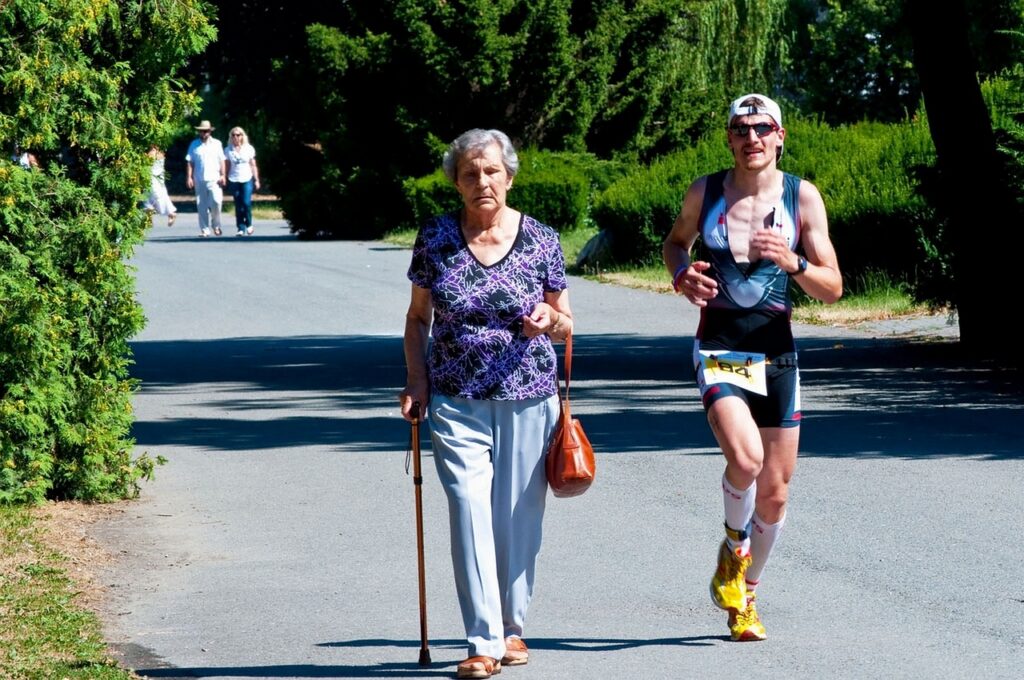
Do you drive the speed limit? Why or why not?
Any thoughts on the last picture above?
P.S. A good friend of mine, Sue, took this photo of a pileated woodpecker at her birdfeeder on her backyard deck. He and his mate take turns at the feeder. They fly in from across the road, so Sue suspects that’s where their nest is. If all goes well, they’ll raise their young (from egg to independence) in 4 months… Life goes on as usual for our feathered friends… They are an example of resilience, courage, and dedicated care for the next generation… There are no headlines calling our attention to them… Maybe there should be… Some facts: these birds are BIG: 19 inches long; wing-span of nearly 3 feet. They mate for life. They “drum” their beaks 20 times per second. Their built in “brain cushioning” prevents concussions. They carve a new nest in dead trees, allowing other animals (owls, squirrels, bats, other birds) to use their previous holes… I hope you can pause and enjoy “Woody’s” beauty! Thanks, Sue, for sharing this lovely picture with us!

Our song today is appropriately called “Slow Me Down” by Grapevine Church. It is a beautiful prayer addressed to our Good Shepherd, our Good Friend.
(Remember, I am recommending only the video I have selected below, and not necessarily the other ones that pop up after my video ends.)
I invite you to write a comment below.
The Story of Three Holocaust Babies

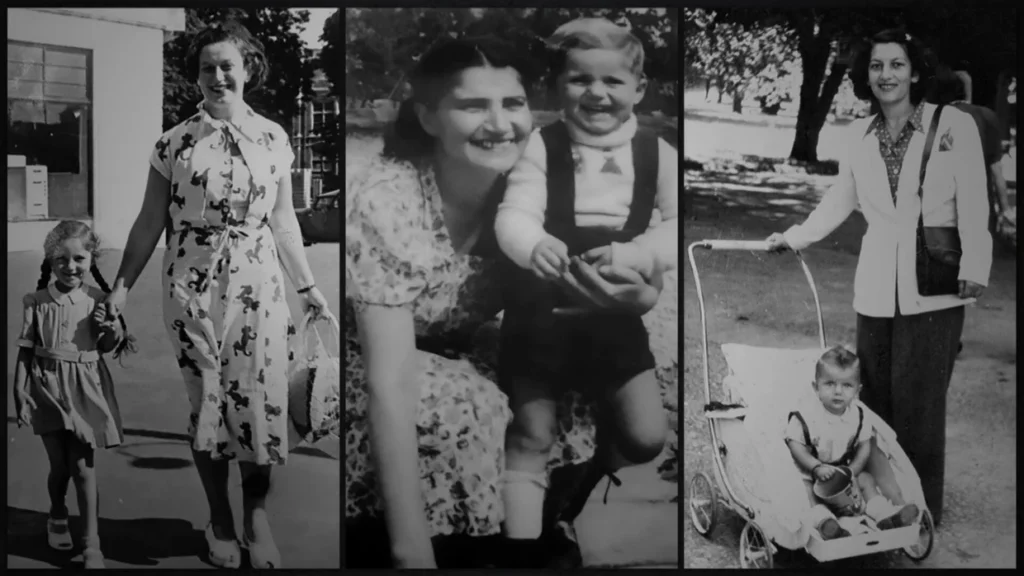
The show “60 Minutes” aired a program a couple of weeks ago that touched me deeply. It was entitled, “Three Holocaust Babies.” Leslie Stahl was the narrator. The 26-minute segment tells the incredible story of three pregnant Jewish women who were shipped to Auschwitz. The camp was so huge and tightly controlled, they never met. Pregnancy meant immediate death. But all three managed to hide their pregnancy and eventually give birth in the waning days of the war. Miraculously, all three babies survived and, at age 65, they met for the first time at a commemoration of the 65th anniversary of the liberation of the death camps. The picture above shows the three “babies” today at age 80.
The full story of their survival can be found in Wendy Holden’s best selling book Born Survivors: Three Young Mothers and Their Extraordinary Story of Courage, Defiance, and Hope. I am offering the CBS video for your reflection today. The story reminds us of the horrors of World War II–more specifically, the brutality of the Nazi Regime. It is not easy to watch. At the same time, the story highlights the unbelievable courage, love, and hope of ordinary people during unspeakable sufferings. Despite unimaginable evil, the sparks of human goodness somehow managed to survive–and prevail.
Here are two pictures from the story:

Here is the video:
Reflective questions:
What were some of your feelings and thoughts after viewing this video? Even one or two words might be enough.
Did any picture, comment by the three survivors, Pete Peterson’s story, or specific details stand out for you? Would you like to share one or two with us below?
What helped Pete Peterson “overcome” his PTSD?
When Mark, as a young boy, tells his mother what he wants to do to Germans when he grows up, what does his mother say to him?
What were some of the “miraculous” events or “coincidences” that made it possible for all three mothers and babies to survive?
Do you think the current adult population in today’s world has the same kind of strength and courage that the generation of the Great Depression and World War II had? Remember that journalist Tom Brokaw called that U.S. generation “The Greatest Generation.” Do you think that’s true?
Does this story have any important messages for us living in today’s world?
Did anything give you hope in this story?

I encourage you to add a comment below. I’d love for us to share our thoughts about this extraordinary story.
“Gird Your Loins”

Today we’re going to have a short lesson on a phrase found many times in the Bible: “Gird your loins.” Before sending Jeremiah to be a prophet, God tells him, “Gird your loins” (Jer. 1:17). God also tells Job, “Gird your loins like a man” (Job 38:3). These examples are addressed to men. But when the Book of Proverbs describes the ideal wife, it says, “She girds her loins with strength, and makes her arms strong” (Pro. 31:17). And even Jesus says to his disciples, who were both men and women, “Gird your loins and light your lamps” (Lk. 12:35). What exactly does this mean?
First, we must ask what the word “loins” means. The loins are the lower back and waist area, the symbol of a person’s strength and power. But the word loins were sometimes equated with “the seat of procreation.” When the Bible talks about “the fruit of his loins,” it is referring to the man’s descendants.
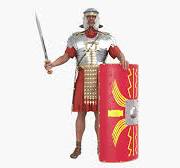
Another historic fact is this: in ancient times men did NOT wear pants. They wore robes, long tunics, and even short skirts. (Digression: as a little girl, when I saw my first picture of Roman soldier, I asked, “Why is he wearing an ice-skating skirt?”) I eventually learned Roman soldiers wore short “skirts” to be ready for battle at all times and to have greater agility when engaged in battle. (Digression #2: The oldest known use of pants occurred in China about 1300 B.C. when nomadic horsemen donned them for greater comfort while astride a horse and for greater dexterity in battle. Trousers didn’t become common in Europe until the 17th Century. Their warmth, praticality, and comfort eventually made them appealing even to women. But women wearing trousers was usually “taboo” until the 20th Century. In the 1950’s my mother wore a “house dress” even when working outside on the farm. But eventually she began to wear slacks and even jeans (how scandalous!)
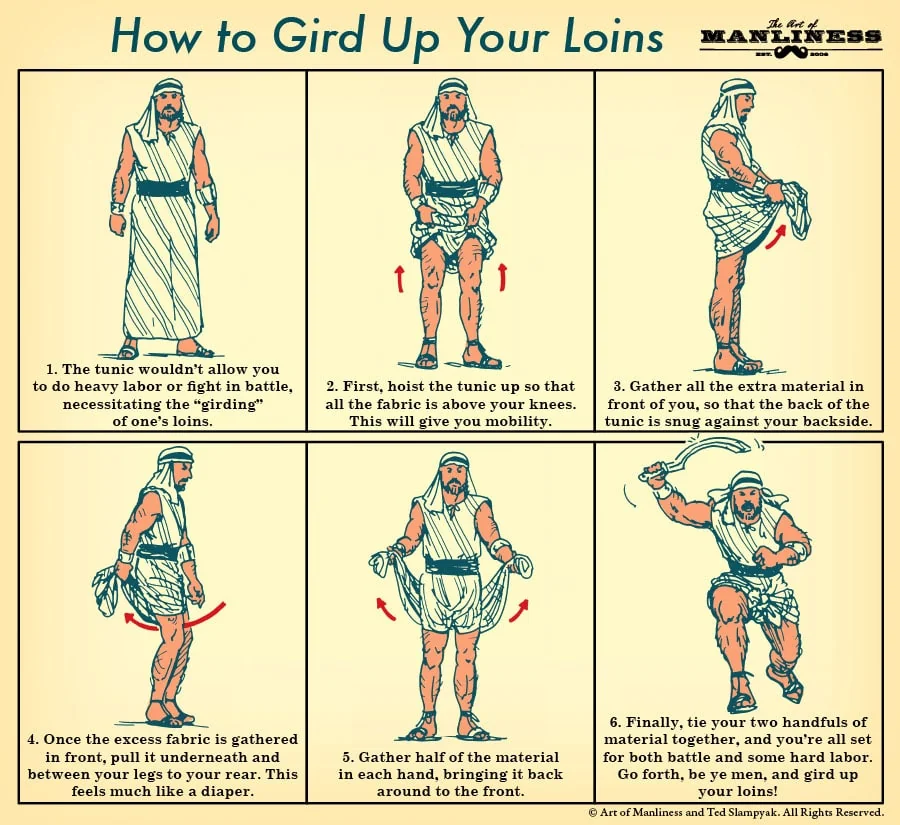
How did a man gird his loins? The drawings below and the simple commentary explain exactly how. (I am grateful to the website, “The Art of Manliness” for giving me permission to use this on my blog. You might want to check out their website. Its stated purpose is “to help men become better men” in all aspects of their lives such as character, career, relationships, fitness, and others. They post some very worthwhile things!)
Now, what does this have to do with us–both Christian men and women–living in the 21st Century?
The phrase “gird your loins” means get ready … for work… for battle.
We must get ready each day to live our Christian discipleship. How do we do this? First, through our prayer, that is, our daily conversing with our Beloved God. I know some people who, as they get out of bed each morning, make the sign of the cross. Some even add, “Here I am, Lord, I come to do your will.” This is like saying, “Here I am, Lord, reporting for duty.” We also prepare ourselves by pondering scripture on a regular basis as well as reflecting on the people and circumstances in our personal life and in the larger world around us. (I imagine most of you who read this blog, read it because you are looking for strength and encouragement to live your discipleship with Jesus.)
We get ready to work. Our Christian faith involves work. God might not say to us, “Gird your loins.” But maybe God might be saying, “Roll up your sleeves, I have a job for you.” And that job can take many forms. This Lent we might ponder what “job(s) or work(s)” God is calling us to do. Maybe it means focusing more attention on our spouse, our children or grandchildren, an elderly parent, a lonely neighbor, our friends. Maybe it means renewing ourselves as a generous care-giver, or helping at our parish or in our neighborhood. Maybe it means getting involved in a current social issue that stirs our heart. Or it may mean to be more patient, kind, courageous, honest, hopeful. And sometimes the “work” God is calling us to do is to “come aside and rest awhile,” that is, to take some time off, relax, and have some fun.
We gather our strength and our power. Strength and power come in many forms. At times it means athleticism, that is, being able ro run fast or to engage in arm-wrestling contests as the first photo shows. But strength and power can also mean: being patient… being sensitive… listening attentively to others… giving someone a second chance. Paradoxically, being strong can also mean being tender.
Let us pray: Loving God, living our life of faith is not easy. It makes daily demands on us. Please make us more sensitive to your calls in our life. Help us to gird our loins, to roll up our sleeves in order to serve you and other people with greater readiness, strength, and joy. Amen.
For reflection:
Did any part of today’s reflection stand out for you today?
Do you begin your day with any short prayer or ritual to God?
Have you ever had the experience of God calling you to do a particular work or task? How did you hear the call? What was the work or task God was calling you to do?
What are some ways you gather your strength to live your Christian discipleship each day?
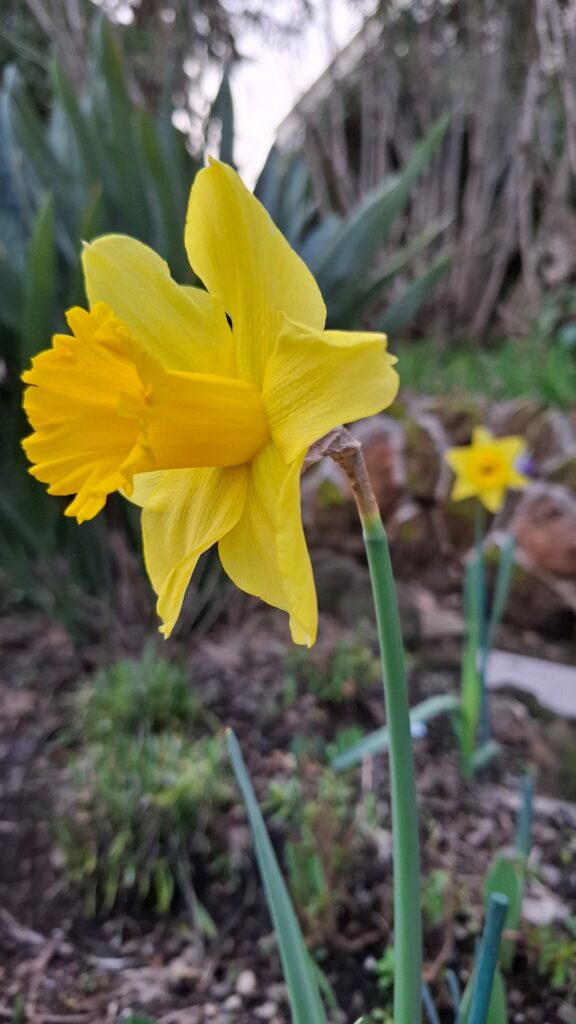
PS: Last week I gave a zoom presentation to our Sisters at our Motherhouse in Rome. What a privilege that was! There were about 20 Sisters from all over the world in the room, many of them younger members of our international congregation. I mentioned it was still cold in northeast Ohio with snow still covering the ground. But they told me it was 57 degrees in Rome and the daffodils were out. Afterwards, Sister Lori Inez from Brazil sent me some pictures of the motherhouse flowers. I wanted to share this single Roman daffodil with all of you! Remember: the beginning of Lent is a sure sign that Easter is on its way!
Our song today is “God Gives Me Strength” produced by Music Magic Hymn. This gentle song is composed of inspiring Biblical verses which I found consoling. When God invites us to a specific work or action, God supplies the strength.
I look forward to reading your comments below!