The Coming of the Dawn
I’m an early riser, up before dawn. I pray in my bedroom every morning. Since my chair faces west, I never see the sunrise directly. Still, my window allows me to watch the coming of the dawn every day for much of the year.
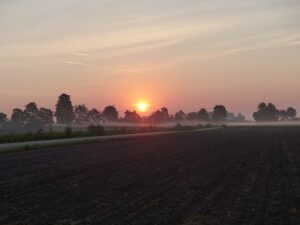
When I first look out my window in the morning, all I see is black—except for a few security lights on the school across the yard. But otherwise, all is dark. But as I sit in my chair and begin to pray, the scene outside my window begins to change—very, very gradually. Almost imperceptibly. The color begins to go from pitch black to black-with-a-tinge-of-dark-dark-blue. A few minutes later I begin to detect the outline of the huge tree right outside my window. I can see no branches at first. Just the general outline of the tree. But soon the dark blue color begins to overtake the black, and I can begin to see the branches of the tree.
This is about the same time I hear the chirping of a few birds. I marvel that they are awake, because it is still “dark.” If I look away for ten minutes or so and then glance back out my window, I can now see the branches of the tree clearly and I can even distinguish a few leaves. The color outside is no longer black, but a deep, pervasive blue.
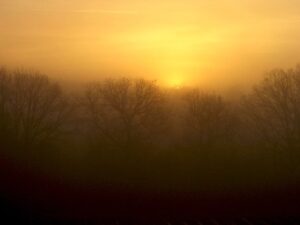
Within minutes, I can see the tree and everything else outside my window. And I know that dawn has arrived. The sun might not be up yet, but day has come. Definitely. On a clear day, I see the first rays of the sun illuminating the buildings up on the hill in the distance.
I watch the coming of the dawn day after day and never tire of it. In fact, the other day I was thinking: Dawn is a lot like God. How?
First, the dawn is 100% reliable. It comes every day. In fact, the dawn has come every single

day of my life for over 72 years! What else in my life has been so reliable, so certain, so true? That’s one way the dawn is like God. They both come no matter what frame of mind I have or what circumstances I’m in. The dawn and God come unfailingly.
But precisely because the dawn comes every single day, I can easily take it for granted. I can say, “Ho hum… another dawn. No big deal.” But every dawn is a big deal. Because every day is a big deal. Because every day is a gift from God. Every day is a gift for me to breathe in… to move around in… to pray in… to work in… to learn and love in… and to find God alive in. Those words of G. K. Chesterton come to mind, the words he said at the end of a day: “Here dies another day during which I have had eyes, ears, hands, and the great world around me, and tomorrow begins another. Why am I allowed two?” Every dawn fills me with gratitude that I am allowed another day.
The dawn comes gradually. Not all at once. That too reminds me of God. Our God seems to prefer the gradual to the sudden, the slow to the rushed. Our God seems to be in no hurry. If
it takes 4.6 billion years to create the earth, so be it. If it takes a lifetime for me to really, really trust God, that’s okay too. Like the dawn, God is often unobtrusive too. Most dawns come with little fanfare. That’s often how God shows up in our lives. No flashing lights. No clashing of cymbals. No fancy pyrotechnics. Just the deep sense that Someone is walking with us.
I don’t know what your experience of dawn has been. Perhaps you’d like to share a few thoughts about dawn or respond to some of the thoughts here. Or, if you’re not an early riser, maybe you’ve experienced some sunsets you’d like to tell us about. I welcome your responses.
Here’s a song called “Come Awaken Love” by Hunter Thompson. Sometimes we “sleep walk” through life. This song asks God to awaken love in our heart. Just as the dawn takes back the light, may we allow God to take back our heart through love.
What are some of your thoughts today? I invite you to share below.
PS: I will be giving a weekend retreat at Benet House Retreat Center in Rock Island, IL from September 15-17. The retreat is entitled “Celebrating Four Gifts of Autumn: Beauty, Harvest, Letting Go, and Hope.” Visit their website or call Sister Bobbi at 309-283-2109 for more information. I’d love to see you there!
Do Manners Still Matter?
Most of us were introduced to the world of manners by our parents. This introduction often included certain “do’s” and “don’ts.” We were told the things we should do: Do say “thank you” when someone gives you something, do say “excuse me” when you burp, do wait your turn, do use your “indoor voice” when you are indoors. We were also told the things we should not do: Do not talk with food in your mouth, do not interrupt someone when they’re speaking, do not point and stare at people, do not hit your brother.
At the time we didn’t realize it, but these small do’s and don’ts were rooted in a fundamental

attitude toward life. People with manners are aware that others exist, and they care about them. It’s as simple as that. People with manners do not think of themselves as the center of the universe. They demonstrate this every time they open a door for someone, cover their sneeze, refrain from talking during a movie, and drive responsibly.
One of the authorities on manners and politeness was Emily Post. She wrote, “All good manners are based on thoughtfulness of others, and if everyone lived by the Golden Rule—‘Do unto others as you would have them do unto you’—there would be no bad manners in the world.”
Being polite and thoughtful can have a positive effect on people. The other morning in the grocery store, I arrived at the “20 items or less” checkout line at the same time a man did. I had about six items in my basket. He was holding two items in his arms and looked like he was in a hurry. I motioned for him to go ahead of me saying, “I have more things.” He smiled, thanked me, and went first. After he was checked out, he turned to me and said, “Thanks again,” and left. Obviously, he was happy that I had let him go first. And I was happy to do this small favor for him—and to be thanked politely for doing it.
Are we less polite than we used to be? Some people think we are. They blame our “growing impoliteness” on our glorification of individual freedom and tolerance. Some believe that manners inhibit freedom of expression. Or they say manners are obsolete because we should tolerate all behaviors no matter how rude or obnoxious they appear to be.

What complicates things is that manners are partly conditioned by culture. What is considered impolite in one culture might not be considered impolite in another culture. When traveling to other countries, therefore, it is good to check out beforehand not only the local cuisine, but also the local etiquette. Also, manners evolve over time—to keep up with changes in society. The invention of the cellphone has made it necessary to formulate new “rules of etiquette” for its use. I came across this one recently: “Don’t talk on your cellphone in a waiting room, checkout line, restaurant, train, or (heaven forbid!) bathroom stall!” (A friend told me she saw this sign in a public restroom recently: “The only call you should answer in here is Nature’s!”)
Whether I say “thank you” for every kind gesture, or hold the door open for you, or step outside to use my cellphone, or pour your coffee before I pour my own—all these polite acts have few, if any, cosmic ramifications. But the tiny, numerous courtesies of everyday life are extremely important because of the moral foundation upon which they rest. With every polite gesture, we are saying to another, “You are important. And I care about you.” Such an attitude can have cosmic ramifications.

Here is a beautiful song by Chris Tomlin that celebrates the kindness of God. It’s called simply “Kindness.”
What are your thoughts on manners? Do you think they’re important or not?
What manners did you teach your children or grandchildren?
Be aware of every act of politeness or kindness you give today and every act of politeness or kindness you receive. How did these acts make you feel?
PS: I will be giving a weekend retreat at Benet House Retreat Center in Rock Island, IL from September 15-17. The retreat is called “Celebrating Four Gifts of Autumn: Beauty, Harvest, Letting Go, and Hope.” Visit their website or call Sister Bobbi at 309-283-2109 for more information. I’d love to see you there!
The Picture on Google
As many of you know, my sister Mary Ann passed away in early December. She was my only sister and my best friend. She was diagnosed with cancer the day before Thanksgiving and she died ten days later. Her death was a shock for all of us who loved her. (I wrote about her death on my post for January 9, 2017).
About two weeks after her funeral, my nephew’s wife wanted to verify my address. So she googled it and up came the street map with my house clearly marked. But on the left there was a small oval marked “street view.” She clicked on that, and to her great surprise, this picture appeared.
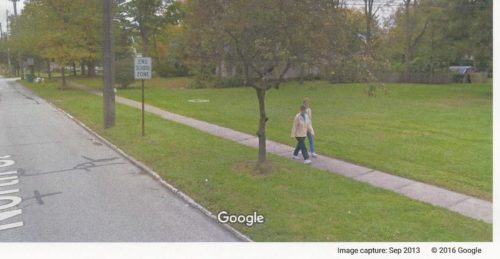
It is a picture of my sister and me walking on my street. According to the caption, the picture was taken in September 2013, but it wasn’t posted until 2016. I remember clearly the day it was taken. As Mary Ann and I were walking in the neighborhood, we saw the Google car with the 360 degree camera on top coming towards us. I said to her, “There’s the Google camera, Mary Ann. It’s taking our picture. Someday we’ll be famous!” Then I forgot all about the incident. Three years later, the picture appears on Google right after my sister dies.
As soon as I saw the photo, I started to cry softly. But my tears were coupled with joy, for the picture brought me immense consolation. I felt as if my sister was saying to me, and to all of us who loved her, “I am walking with you still.”
I made a copy of the picture, framed it, and set it on my desk where I can look at it often. The picture recalls the many times Mary Ann and I walked together—in my neighborhood, in her neighborhood, or in a park. But more than that, the picture reminds me that she walks beside me even now.
Here is a little prayer I wrote based on this picture. Perhaps you might be able to say it to a loved one of yours:
My beloved one, you have preceded me in death. While you were being born into eternal life, I could only watch helplessly and tearfully. Your leaving left a hole in my heart that no one else can fill. Your leaving left me to walk the rest of my earthy life without you.
But I know you haven’t left me. Not really. At times I sense you are walking beside me, bestowing comfort and encouragement. Even the pain of my grief is a gift from you, for it reminds me of the strength and depth of our love that nothing—not even death—can destroy. Beloved one, please continue to guide my steps here on earth until we walk together again in eternity. Amen.
The song for today is called “I’ll See You Again” by Westlife. Perhaps you can pray the words of this song to someone you’re missing…
What do you think… about this reflection… this song… Do you ever sense a deceased loved one is near you? I invite you to respond below.
Puppy Love
I think one of the cutest things our Creator God ever fashioned was a puppy. To me, all puppies are cute—from baby labs to basset hounds, from St. Bernard’s to dachshunds, from Irish setters to Chihuahuas. Even mongrel puppies are cute. In fact, it is hard to come up with anything cuter than a puppy. Even the word “puppy” is cute. Say it aloud a few times and see how much fun it is to say.
Researchers have done studies to find out why puppies are so cute. One reason is because  puppies are furry. Humans seem to like furry things. We enjoy the very feel of fur. Puppies also come in an attractive array of colors. Their puppy voice is cute too—a little yip instead of a ferocious bark. Like human babies, puppies have big heads and big eyes—qualities we tend to view as cute. Even much of puppy behavior is cute—the way they walk and run, the way they are curious about everything, the way they play, the way they can look sad when they have done something “bad.”
Cuteness is not a wimpy quality, say these researchers. Cuteness is one of the most powerful forces in the world since it shapes behavior. Cuteness elicits care-giving—a vital behavior for the preservation of many species of animals in our world. If the young weren’t so cute, it would be more difficult for adults to put up with the not-so-cute things they do—for example, their constant demand for attention and their “uncontrolled pooping.”
Here are seven puppy facts you might not know:
1) Puppies are born blind, deaf, and toothless.
2) Puppies develop the sense of smell at three weeks, hearing at four weeks, and full vision at six weeks.
3) Puppies spend 14 hours a day sleeping.
4) Over 5 million puppies are born in the U.S. every year. Many of these are born to wild dogs.
dogs.
5) A puppy is a puppy until it is one year old.
6) There is a National Puppy Day. In 2018 it will be celebrated on Friday, March 23. The day was established in 2006 to celebrate puppies and to promote adoptions.
7) The word “puppy” to designate a young dog has been traced back to the 15th Century.
Puppies are too cute for words. So I’ll finish this reflection with a few pictures of cute puppies:






(All puppy pictures are from Pixabay.)
What do you think about puppies? Have you had any positive or negative experiences with them?
“Cuteness elicits care-giving.” Have you experienced this phenomenon?
What other beings in God’s creation are you especially grateful for?
It seems appropriate that I conclude today’s post with a short video of puppies playing. Let us thank God today for all the cute things in our world. And may we always remember to make time for care-giving and for play in our life!
Do you wish to share anything with us today?
Jim Wallis, Sojourner
During my retreat last Fall, I listened to some talks by Jim Wallis, a Christian writer who speaks regularly at religious conferences, often Catholic ones. His writings and talks both inspire me and challenge me. I’d like to share some of his thoughts with you.

First though, let me tell you a little about Jim Wallis. He was born in 1948 in Detroit, MI where he grew up in the city and attended an Evangelical Church. He eventually graduated from the Trinity Evangelical Divinity School in Illinois. But somewhere along the way, Wallis came into contact with Catholic social teaching. It changed his life. Today it fuels his passion for peace and social justice. Wallis is the founder of Sojourner, both the magazine and the Washington D.C. based Christian community.
Wallis is married to Joy Carroll, one of the first women ordained a priest in the Church of England. They have two sons. He is the personal friend of people such as Desmond Tutu, Bono, and Bill and Linda Gates. He has also served as spiritual adviser to former President Obama. Over the years he has been arrested 22 times for acts of civil disobedience. At the same time, he has won numerous awards for his writings and his work. Here are thirteen quotations of his from my retreat notes. I invite you to read them prayerfully and see if any of them speak to your heart.
1) “The world will not change until we do.”
2) “Jesus didn’t say, ‘Blessed are the peace-lovers.’ He said, ‘Peace-makers.’ He is referring to a life vocation, not a hobby on the sidelines of life.”
3) “Hope unbelieved is always considered nonsense. But hope believed is history in the process of becoming changed.”
4) “We can find common ground only by moving to higher ground.”
5) “A budget is a moral document.”
6) “The three wealthiest people on earth now control more assets than the combined incomes of 600 million people in the world’s 48 poorest countries.”
7) “So when the only domestic social policy is tax cuts that mostly benefit the wealthiest Americans, we say, ‘Where is faith being put into action here?’”
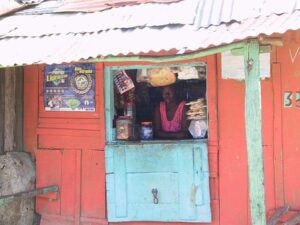
8) “Sometimes it takes a natural disaster to reveal a social disaster.” (He was referring to Haiti.)
9) “Poverty is the new slavery. Poverty and global inequality are the fundamental moral issues of our day.”
10) “The people who have more money and goods than any people in the history of the world spend most of their time worrying about not having enough.”
11) “Last year Americans spent $450 billion on Christmas. Clean water for the whole world, including every poor person on the planet, would cost about $20 billion. Let’s just call (our spending on Christmas) what it is: A material blasphemy of the Christmas season.”
12) “At times I think the truest image of God is a black inner city grandmother in the United States today or a mother of the disappeared in Argentina or the women who wake up early to make tortillas in refugee camps. They all weep for their children and in their compassionate tears arises the political action that changes the world. The mothers show us that it is the experience of touching the pain of others that is the key to change.”
13) “Hope is believing in spite of the evidence, and then watching the evidence change.”
I’ll close with an “interesting” little story Wallis told. One Sunday his wife, the priest, was presiding at the altar at Mass. Wallis was sitting in a pew with his two small sons. In the middle of the service, his youngest boy whispered to his father, “Are men allowed to do what Mom is doing?”
Do any of Wallis’ statements touch your heart? If so, which one(s) and why?
Do any challenge you?
Are there any you don’t like or don’t agree with?
The video today is called “I will Be My Brother’s Keeper” from a song by Matt Maher. As we listen to the words, may we reflect on how we can help to be the “keeper” of the brothers and sisters we meet today—whether at home, at work, in a store, on the street, or in the news.
PS: I want to thank all the wonderful people I met at Villa Maria Del Mar retreat center in Santa Cruz, California from July 7-14. The center is located right on Monterey Bay. One highlight for all of us was spotting a whale in the bay. We watched her from inside the retreat center. We first saw her spout a few times and then she rose straight up out of the water as if to get a better look at us! Thank you too for all the women I met at the Presentation Motherhouse in the heart of San Francisco on Sunday, July 16. In the group were two women who were born and raised in Chardon, OH! Small world! Special thanks to my two hostesses: Rose Anne Ryken (Santa Cruz) and Sister Rosina Conrotto (San Francisco).