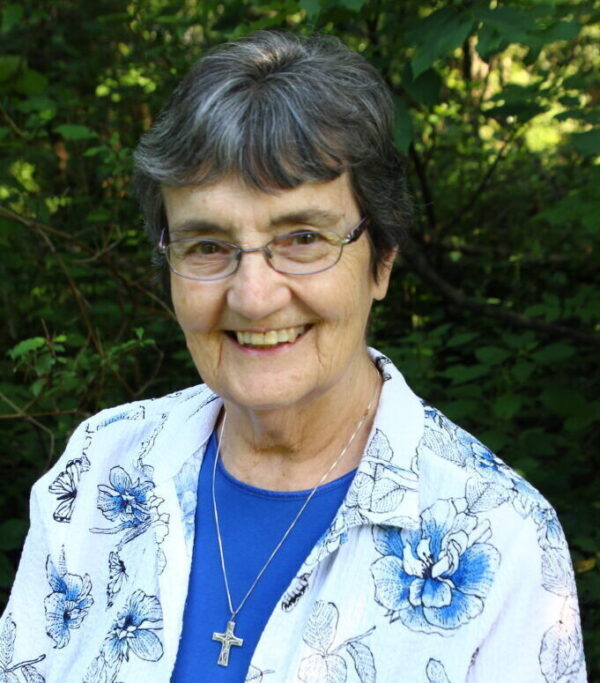
The Day I Was Born
I was born on September 16, 1944. It was a Saturday. My mother said I arrived just in time for lunch. But what was happening elsewhere in the world the day I was born? And did these events somehow influence who I became?
I was born in the midst of World War II, that massive armed conflict that killed more people than any other war in human history. On the day I was born the Allies launched a military operation called Operation Market Garden. The objective of the campaign was to secure a series of bridges in German-occupied Netherlands as well as those leading into Germany. Though initially successful (the Belgium town of Eeklo was liberated on my actual birth date), the campaign was ultimately a failure—due largely (some analysts say) to the weather. The failure of this campaign prevented the Allies from liberating northern Netherlands before the winter of ’44-’45, resulting in the horrific hongerwinter (Hunger Winter) in which tens of thousands of Dutch civilians died of cold and starvation.
The estimated casualties for Operation Market Garden, begun on my birth date and lasting until September 25, were 500 Dutch Civilians, 8,500 Germans, and 16,100 Allied Forces, including 3,700 Americans.
 Two weeks before I was born, on September 2, 1944, Anne Frank and her family were placed on the last transport train from Westerbork, Netherlands to Auschwitz. Anne was eventually transferred to the concentration camp in Bergen-Belsen where she died of typhus in March 1945, just three months before Germany surrendered. One day in the future, when I was 14, I would read the diary she started writing on her 13th birthday while in hiding, and I would be forever inspired by her courage, idealism, and her amazing ability to put her thoughts and experiences into words.
The day I was born, U.S. Marines were fighting on Peleiu Island in the Pacific. In Europe, Soviet forces were advancing toward Riga, Latvia. The day I was born Adolf Hitler was meeting with his military advisers at Wolfsschanze in East Prussia. The day I was born Winston Churchill and Franklin Roosevelt were concluding their meeting in Quebec, a meeting that finalized their war strategy. And on the day I was born, Mahatma Gandhi was addressing a prayer meeting in Bombay.
I was born amid the carnage of war. While thousands of people were dying in horrible ways, I was being wrapped in a pink blanket and driven to the small farm tucked safely away in northeast Ohio where my sister and two brothers eagerly awaited my arrival. And there I would be fed and cared for by two loving parents. We were not, however, untouched by the war. No one was. My Dad, a tool and die maker, was working long hours helping to produce the massive fleet of airplanes needed in the war. My six uncles were all in the military fighting in various countries in Europe. And at my birth, I was issued a ration book which my mother saved. It lists my height as 21 inches and my weight as 7 lbs. 8 ozs.
We are all born into a particular time and place. Sometimes we foolishly wish we had been born earlier or later or elsewhere. But I have come to believe that each of us is born at exactly the right time and our birth date is all part of God’s providence for us. And in the times and places we find ourselves, God’s grace is always moving and stirring us to greater love.
We call God’s care for us Divine Providence. But belief in Divine Providence doesn’t mean we sit idly by and wait for God to do all the work. As the old proverb says, “God feeds the sparrows, but God doesn’t toss their food into their nests!” Instead, we must partner with Divine Providence and, using our personal resources, help to move the world toward greater wholeness and peace.
- What was happening in the world on the day you were born? (Check the internet or a history book).
- When and how have you experienced Divine Providence in your life?
God of Divine Providence, thank you for my birthday.
Thank you for my parents who, with you, gave me the gift of life.
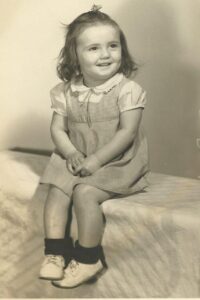
Thank you for all the blessings that nurtured my growing up
and for the hardships and challenges that played a role in my maturing.
May the celebration of every birthday remind me how precious time really is,
and may it encourage me to use my days well.
Help me to welcome babies and children into this world. And by partnering with you in small but steady ways, may I help to make this world a better place for all of us.
Amen.
This is a new song about Divine Providence by Jason Gray entitled “Sparrows.” It’s based on Matthew 10:29: “Are not two sparrows sold for a small coin? Yet not one of them falls to the ground without your Father’s knowledge.”
Do you have any comments on today’s reflection? If so, we’d all love to hear from you!
The Bristlecone Pine Tree
In a remote and inhospitable area of the White mountains in California, there grows a remarkable tree: the Great Basin Bristlecone Pine (Pinus longaeva). These trees rarely exceed 30 feet in height. Their girth isn’t that impressive either. But what is astounding is their age: Some of them are 5,000 years old! (more…)
The Spiritual Practice of Going Barefoot
(As I wrote last week, I’m taking a little vacation from my blog. So this week I’m running an earlier reflection from August 26, 2013. I will resume writing my regular blog on Monday September 5.)
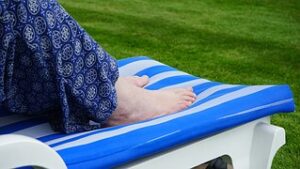 Someone has said that going barefoot can be a spiritual practice. There’s a scriptural basis for this assertion. When God appeared to Moses in the burning bush, God told him to take off his shoes, for he was standing on holy ground (Ex. 3:5). But isn’t all ground holy? If so, then shouldn’t we take off our shoes regularly so we can be one with our sacred earth?
As kids, many of us went barefoot in summer. I know I did. Right after school ended, we kids celebrated this happy event by kicking off our shoes and socks and running around our farm barefoot. At first the gravel in the driveway hurt our feet. As we walked crossed the driveway in early June, we’d grimace and say, “Ouch! Ouch! Ouch!” But by August, after we had built up some callouses, we’d cross the driveway with ease. Before going to bed each night, our mother scrubbed our dirty feet so vigorously it hurt. But that was a small price to pay for the freedom of no shoes.
When I spent a month in Korea a while back, I was impressed with their practice of 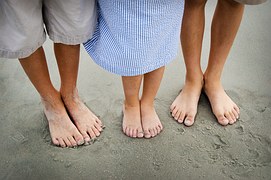 removing shoes when entering a house. At our provincial center in Inchon, there are little cubby holes by the entrance where the sisters deposit their shoes when coming in off the street. Even when we visited a kindergarten there, we were asked to remove our shoes and were given slippers to wear during our visit.
In India I was taking off my shoes every time we visited a shrine or a temple. There would be hundreds of shoes at the entrance to these places—even the Taj Mahal. At first I was reluctant to remove my shoes. I feared picking up some horrible parasite. I also feared I would never see my shoes again! But I quickly learned that some people make a living at the entrances to these shrines by offering to guard your shoes for you while you’re inside—for a few shekels, of course. I never lost a pair of shoes the whole time I was in India—although every evening I scrubbed my feet vigorously.
When I lived alone in an apartment in Detroit, I noticed something about myself. Every time I’d come home from work, I’d automatically kick off my shoes. I usually stayed barefoot or in my stocking feet until I crawled into bed at night. When I visited my relatives in the Czech Republic, I saw that the Czechs (like the Koreans) remove their shoes before entering their homes. If you look down the hall in an apartment building, for example, you’ll see a half dozen shoes stacked outside every door. My propensity for bare feet must be a genetic thing!
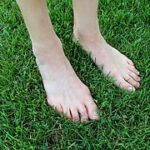 I’m not advocating going barefoot all the time, of course. Even as a child in summer, we had to put on our shoes to go inside the coop or barn. In Uganda, I saw many children without shoes—not because they were doing a spiritual practice, but because they couldn’t afford shoes. There are many organizations that provide new or gently used shoes for kids in developing countries, for example, Soles4Souls, Walk in My Shoes Global Project, and www.yesshoesinc.org.
The night before Jesus died, he washed the feet of his disciples, performing a servant’s task. For sure, those feet weren’t very pretty. They were probably rough, dirty, smelly, with broken nails, bunions, and bent toes. Yet he washed them tenderly, bestowing a dignity upon all feet, including our own. Yes, our feet are beautiful no matter what they look like, for they bear the weight of our entire body. They also bear the wear and tear of our comings and goings as we do good to others.
Go barefoot, then—before summer comes to an end. (For those of you living in the southern hemisphere, your summer will be coming soon!) Thank God for your feet today and for the privilege of walking on earth, this holy ground.
Today’s song is “Holy Ground”:
What do you think of going barefoot? Has it ever been a spiritual practice for you?
The Ways We Say Goodbye
(I am taking a little vacation from writing this blog. So today and next Monday I am running two of my earlier reflections. This one is from July 22, 2013. I will resume writing new reflections on Monday September 5.)
When we part from another person, we ordinarily say “goodbye” in English. The etymology of “goodbye” is interesting. It is derived from the phrase “God be with you.” If you squish the four words together, you will come up with “goodbye.”
The French adieu and the Spanish adios are similar. They are short for a dieu vous 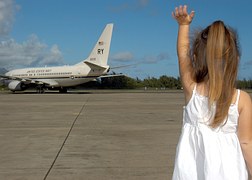 commant and a dios vos acomiendo both of which mean “I commend you to God.” I think it’s rather wonderful that our parting words to one another are really a short wish or prayer that the other person might walk with God. (I wonder if atheists know this?”)
The German goodbye is different. It’s auf wiedersehen which literally means “until we see each other again.” I like that. It implies that this parting in not final. In English we sometimes say “See ya!” which implies the same thing. When I say my final goodbye to a loved one at their death, I sometimes whisper under my breath “Auf wiedersehen,” meaning “I’ll see you again—in eternity.” (There’s an old German proverb that says, “Those who live in the Lord never see each other for the last time.”)
We say other things to each other when we bid goodbye. I often hear and say “Take care.” I like that too for it means, “You are precious to me—so take care of yourself.” Or, “The world is a precious place, but a precarious one, so take care as you negotiate your way through it.”
At our partings, we often hear, “Have a good day.” Some people think this phrase is so overused it has been rendered meaningless. But I, for one, still like the phrase. I think it fosters good feelings between people—even strangers (a cashier at the checkout and a customer, for example.) The phrase also implies that we, to a certain extent, determine what kind of a day we’re going to have—often by our attitude. (I read somewhere: If someone says to you, “Have a good day!” just say, “Sorry, but I have other plans.” It usually gets their attention.)
 Saying goodbye extends to written communication as well. How do you end your letters, emails, text messages? When I write to a loved one, I often end with “Love, Melannie,” “Love and prayers, Melannie,” or “With much love, Melannie.” Sometimes I say “prayerfully” or “In Jesus or “In Mary.” With more formal correspondence I usually opt for the simple yet timeless, “Sincerely.”
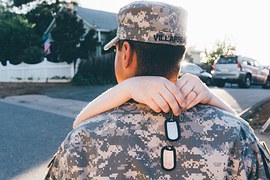
Our partings from one another are very significant. That’s because we never know for sure when we will see each other again—or even if we will see each other again. When we experience the sudden or unexpected death of a friend or loved one, often we immediately recall our last goodbye—which has now become our “final” goodbye. (A touching story: A couple had been married for 50 years. When the wife crawled out of bed one morning, she said “good morning” to her husband and gave him a kiss. They chatted for a moment. Then she got up while he stayed in bed. A short time later she went back to check on him and found him dead of a massive heart attack. Later she remarked, “If I had known he was going to die that morning, I would never have stopped kissing him.”)
Because our partings are so important, we often mark them with ritualistic words (goodbye…see ya… take care… I love you) and with actions (kisses, hugs, pats on the back, handshakes, high-fives, fist bumps). These words and gestures are all beautiful expressions of our love, respect, and appreciation for one another.
Which raises the question: How should I end this reflection? I think I’ll just say: goodbye, auf wiedersehen, and take care. Love & prayers, Melannie.
The song for today is the classic “Time to Say Goodbye”sung by Andrea Bocelli and Sarah Brightman:
What are some of the ways you say goodbye to people?
The Human Condition and Fear and Faith
I’ve been thinking a lot about the human condition lately. The headlines in the news have stimulated my thinking.
The phrase human condition is in itself interesting. Being human is a condition—maybe like heart burn or asthma. It’s a condition (though marvelous at times) that comes with built-in limitations.
 We’re human. That means we make mistakes. (Isn’t that what the poet Alexander Pope said? “To err is human.”) We’re human. We don’t know the future. We’re human. We’re prone to certain drives or illnesses. We’re human. We’re going to die. Being human means we have very little say-so over our lives. Often we are beset by circumstances beyond our control—-the economy, health issues, freak accidents. Many times the only control we have is how we respond to the things beyond our control.
That’s why being human can be very frightening. If we really dwelt on how vulnerable we are, we wouldn’t get out of bed in the morning. But even staying in bed could be dangerous. The ceiling could come crashing down upon us. Or lying around in bed could make us more susceptible to catching pneumonia! It seems to me what is needed to live lives with at least a modicum of peace, sanity, and happiness is courage. But what is the  source of such courage?
The source is not ourselves. We’re only human. It’s not others. They’re only human too. If we turn to the Bible, we find our source of courage: the God who created us and thus knows our human condition even better than we do. The Bible says this same God loves us unconditionally, madly, tenderly, and eternally despite our limitations and failings.
The Bible is filled with stories of human beings as vulnerable, weak, and noble as we are. They were not exempt from fear. But their fear was coupled with their faith in God. This faith or trust in God made their fear bearable. Think of Moses at the Burning Bush trying to convince God to send someone else to lead the Hebrews out of Egypt. God’s response to his objections was, “I’ll be with you.”
Think of the young girl Mary trembling before the angel Gabriel, yet trusting so much in God she was able to say “yes” to circumstances she could never have imagined. And think of Jesus terrified in the Garden of Gethsemane finding the courage to say “yes” to a horrific death because he trusted in Abba, his Father.

In her book, The Preaching Life, Barbara Brown Taylor writes about fear and faith. She describes fear as “a small cell with no air in it and no light. It is suffocating inside, and dark. There is no room to turn around inside it.” She says that faith is not “a well-fluffed nest, or a well-defended castle on a high hill.” Rather faith “is a rope bridge over a gorge.” She points to the story of Jairus, the official whose young daughter had just died. Before tending to the tormented man’s daughter, Jesus gives Jairus the shortest sermon he ever preached: “Do not fear, only believe.”
I don’t know what fears you might be dealing with right now, but, since you’re human, I imagine you have some. And I don’t know where you are on that rope bridge over the gorge either. Perhaps you are taking your first hesitating steps onto that swaying bridge. Or maybe you’re somewhere in the middle where it is sagging the most. Or perhaps you’re nearing the end and you’re already catching glimpses of “the other side.” But wherever you are, this is my prayer for you (and for myself!): May we learn to live the human condition with faith and courage. And may we even learn to love our human condition with its limitations and gifts, its imperfections and wonders, its heartaches and joys, knowing that Jesus lives and loves it too.
The song is “Be Not Afraid.” I believe it is sung here by John Michael Talbot even though the credits say Josh Groban…
What are your thoughts on the human condition, faith, and courage?
What did you think of the song?
PS: Once again I ask for your prayers for a retreat I’m facilitating at the Marie Joseph Spiritual Center August 20 to 27 in Biddeford, Maine. The center is located right on the ocean! Afterwards I’m staying in Maine for a few days for some R&R with an SND friend in Kennebunk. This means I am taking two weeks off from writing this blog. But the next two Mondays, the 22nd and the 29th, I will post two reflections from a few years ago. I will resume with new reflections on Monday, September 5. Thank you again for reading this blog! I really appreciate you!