
Conservatives and Liberals Need Each Other
In his speech at the Dallas Memorial Service a few weeks ago, former president George W. Bush said this: “Too often we judge other groups by their worst examples while judging ourselves by our best intentions.” I thought his words were very insightful.
While I was still pondering them, a friend gave

me a short article by Fr. Ronald Rolheiser, OMI, entitled “Our Churches Need Both Conservatives and Liberals.” Later I found another article by Rolheiser on line about this same topic. I was interested in these articles because I, like some of you, struggle with the tension between conservatives and liberals wherever I encounter it—but especially in politics and in the church. With that in mind, I’d like to share this brief summary of Rolheiser’s words with you.
Rolheiser says, “Liberals and conservatives should be judged by what’s best in them, not by their worst expressions.” He then describes both conservatives and liberals at their worst and then at their best.
He says that, in Church circles, conservatives at their worst are “mean-spirited, narrow, and grandiose.” They view every liberalizing tendency as “dangerous, godless, (and) an enemy.” Conservatives at their worst “live a lot by fear, and their primary instinct is to protect, circle the wagons, reduce ambiguity.” At their worst conservatives “move more naturally to exclusion than inclusion.” They tend to be “overly serious” because they are “the sole guardians of God and truth.” They see a whole generation of Christians who have never been catechized and who lack a Christian identity. That is why they “insist on proper boundaries, rules, and regulations.”

Liberals at their worst are “naïve and arrogant.” They see “Secular enlightenment…as the exclusive agent in having brought about the liberation of human freedom from superstition and false authority.” They also see secular enlightenment “as the sole agent in the struggle against racism, sexism, and other forms of inequality and injustice.” At their worst, liberals fail to see that’s what best inside their morality “comes out of Judeo-Christian roots.” If such liberals do not like you, “they will try to intimidate and shame you intellectually.” Liberals insist that what is needed is change—not more catechesis and rules, but renewed emphasis on love and personal responsibility.”
That’s conservatives and liberals at their worst. What are they at their best?
At their best, conservatives keep us mindful of some important truths:
+ energy isn’t always friendly; change isn’t always for the better
+ “Taboos exist for a reason”; there is such a thing as a “slippery slope”
+ some things need to be protected—like our countries, neighborhoods, marriages, families. “It’s naïve to think that what’s precious doesn’t need to be protected.”
+ there are some absolutes we cannot ignore without seriously hurting ourselves and the world
+ human beings often lack the inner strength to live the Gospel of love without some rules

Liberals at their best, keep us mindful of these important truths:
+ freedom is a divine gift; “God wants us to be free, and free from fear.”
+ there are as many dangers in being too safe as there are in taking risks. As Goethe pointed out: the dangers in life are many and safety is one of those dangers.
+ the golden age of the church was not as golden for non-whites and women
+ liberals challenge us to true “catholicity,” to an ever-wider embrace; “the truth revealed by Jesus (is) that God’s heart is not a ghetto but a house with many rooms.”
Rolheiser says, “most liberals and conservatives fight each other when in fact we badly need each other. Both carry important truths, and our culture and our churches would be far healthier if both would accept that.”
I don’t know to what extent you agree or disagree with Rolheiser’s appraisal. But it might be fruitful to reflect on these questions:
When it comes to the Church, do you consider yourself a liberal or a conservative—or somewhere in between?
If you are a conservative, what is your attitude toward liberals? If you are a liberal, what is your attitude toward conservatives?
No matter what your stance is, where are you being called to conversion?
In this talk about conservatives and liberals we must remember that the bottom line is not being right. The bottom line is love. Here is the song “Love Never Fails” by David Haas. It is based on St. Paul’s beautiful words on love from 1 Corinthians 13.
Do you have any thoughts on conservatives and liberals that you would like to share with us?
PS: Last week I spent a few days a the Chautaugua Institute in New York, a gift from some friends and the Catholic Community there. In future blogs I will be drawing from some of the talks I attended there. Also last Saturday I facilitated a retreat day for the women from St. Lad’s Parish in Westlake, OH. The setting (The River’s Edge in Rocky River, OH) provided a beautiful background for our prayer, reflection, and sharing. A big thank you to Pam for organizing the event and to everyone who came!
Are You a Perfectionist?
Are you a perfectionist? It’s a good question to ask ourselves on occasion.
What is a perfectionist? In psychology, perfectionists are individuals who possess an excessive drive for flawlessness. They set extremely high performance standards for themselves and are unreasonably critical of themselves when they don’t meet their standards. They also tend to measure their self-worth by productivity and are susceptible to depression when they “don’t produce.”
I wrote a poem about perfectionism in my book, When the Blue Heron Flies. Let me share that poem with you here and then offer a few questions for your personal reflection:
“Perfectionism”
Perfectionism is a cruel taskmaster.

Scant is her reward for your onerous labors.
She bestows no peace, no joy, no closure.
She never says, “Well done! Good job! Take a rest!”
Instead all she ever says is, “More! More! More!”
Even if you meet her demands
in a given area of your life,
she quickly finds fault with all the rest of you
and persists in her relentless nagging.
Why strain yourself for her unwinnable approval?

Far better to expend yourself on befriending one of these:
Humility, Patience, Loose Ends.
Do you ever get caught up in the pursuit of perfectionism? If so, why? If not, why not?
The poem suggests befriending one of these: humility, patience, loose ends. Have you befriended any of these? How do these prevent us from being caught up in perfectionism?
Our song today is “Trust in You” by Lauren Daigle. In our quest to curb perfectionism, we must remember that ultimately our trust is not in our talents, power, cleverness, or even goodness. Our trust is in God.
Is there anything on this topic that you would like to share with us? We enjoy hearing from you!
Gene Kelly: Actor, Singer, Dancer, Choreographer
Recently I turned on the movie channel and chanced upon a showing of An American in Paris. After watching it for just a few minutes, I was hooked. In fact I ended up watching the entire film.
This 1951 musical features the music of George Gershwin and the dancing of Gene Kelly.
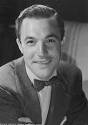
Was there ever a more brilliant and entertaining combination? The movie won eight Oscars including a special one for Gene Kelly who not only starred in the film, but co-directed it and did all the choreography. I confess, Gene Kelly’s dancing has always utterly amazed me! So I did a little research on the man.
Gene Kelly was born in 1912 and raised in a working class neighborhood in Pittsburgh, PA. At the age of eight, he and his younger brother were forced by their mother to take dancing lessons. They hated these lessons—mostly because the other boys called them sissies. Besides, Kelly’s dream at that time in his life was to play shortstop for the Pittsburgh Pirates—not to dance! As a teenager, however, he resumed his dancing, mostly in staged musicals. In college he majored in journalism, but when the Depression hit, he quit college to help support his family. In 1932 his family opened a dance school and eventually Kelly decided to pursue a career in dancing. He moved to New York and, through hard work and exceptional talent, he began landing roles in stage productions and then movies.
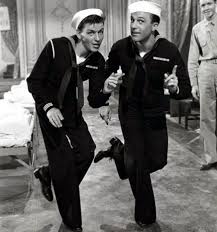
Kelly’s dancing has been described as “athletic and muscular.” Fred Astaire, whom he admired and worked with on occasion, danced mostly in a top hat and tails. Kelly, in contrast, often danced in T-shirts and ordinary pants. Astaire’s dancing was called “aristocratic, classical, aerial” whereas Kelly’s was labeled “democratic, romantic, terrestial.”
Kelly was always the innovator. He was the first to use the split screen in a musical. He also combined live action with animation. For example, in Anchors Away (1945) he dances with an animated character named Jerry Mouse. In another film he tap dances wearing roller skates! Another time he tied garbage can lids to his feet and used the lids as taps!
By all accounts Kelly worked very hard to make his dancing appear effortless. One dancer
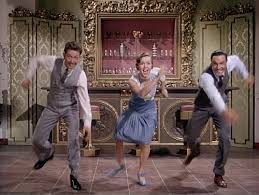
said that after rehearsing for eight hours, all the exhausted dancers left the theater—except Kelly who stayed on to practice his steps even more. In his later years he seemed most proud of helping many neophyte actors with their careers. It was Kelly, for example, who picked Debbie Reynolds for Singing in the Rain. She was only 18 years old at the time and didn’t know how to dance. But Kelly taught her and she ended up becoming a great dancer, explaining, “I learned from the best.”
In his personal life, Kelly married actress Betsy Blair in 1941. They had one child but later divorced. He then married Jeanne Coyne with whom he had two more children. They were married until her death in 1973. In his later years Kelly was married to Patricia Ward until his own death in 1996. Although raised Catholic, Kelly became disillusioned with the Church when it supported Franco during the Spanish Civil War. Later, after visiting Mexico, he became even more estranged from the Church for aligning itself with the rich and powerful while neglecting the poor. Sadly, he became an agnostic. In the 1980’s Kelly suffered two strokes. At his death, he requested that there be no funeral or memorial service.
What will Gene Kelly be most remembered for? Probably his dance to the song “Singin’ in the Rain.” Kelly was ill the day that dance was filmed. In fact, he had a temperature of 103! Yet he dances with vitality and power. At the beginning of the dance he leaps onto the lamp post with ease. He later turns his umbrella into his dancing partner. And at the end he splashes in the puddles like a little kid. For me, the song and dance encapsulate the transforming power love can have on a person’s life. Love can transform even rainy days into beautiful times! The Boston Globe said of Kelly’s dance: “Has exultation ever been expressed more memorably?” I think not!
I am closing with two short videos. The first is Kelly’s “Singin’ in the Rain” dance. The second is a montage of his dancing. I hope you enjoy one or both of them!
“Singin’ in the Rain”:
“Montage of Gene Kelly Dancing”:
What are your thoughts on Gene Kelly? On music and dance? On the power of love to transform our life?
PS: Thank you for your prayers for the spirituality day I shared with the Sisters of St. Joseph of Watertown, NY. And thanks to Sister Eamon and all the SSJ’s for their warmth, hospitality, prayerfulness, and fun!
Today
Today won’t come back. When midnight strikes, today will be gone. Forever.
Sometimes we don’t appreciate today. Today sometimes gets buried in all the things we need to get done. Or today is merely endured because there are some things we don’t like  about today. Maybe it’s raining. Or maybe we’re at odds with a loved one. Or maybe we’re embroiled in a difficult situation, we’re worried about a sick friend, we’re bored at work, we’re caring for a cranky child, we’re nursing a sore back, or we’re disturbed by the headlines in the news. So when today ends, we say, “Good Riddance!” and hope for a more congenial tomorrow. In doing so, we may be failing to see the goodness and beauty nestled just beneath the surface of today.
The truth is, joy seldom comes to us unadulterated. What’s right and good grows side by side with what’s wrong and bad. Isn’t that what Jesus’ parable about the weeds and the wheat says? Maybe that means we have to look harder at today. We have to be more patient with today, more accepting of it. And maybe we need to be more trusting of the God who walks beside us every today.
What if all we had left were today? Would we appreciate it more? Would we explore it more? Would we be more alive to its mystery?
In her book, The Listening God, Sister Miriam Pollard, OCSO, says today is sometimes  like a poorly wrapped gift. She writes: “We must develop a skill for unwrapping inelegant parcels if we want what is hidden inside.” Another image she uses is this: “Today is a secret whispered in a noisy room. We have to learn how to hear.” And finally: “This minute is a husk around a joy that will remain untasted if we don’t cultivate the ability to peel.”
Isn’t that one reason you pray? Isn’t that one reason you made time today to read this blog? I suspect you are hoping that praying and reading reflections like this one might aid you in unwrapping the parcel of your particular life. Or these things might help you hear the whisperings (or at least the footsteps) of the God who is beside you amid the noisiness of today. Or they might cultivate your ability to peel away the outer husk of your life in order to taste its specific joy.
So don’t let today slip by unappreciated. Don’t let its goodness, beauty, and joy go undetected. Notice them. Thank God for them and for all the things that are good and right and beautiful with your life—and with the world.
Remember, yesterday is gone. Tomorrow isn’t here yet. All we’ve really got is today.
In the U.S. The National Republican Convention begins this week in Cleveland, my “home town.” For several months the Sister of the diocese of Cleveland have been encircling the city in prayers for peace. Many others have joined us in this prayer. Won’t you too?
On a personal note, I will be giving a spirituality day for the Sisters of St. Joseph in Watertown, NY on Wednesday July 20. I ask your prayers for this intention too. Thank you!
The song I chose is St. Francis of Assisi’s beautiful prayer, “Lord Make Me a Channel of Your Peace”:
Do you have any suggestions on how we can appreciate today more?
Or how we might work for peace?
Attention! Attention Please!
Did my title get your attention? I hope it did, because I’d like to say a few words about attention today.
First your ability to pay attention is one of your greatest gifts. To be able to focus on another person, a story, or a specific task at hand is an important asset we sometimes take for granted. Ask teachers who work with children with Attention Deficit Disorder (ADD). Their teachers will tell you that these children often struggle to pay attention even for a few minutes.
Secondly, notice how in English we say pay attention. There’s always a cost involved

in paying attention. It means if we give our full attention to this thing, then we can’t be paying attention to that thing. Paying attention entails self-discipline. Just watch baseball players at bat, how they are totally focused on seeing the ball. They don’t allow anything (a heckling fan, a sudden gust of wind, a yell from the opposing team’s dugout) to distract them from the one thing they are paying attention to: that baseball being thrown at them.
Thirdly, there are countless things vying for our attention every minute of every day. Television advertisers know this. That’s why they go to great lengths just to get our attention and then they try to keep our attention for 30 seconds or so. Why such great pains? Because they’re trying to get us to buy their product, vote for their candidate, or support their cause. In order to do this, they have devised ingenious ways to get our attention. They use cute children, talking lizards, quacking ducks, beautiful scenery, or catchy music. If that fails, then they SHOUT AT US!!! (God bless the person who invented the mute button!)
What does paying attention have to do with our Christian faith? A lot! In one way we can say that Jesus came to focus our attention on the important aspects of life such as prayer, loving relationships, personal integrity, compassion, forgiveness, trust in God. How often he said to his disciples and to the crowds, “Behold!” That’s simply another way of saying, “Pay attention!” Pay attention to the lilies of the fields and the birds of the air. Pay attention to this story I am about to tell you. Pay attention to the poor, the sick, and the marginalized among you.
The artist Julie Cameron said that paying attention “is an act of love, an act of connection.” Many great writers, she says, lived ordinary and limited lives. “What was unlimited was the quality of attention they brought to bear on their experience.” The French writer, Simone Weil, would agree. She wrote: “If one looks long enough at almost anything, looks with absolute attention at a flower, a stone, the bark of a tree, grass, snow, a cloud, then something like revelation takes place.”

Today might be a good day to pay attention to what you pay attention to. If you’re reading this blog, for example, then you decided to pay attention to this blog. Why? Other questions for reflection might be these:
+ Do you pay attention to the beauty and wonders of creation?
+ Do you pay attention to the poor, sick, and marginalized among us?
+ Do you pay attention only to peoples’ shortcomings, or do you notice their good points too?
+ Do you pay attention only to what’s wrong in the world or in your personal life, or do you pay attention to what’s right and good?
+ Do you pay attention regularly to God in prayer?
Jose Ortega y Gassel said this about paying attention: “Tell me what you pay attention to, and I will tell you who you are.” Now, that’s something to pay attention to!
Today’s song is “And All the People Said Amen” by Matt Maher. The video shows several individuals paying attention to others…
What are your thoughts on this topic and/or this song?
PS: I wrote this reflection before the tragic events in Minnesota, Dallas, and elsewhere in the U.S. Let us pray for the victims and their loved ones. And let us pay attention to the underlying causes of this unrest and violence, asking God for peace—in our own hearts, our families, our neighborhoods, our countries, our world.