Our Rivers, Our Kin
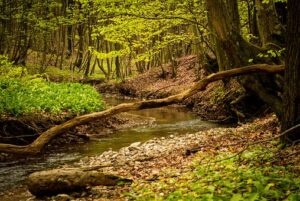
When I was growing up on our small farm in northeast, Ohio we had a creek that ran through our back woods. As kids, we often played in and around it. We fished for crayfish there, waded in it, built log bridges over it, and simply enjoyed the sound the water made as it flowed by.
 As a child, I seldom wondered where the water came from or where it was going. But as an adult, I was more curious. I asked my brother Paul (he worked for years for the Northeast Ohio Sewer District and knows a lot about water) and I learned that our little creek began in a swale east of us and it eventually flowed west into Euclid Creek and then north into Lake Erie. This means the water in our creek flowed into Lake Erie, over Niagara Falls, into Lake Ontario, through the St. Lawrence Seaway and into the Atlantic Ocean. Wow! What an incredible journey.
This childhood memory connected me with a new term I came across recently: watershed discipleship. Watershed discipleship is a movement started by Ched Myers. It asks us to see what it means to be a disciple of Jesus within our watersheds, that is, within our naturally defined ecological region.
For example, when someone asks me where I live, I usually answer Chardon, Ohio or Geauga county. These terms designate social and political spaces. But if I say, “I live in the Chagrin River Watershed,” I am citing a geological and ecological reality much older than the place names we’re used to. I am saying that when it rains, the water that runs off my roof eventually runs into the Chagrin River on its way to Lake Erie. By identifying myself by where my water flows, I am connecting myself to all my neighbors geographically. Such an awareness of my watershed might also make me more attentive to the condition of my water and the creek, river, lake (and sewer structures) that bring me water and carry my used or excess water away.
Someone said we should look at rivers as our kin. In order to appreciate the the rivers in the USA, simply look at the map below. Every blue line is a river.

Our rivers are important for many reasons. Here are a few: They supply water, add fertility to the soil, drain the earth’s surface, are a means of transportation (notice how many major cities in this country were founded on rivers or lakes!) Rivers also provide habitat and food for many of earth’s organisms. Finally, they are a source of beauty and recreational fun.
Many of our rivers, however, are threatened by pollution often caused by industry, mining, farming, and development. But sometimes rivers are threatened by political decisions as well. Currently, the Lower Rio Grande River in Texas is 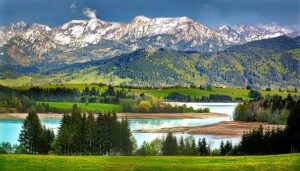 threatened by the proposed “border wall.” As it is projected now, this wall would separate communities from the river, cut off the river from its flood plain, exacerbate flooding, and destroy wildlife habitat. If we think only politically and not ecologically, we risk harming or even destroying our natural habitat.
In the name of watershed discipleship, I suggest you reflect on the following:
What watershed do you live in? Where does your water come from? Where does the water from your roof go?
As you walk or drive around this week, pay attention to the creeks, rivers, or lakes you see. How healthy are they? Do they connect with each other?
Cleaning up our rivers can seem daunting. But reducing water pollution begins at home in simple ways like these:
1) Never pour oil, grease, medications, household chemicals or cleaning agents down your sink or toilet.
2) Avoid using the garbage disposal. Run the dishwasher and washer only when they are full.
3) Invest in a water efficient toilet or put a brick in your standard toilet to reduce the water used per flush.
Can you come up with other ways?
PS: Once again I ask your prayers for a retreat day I will be leading for the pastoral care ministers of the diocese of Albany, NY. The day is entitled “Walking with the Heart of Christ” and is Wednesday, June 13. About 170 pastoral care ministers will be in attendance. Thank you for your prayerful support!
ALSO: Special thanks to Sister Alex and the other pastoral care ministers at Mercy Medical Center in Lorain for inviting me to be a part of their “Quiet, Reflective Day Away” last Thursday. I really enjoyed our sharing on hope.
Our “song” today is a 4-minute video of the Verde River in Arizona. Filmed by Doug Von Gausig, the video is entitled “The Beauty of a Flowing River.” May this river’s “song” give us a greater appreciation of the creeks, streams, rivers, lakes, and oceans of our world.
So, what watershed do you live in? Are you near any creeks, rivers, wetlands, ponds, or lakes? Please share your answers below–or anything else you wish to say about this reflection or “song.” Thank you!
Where Does Prayer Begin?
One morning during prayer I read this petition from a booklet I was using: “Help us to reach out to those who are elderly, lonely, or ill.”
I paused. Then I chuckled. “That sounds a lot like me!” I said.
I qualify for the elderly part. After all, I’ve been around the sun 73 times. Anyone who’s made that many solar orbits has earned the title elderly. Or (employing another metaphor) when I look into the mirror in the morning, I clearly see that I am no longer a spring chicken. I’m more of a winter hen. I know some of you reading this blog are also winter hens (or winter roosters!) or summer or autumn fowl.

And that word lonely also describes me at times. Although I have a wonderful family and beautiful friends, I still feel “alone” at times. Or unconnected. Or not completely understood. Heck, I don’t even understand myself at times—my anxieties, my fears, my yearnings. How can I expect others to understand me? The poet John Donne wrote, “No man (or woman) is an island.” But Anne Morrow Lindbergh wrote, “I feel we are all islands—in a common sea.” Sometimes I lean more toward Anne’s take on things than John’s.
And that word ill? That too describes me at times. I’m guessing many of you reading this blog can say the same thing about yourselves—whether you’re feeling a kink in your lower back or are dealing with a serious illness.
So, “Help us to reach out to those who are elderly, lonely, or ill.” “That’s me,” I said. “Start with that.”
So when I turned the prayer around to point at myself, what did I pray for?
For myself and for others like me, I prayed for more gratitude for all the years I’ve been privileged to live on this gorgeous and mysterious planet. And I prayed for less complaining about the small things that irk me but are just a part of daily life: traffic jams, computer glitches, ubiquitous ads, grumpy people, long lines, and inconveniencing weather. I prayed for more patience with my kinks, my imperfections, my anxieties. I asked to accept my level of energy at this particular time in my life. And I  prayed for greater humility and trust when it comes to letting go of things… like unreal expectations… the desire to be in control… the need to be right… the belief that I must and can fix everything—including other people.
The old proverb says, “Charity begins at home.” Sometimes our prayer does too.
What do you pray for? Do you ever pray for yourself?
I chose a David Haas song for today entitled, “You Are Mine.” I don’t know where you are spiritually today, but my prayer is this: May you hear God or Jesus saying these words to you today…
Do you have anything to comment on or add? We like hearing from you!
A Reflection for Memorial Day
Memorial Day is an American holiday set aside to remember and honor all those who died while serving in the American Armed Forces. The origin of the holiday is not entirely clear. In fact, several cities claim to be the birthplace of the holiday: Charleston, SC; Waterloo, NY; and Columbus, GA.
The Charleston story is especially poignant. During the Civil War, 257 Union soldiers died in the prison in Charleston. They were hastily buried in unmarked graves. Shortly after the war, the town’s black residents
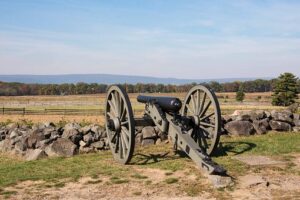
landscaped a burial ground and gave the men a proper burial. At the dedication of the new cemetery, the people decorated the graves, listened to speeches, prayed, and then did what many of us still do on Memorial Day: they had a picnic nearby.
No matter who gets credit for the holiday, this fact is clear. The entire nation had suffered unbelievable losses in the Civil War. The problem arose: how to memorialize and honor the 625,000 dead? The poet Walt Whitman describes how vast the carnage was: it was “the dead, the dead, the dead—our dead—or South or North, ours all.” 625,000 dead! If the same number of Americans per capita had died in Vietnam, the Vietnam War Memorial would have 4 million names on it instead of 58,000.
After the Civil War, memorial celebrations took root in cities and towns across the country—in both the North and the South. The day was originally called Decoration Day and was celebrated on various dates too, usually at the end of May. But in 1968 Congress officially named the day Memorial Day and set the date for the last Monday in May. This assured everyone of a three-day weekend. For many, the day also became the official beginning of summer.

In the U.S. we also celebrate Veterans’ Day on November 11. Whereas Memorial Day honors those who actually died while serving, Veterans’ Day honors all who have served or are currently serving in the Armed Forces.
How do you celebrate Memorial Day?
* By displaying the American flag?
* By participating in local ceremonies and festivities?
* By going to Mass?
* By having a picnic?
* By watching the National Memorial Day concert on the west lawn of the capitol building?
* By your personal prayer of remembrance?
* By praying for peace?
* By doing some form of service to those in need?
However we choose to celebrate Memorial Day, may we never forget its origin and purpose: to honor those who gave the supreme sacrifice of their lives that we might have the gift of freedom. And may we continue to use that freedom to work and pray for peace that will eventually make war memorials a thing of the past.
Happy Memorial Day to all of you!
I chose “Let there Be Peace on Earth” for today’s song. This version is sung by Vince Gill and others.
Do you have anything you’d like to share today?
How Do You Feel about Bugs?
How do you feel about bugs?
This question recalls a true story about my grandnephew, Aaron. When he was about 10, he was on the playground one day with some other boys when they spotted a praying mantis. Almost instantly, some of the boys began to torment it with a stick. Aaron protested, saying praying mantises were good and the boys should leave it alone. But the boys continued their “bug abuse,” eventually killing it.
When he got home from school, Aaron was still very upset about what had happened and told his mother. “Why did they have to kill it?” he asked. His mother told him she didn’t know why, but he had done the right thing by standing up for the praying mantis. She added, “I’m proud of you.” (Aaron today is studying biomedical engineering at Colorado State University.)
I can identify with Aaron for I have the habit of trying to save insects even when I find them in my house. If I spot a large black ant on the kitchen floor, for example, I don’t kill it. Instead I get a large used envelope and gently coax the ant inside. Then I carefully carry the envelope outside and deposit him (or her or it) on the grass. I do the same thing for beetles, spiders, and other critters. (I draw the line at flies and bugs that carry disease.)
I don’t know how you feel about insects or bugs, but let me share a few thoughts
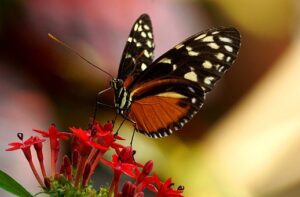
about them with you. First, a few facts:
Scientists estimate that of the 9 million different species on earth, a whopping 90% of those species are insects. Here’s another fact: there are 1.4 million ants for every single human being on earth. Why are insects so successful at surviving? (Some even survived the Mt. St. Helen’s eruption!) First, their small size makes it easier for them to hide from danger or predators. Their small size also reduces their energy requirements. Imagine what an ant eats per day compared to what you eat! Insects also enjoy a wide diet. They are not picky eaters. You won’t find a baby fly saying to its mother, “But I don’t like broccoli!”
Many insects also have wings that aid in their ability to escape danger. We all know how hard it is to swat a sitting fly. Insects also frequently have tough exoskeletons. We humans and many other animals wear our skeletons on the inside. And finally, insects have (as one researcher put it) a “prodigious ability to reproduce.” A termite queen can lay 6,000 eggs in a single day! Whew! I wonder if she gets Sundays off?
Insects are vital to the good functioning of planet earth. They help break down and dispose of wastes, dead animals, and dead plants. Imagine how messy earth would be if trees, animals, and plants
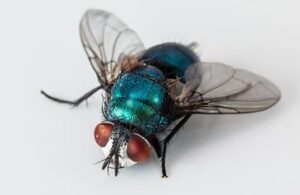
didn’t decay. Insects are an important food source for amphibians, reptiles, birds, and mammals. In some cultures, even the mammal homo sapiens eats insects. (I can hear some of you going “ugh!”) Finally, insects are vital to many ecosystems on earth because they aerate soil, control insect and plant pests, and pollinate blossoms. Concerning pollination, the Smithsonian website states: “The value of pollination of plants by insects is nearly incalculable.”
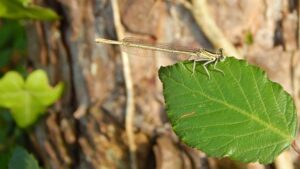
If you’re a gardener, you know there are some “good” insects that you want to invite into your garden: lady bugs, lacewings, hover flies, ground beetles, wasps, spiders, dragonflies, and (of course) honeybees. Many of these “good” insects feed on insects that are “bad” for your garden: aphids, caterpillars, mites, and such.

Most insects live for only a few days, weeks, or months. But there are exceptions. Remember that termite queen I mentioned earlier? She can live for 50 years! Go figure! Final word: a recent study concluded that the average American home has 100 different species of arthropods in it (spiders, insects, centipedes, ladybugs, and such). Most are living in harmony with the house dwellers… So the next time you spot a spider in your bedroom, instead of smashing it with your slipper, consider herding it under your dresser or finding a large envelop and carefully coaxing the spider inside and…
How do YOU feel about bugs?
Is there anything about bugs that fascinates you? scares you? instills gratitude in you?
Be on the lookout for bugs this week. How many can you spot? How many can you name?
(All photos are from Pixabay)
PS: It is now Monday afternoon and I just got back from my week at Sophia Retreat Center in Atchison, Kansas. I want to thank the wonderful group of women who spent the week meditating with me on “Finding God in the Ordinary and Amazing.” I enjoyed our time together. And thanks also to the Mount St. Scholastica community of Benedictine Sisters there for their hospitality, prayerfulness, inspiration, and sense of fun.
Yes, there are many insect songs. I chose this one for children. I thought you’d enjoy its positive attitude toward insects and the unique insects depicted in the video:
I encourage you to respond below. My readers and I always enjoy hearing from you!
The First Pentecost: A Wild Time Was Had by All
The first Pentecost was anything but a tame event. The winds howled, the walls rattled, the earth shook. What’s more, “tongues of fire” descended upon everyone huddled in that upper room. Clearly the Holy Spirit came not as a gentle breeze, but more as a hurricane or earthquake.
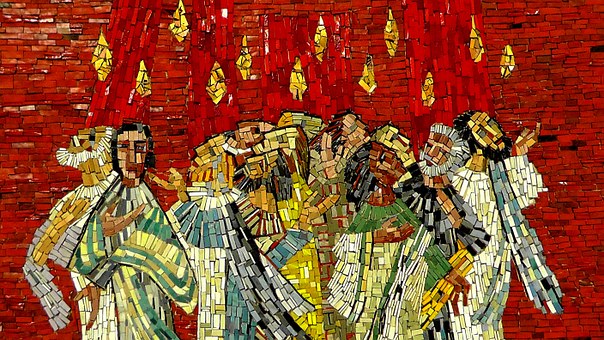
The disciples too seemed filled with this “untamed power” of God. They didn’t leisurely saunter out of the upper room that day. No, they were almost catapulted out the doors and into the streets. Once outside, they began speaking with such joy and enthusiasm that some of the bystanders thought they were drunk. The effect of their preaching was also wildly amazing: 3,000 individuals converted to the gospel in a single day!
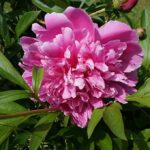
The story of the first Pentecost raises some questions for us. First, do we appreciate God’s wildness? Do we appreciate the wildness of God’s love that created the cosmos in the first place? How wild is the universe? Try to count the stars… gaze at and smell a peony… listen to the Cardinal’s song… look for deer in the park… stroll along a shore. Do we appreciate the wildness of God that gave us Jesus, God incarnate… The wildness that enabled Jesus to surrender to a cruel death out of love for us. The wildness that caused God to make foolish promises to us like, “I will be with you always”?
 The wildness of Pentecost raises another question? Does anything of the wildness of God exist in me? In the name of God or love, what wild things have I done in my life? One of the wildest things I ever did was enter the convent when I was not quite 18. (I hope my wildness didn’t end with that!) Maybe you did a wild thing by getting married and then by wildly welcoming “untamed” children into your life. Or maybe you chose a path in life that put helping others ahead of monetary gain. Actually, anyone trying to live a life of integrity and compassion and unselfishness is doing a very wild thing in a world that rewards cunning, has little sympathy for those in need, and is constantly urging us to “Watch out for #1!”
With these thoughts in mind, let us pray this Pentecost Prayer…
Spirit of Pentecost,
We thank you for the wildness of your love.
We thank you for the power, ingenuity, breadth, extravagance, and joy of your untamable love.
Give us a share of your wildness.
Help us to live according to the radical demands of the gospel.
Help us to trust in your promptings, whether they come as a gentle breeze or forceful gale.
May we always be filled with the exuberance of your Spirit
wherever your Holy Winds may take us. Amen.
I chose a song that is lively and a little wild. It’s “Witness” by Jordan Feliz. (I love the “drums” which sound like someone beating garbage cans!) To me, the song says, through all the ups and downs in life, God’s love is gushing all around us. In our life, we have many witnesses to this faith and trust in God. Can we be a witness to others too?
PS: Please pray for a retreat I will be facilitating at the Sophia Center in Atchison, KS from May 15-20. The theme is “Prayer: Finding God in the Ordinary and the Amazing.” Thank you!
Retreat Cruise: In case you are registering for the Retreat Cruise, be sure to include the following: Host: Svoboda/Sisters of Notre Dame, Host ID #58170. The brochure on this blog page already has this information filled in. Thank you!
Now it’s your turn. Is there anything you’d like to add or comment on? If so, please do below.