Building Bridges of Peace
The date was December 9, 1967. The occasion was the Veterans Day remembrance ceremony in Missoula, Montana. Attending the ceremony was Dan Gallagher, a demolitions specialist, who had just returned from a 13-month tour in Vietnam. But at the front gate of Fort McChord, where the ceremony was to take place, a group of anti-war demonstrators had gathered.
Dan saw her right away: a young woman with long blonde hair about his age, 20. Her name was Betsy Mulligan and she was waving a sign with big red letters that said: “Baby Killer.” He says, “I saw more hate in her eyes than I had seen in the eyes of the Viet Cong.” Little did Dan and Betsy know back then, that one day, many years later, they would lay aside their mutual hate and mistrust, and forge between them a bridge of mutual respect and understanding.

Fast forward to the year 2005. Minnesota film maker Jan Selby decides to make a documentary film about the giant peace sign that had once divided the city of Missoula in the 1960’s. He contacts both Dan and Betsy knowing they are both articulate spokespeople for the opposite sides of that war controversy. Dan is now a semiretired attorney who hosts a show called Veteran’s Viewpoint on the local public radio station. Betsy is the executive director of the local Jeannette Rankin Peace Center in Missoula.
Dan invites Betsy to be a guest on his radio show for a one hour discussion on peace. She accepts. Selby films their encounter. The two begin talking and soon realize they have much in common. Both were raised Catholic. Both had parents who encouraged lively but respectful discussions at the dinner table. As Dan sat across from Betsy in the studio that day, he saw not the angry young woman he remembered. But rather, “I saw an incredibly decent, intelligent, and articulate person.” He realized he had been labeling peace activists “wackos” or at least saying they were “niaïve.” But as he listened to her, she began to make a lot of sense.
Betsy too had to move “beyond stereotypes and a self-righteous mindset.” She had to learn

“to approach people with other ideas with more curiosity and a willingness to learn from them.” Selby’s award winning documentary, Beyond the Divide, tells the story of how the relationship between Dan and Betsy developed. Betsy eventually learned to make the distinction between a soldier as a person and the war she opposed. Dan learned to let go of his anger and to forgive those who had hurt him so badly through their opposition to the war.
In 2011 Dan invited Betsy to speak at the annual American Legion Post 101 for Veterans Day. Standing in front of the crowd, many of whom were veterans, Betsy expressed regret for the way some of the peace advocates had mistreated veterans. Such animosity “removed the opportunity we had to learn from each other, to listen to and appreciate each other.” After the ceremony, many veterans came up to shake Betsy’s hand. Commenting on her speech, Dan said, while choking up a little, “Some veterans have waited 40 years to hear such an apology.”
 In 2012, the staff at the Jeannette Rankin Peace Center, decided unanimously, to honor Dan Gallagher with their annual Peacemaker Award. In his acceptance speech, Dan talked about the courage he saw on the battlefield. But he also spoke of the courage he sees in anyone fighting for a just cause. He said, “I salute not only my fellow veterans and soldiers, but all of you who are willing to stand on principle, especially those who speak the language of peace.”
Dan and Betsy have become friends. They even get together for lunch about once a month. The kind of bridge they built between them “is not limited to discussions about wars,” says Betsy. “We all have divides in our lives.” It could be a divide with a family member, a neighbor, a colleague at work, a fellow parishioner, a member of another political party, an elected official. Betsy concludes, “We all have places where we can find opportunities to make peace.”
(This reflection is based on an article entitled “Bridges to Peace” by John Rosengren in the February 2017 issue of U.S. Catholic. Last December Dan Gallagher died of heart failure. He was eulogized for both his work for veterans and his work for peace.)
Does anything stand out for you in the story of Dan and Betsy?
Where are the divides in your personal life? What might you do to begin to forge a bridge of peace?
The song today is a version of St. Francis’ prayer for peace, sung here by Sarah McLachlan:
Would you care to respond to anything here today?
Three Cheers for Dentists!
I had dental work done recently. Not just a cleaning, but actual “work,” which is a euphemism for drilling! But I don’t want to bore you with the details of my last visit to the dentist. Instead, I want to celebrate dentists today. For I believe they are often the unsung heroes in the field of medicine.
I wanted to write about dentists because, in a way, I feel sorry for them. Nobody wants to go and see them. Whoever says, “Yippee! I get to go to the dentist today!” Many of us have to be dragged there. Or we come up with creative excuses for not making that dental appointment: “Nothing hurts. I’ll wait until something hurts.” Or “My dog’s birthday is coming up. I need time to plan the party.” Or, the old standby, “I’m too busy. I’ll wait until I’m not so busy.”
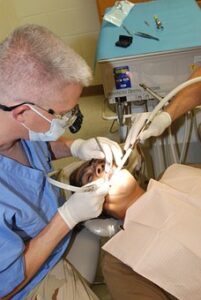 The only time we want to see a dentist is if we’re in serious pain. Then we can’t wait to get to the dentist, because we know dentists can provide almost instant relief. In fact, that’s one reason my dentist said he decided to go into dentistry and not into general medicine. “As a dentist I can help people much more quickly than if I were a doctor,” he said.
I admire dentists. They work in such a small space, the human mouth. And on such a small thing: a human tooth. They have to learn a wide variety of skills too. They have to know how to do examinations, diagnoses, drilling, filling, crowns, bridges, and extractions. While they’ve got you in their chair, dentists also check out your mouth, jaw, and neck for potential problems such as growths.
I met a nun once who was a dentist. She became a nun first and a dentist afterwards. She spent her life serving primarily the homeless in a large city. My dentist is also altruistic. He regularly volunteers his expertise in a so-called “developing country.” What a generous thing to do! This year he’s taking his oldest daughter with him. What a great idea!
I did a little reading on dentistry and was surprised to learn that dentistry is one of the oldest of the medical professions, dating back to 7,500 BC. The Egyptians (we think) were the first to make replacement teeth—forerunners of modern dentures and crowns. And there is evidence that teeth were being drilled as far back as 9,000 years ago! And the earliest known filling was found in Slovenia and dates back 6,500 years! It was made of beeswax.
Here are a few other facts about teeth and dentistry that I found interesting:
* Dentistry became a profession in the 19th Century. Prior to that, dental problems were treated by barbers and general physicians—and even blacksmiths.
* Tooth decay was low in pre-agricultural times. But starting 10,000 years ago, the growth in agriculture corresponded with the growth in tooth decay.
* The average American spends 38.5 days brushing their teeth over their lifetime.
* Tooth enamel is the hardest substance in the human body.
* If you don’t floss, you miss 40% of your tooth surface.
* If you drink three or more cans of soda a day, you will have 65% more tooth decay.
* The Blue Whale, the largest mammal on earth, eats only shrimp because it has no teeth.
* A snail’s mouth, which is no larger than the head of a pin, can have 20,000 teeth! (That is not a typo!)
* In 1950, the Tooth Fairy paid an average of 25 cents per tooth. In 1988, $1.00. The going rate now is $2.00.
* George Washington never had wooden teeth as many of us were taught. His dentures were made of gold, hippopotamus tusk, elephant ivory, and human teeth.
* And finally, the average American woman smiles 62 times a day; the average American man, 8 times. (What gives here? Any theories?)
Today let’s give thanks for our teeth and all they do for us. And let’s thank God for dentists, oral surgeons, dental hygienists, and all who work in our mouths to keep them healthy—and to keep us smiling!
I couldn’t find a religious song on dentistry (although I found some cute children’s songs about brushing your teeth! One was even by Bruno Mars when he appeared on “Sesame Street.”). So I chose a song on healing. This song is called “Healer” and it’s by Kari Jobe.
Would you care to share any thoughts on dentists or anything else in this reflection?
Five Truths about Love
Valentine’s Day is coming soon. It’s one of my favorite days of the year. I love it, first of all, because it comes in the middle of February, often a time of darkness and cold—at least where I live. It comes smack in the middle of the celebrations of Christmas (now a distant memory) and Easter (still weeks away). I also love Valentine’s Day, a Christian/pagan feast, because it celebrates love—all kinds of love—eros (sexual love), philia (brotherly/sisterly love), and agape (love of the soul). On Valentine’s Day we take time to show our appreciation for those we love.
 And I appreciate all of you, my dear readers of this blog! I launched this blog on February 13, 2012! (Happy anniversary to us!) I can’t believe I’ve been writing these weekly reflections for five years now. And some of you have been with me since the beginning (thank you for your patience and stamina!), and many of you have joined us somewhere along the way. I always appreciate new comers too. Today I would like to celebrate this feast of St. Valentine by offering you five truths about love that I have gleaned through my lived experienced, my long lived experience. I wonder: do any of these truths resonate with your lived experience?
- Love begins and ends with God. St. John said it best: “We love because God loved us first.” All love flows from God. But love isn’t so much something I do; it is something I participate in. More accurately, love is not a thing at all. Love is a person. Again I quote from the letter of St. John: “God is love.” If we’re having difficulty loving then maybe we have lost sight of God’s great love for each one of us. Or maybe we have turned love into a project.
- Loving is the hardest thing we do. Why did Jesus have to say over and over again, “Love one another… Love one another… Love one another”? Because he knew how hard it was! Loving is so difficult and so challenging, no one gets it right every time. This realization should make us more patient with all the clumsy or faltering attempts at loving we see—both our own and those of others.
- Love hurts. If we love, we will hurt. It’s as simple (and sobering) as that. This means we will get hurt; but it also means we will probably hurt others—especially the very ones we love. If we are involved in a loving relationship, then, sooner or later we have to learn to say “I’m sorry” and “I forgive.” And we will also be hurt when the people we love are taken away from us—especially through death, the “ultimate taking away.” The point is, if you want a life without hurt, don’t love. But guess what? Choosing not to love will hurt too. I guess
 it’s a matter of picking your hurt!
 - Loving is the most important thing we do. We do many important things in a lifetime. We get an education, we secure a job, we get married, we have kids, we go to church, we win awards, we take care of our health, we manage our finances, we plan for retirement. But by far, the most important thing we do is love. In fact, if love is not a part of all the important things we do in life, then those things have little value. (See the next truth below).
- Love must permeate everything we do. The theologian Richard McBrien said that love is at the heart of every Christian virtue. Justice without love is legalism. Hope without love is self-abasement. Care without love is mere duty. Fidelity without love is servitude. Love must permeate everything we do, whether we’re changing a diaper, cooking supper, teaching a class, feeding the dog, helping a kid with his homework, shoveling snow, driving our granddaughter to her dance lesson, sitting at a meeting, attending Mass, or even writing a blog.
So there you have it: five truths about love. What truths would you add?
Happy Valentine’s Day!
I chose an old love song to God for today: “Be Thou My Vision.” This is an 8th Century Celtic hymn here sung by the group 4Him.
Would you like to respond to the reflection or song?
Traveling in Good Company
When we cleaned out my sister’s apartment, we divided up her belongings. One item my sister had was a statue of Mary. This was no ordinary statue. It was quite large—over 3 feet tall. It had been given to my maternal grandmother when my mother, her first child, was born in 1915. My mother treasured the statue because it was a direct link to the mother she never knew, the mother who died shortly after the birth of her second child when my mother was only two.
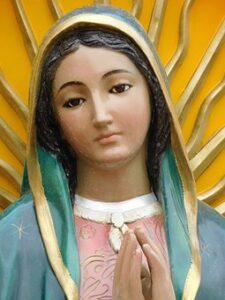
We had grown up with this statue of Mary in our house. It had stood on a small wooden table in one of the bedrooms or later in the living room. I remember, as a child, putting flowers in front of the statue: daffodils, lilacs, or roses that grew in our yard.
But now, none of my sister’s children wanted the statue. I couldn’t blame them. Who wants such a huge statue in their house these days? My nieces and nephews thought: Surely I, the nun, would want to have it, right?
Well, not exactly. But I said I would take the statue to our provincial center. They might find a place for it there. More likely they would give or sell it to someone who collects religious items, such as statues and crucifixes, and refurbishes them.
Mary was too heavy for me to carry, so my nephew Chris hoisted her up and lugged her out to my car. My trunk and back seat were already filled with other “stuff” I was going to try to find a home for, so Chris stood the statue on the front passenger seat. He gently buckled Mary in with the seat belt. Then he wrapped a bungee cord around her and the seat to secure her even more. “Try not to make any sudden stops,” he cautioned.
I began my sixty-mile journey home with Mary in the passenger seat of my car. As I drove along, I glanced over at her every now and then just to be sure she was okay. There she was standing stiffly—with perfect posture—on the seat next to me. The palms of her hands were pressed together in front of her with her fingers pointing straight up to heaven. Mary was in full prayer mode the whole way. (Maybe she didn’t trust my driving!)
I wondered what other drivers thought as they passed me or pulled up next to me at a stop light. Maybe they were tempted to yell, “Hey, Lady, they make smaller ones, you know! Ones that fit on the dashboard!”
I didn’t go to our provincial center for two days. During that time Mary rode around town with me as I did a few errands. She went with me to pick up a prescription at the pharmacy. (I decided not to use the drive-thru this time.) While I pumped gas at the gas station, Mary stayed in the car, praying. Eventually I dropped her off at our provincial center. The last time I saw her, she was lying on her back on a cart as one of our workmen was slowly pushing her down the hall. She was still praying. (I thought, “That woman prays 24/7!”)

This little episode with the Mary statue got me thinking. As Christians, we believe we don’t walk through life alone. We believe God walks beside us every step of the way. (Some people like to think of God as their co-pilot. But I like the old maxim that says, “If God is your co-pilot, switch seats!”) We also believe in what is called “The Communion of Saints,” that is, our oneness with the whole body of believers which includes canonized and un-canonized saints. We also believe our deceased loved ones are somehow very present to us in mysterious ways, and that the bonds of love we had with them during their life on earth persist even after their death.
Today might be a good day to give thanks for those individuals who accompany us on our earthly journey—individuals divine and human (and angelical!), canonized and un-canonized, living and deceased. Even a few minutes of reflection will make us realize: How lucky we are to be traveling in such good company!
In whose company do you walk through life?
The song is “You Will Never Walk Alone” from the musical Carousel, here sung by “The Celtic Women.” I remember when this musical first came out. It had some wonderful songs. This particular song doesn’t mention God specifically or those who have gone before us and who accompany us now. Yet it does speak of that great Christian virtue, HOPE:
Are you traveling through life in good company? If so, who? Would you be willing to share some of that company with us?
The Gift of Sounds
Fred Newman has an unusual occupation. He is a sound actor. This means he makes a living by making all kinds of sound effects using essentially his mouth, nose, and throat. If you have ever listened to Garrison Keillor’s Prairie Home Companion, then you have heard him in the background supplying the sound effects for the various stories Keillor and his creative team enact. (more…)