Another Dip into My Quote Collection
Those of you who have being reading this blog for awhile know that I collect quotations. I have seven small file drawers crammed with 3 X 5 cards on which I have written thousands of quotes over the years, mostly from books or magazines I’ve read. I wrote about my collection in my post for June 1, 2015. (If you want to access it, just go to the box entitled “Search” on the lower left of this page and type in “My Quotation Collection.”)
For today’s blog, I simply want to share a few of my quotes with you. As I always say, if

someone else has said it well (and better than I ever could!), why not just copy down what they have said and give them the credit. These fifteen quotations are on a variety of topics and written by a variety of individuals. I will give you the general topic before each quote:
1) Life: “Everything that happens to you is your teacher. The secret is to learn to sit at the feet of your life and be taught.” (Polly Berrien Berends)
2) God: “There is no proof for the existence of God, only witnesses.” (Rabbi Abraham Heschel)
3) Love: “Unless you love someone, nothing makes sense.” (W.H. Auden)
4) Friendship: “I always held that the great high privilege, relief, and comfort of friendship was that one had to explain nothing.” (Katherine Mansfield)
5) Doubt: “Doubt is faith’s cousin.” (Fr. Don Cozzens.)
6) Community: “Love needs someone else. Joy is something shared. Peace is mediated. Patience is interactive. Generosity is toward. These communal activities have no reality except with another.” (Cedric Mayson)
7) Humor: “A grace to pray for—that our self-interest, which is inescapable, shall never cripple our sense of humor, that fully conscious self-scrutiny which alone can save us.” (Dag Hammarskjold)
8) Housework: “Housework can’t kill you, but why take a chance?” (Phyllis Diller)
9) Prayer: “The only people who pray well are those who continue to pray. Perseverance is the only mark of ‘success’ in prayer.” (Richard Rohr)
10) Adversity: “Let us thank God that he makes us live among the present problems; it is no longer permitted for anyone to be mediocre.” (Pope Pius XI wrote this is the 1930’s. It was one of Dorothy Day’s favorite quotes.)

11) Holiness: “You do not have to be holy to love God. You have only to be human. Nor do you have to be holy to see God in all things. You have only to play as a child with an unselfish heart.” (Matthew Kelty, Trappist Monk)
12) Hope: “Hope and fear cannot occupy the same space at the same time. Invite one to stay.” (Maya Angelou)
13) Skepticism: “I’m so skeptical I can’t believe it!” (I.B. Singer)
14) Death: “When it comes time to die, make sure others will not merely say, ‘Isn’t it too bad she died.’ But rather, ‘Isn’t it wonderful that she lived.’” (anonymous)
15) Loving: “There are a hundred paths through the world. / Every one of them is easier than loving. / But who wants easy?” (Mary Oliver)
Do any of these quotes touch your heart today? If so which one(s)? And why?
Do you have a favorite quote that has nourished or inspired you?
Sometimes we try too hard in life. We try too hard in prayer, in our personal relationships, even in being good. This song by Amy Grant with James Taylor reminds us: “Don’t Try So Hard.” “God gives you the grace… God’s not leaving.” I hope you like it:
Do you have anthing you’d like to share with us—about the quotations or song?
Mourning Mary Ann
My sister, Mary Ann Hartman, passed away a few weeks ago after a brief illness. She was 77. A widow, the mother of five and grandmother of nine, she was my only sister and my best friend.

The day before Thanksgiving she learned she had cancer in her stomach, liver, and kidneys. Prior to this diagnosis, she was essentially asymptomatic. Mary Ann declined chemo and dialysis, saying, “It’s all in God’s hands.” And later, “I’m ready to die.” She died ten days later in hospice surrounded by her children, their spouses, a couple of grandchildren, and me.
Losing a loved one is always difficult. But losing a loved one right before Christmas is especially hard. Here are a few of my thoughts taken from my journal during those first few weeks after her death. Though the grieving process is different for everyone, maybe something here might speak to your own experience of loss.
* * * *
+ The sympathy cards keep pouring in. And I appreciate every one—honest I do. But today I wanted to say, “Enough already!” Each card underscores the gravity of my loss.
+ People ask, “How are you, Melannie?” How do I answer that? Do I say, “Fine”? No. My sister is gone. How could I be fine? From now on, my “fine” will always be tempered by the loss of Mary Ann.
+ I wish I had had more time to talk with Mary Ann those last few days. And I wish she had had more strength to stay awake and speak to us, to me. But there I go again, trying to orchestrate the perfect death…instead of giving thanks for all the time we did have with her as she lay dying. And all those countless times over the years that I did have to talk with her—whether on the phone, across the table in a restaurant, beside her on her couch, with her in the park, next to her in the car. I tell myself, “Regret less. Give thanks more.”
+ Christmas cards are mixed in with sympathy cards. Before I open a card I try to guess: Christmas or Sympathy? The hardest to read right now are the Christmas cards—especially from people who haven’t yet heard “the news.” All that bright cheer amid my dark sorrow. It’s almost too much to bear.
+I feel strangely immune from pain. With Mary Ann’s death, I’ve been dealt one of the hardest blows life can give. And yet, here I am still alive. Limping from the blow, yes. But still walking.
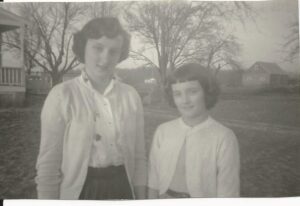
+ It’s her fault my grief is so great. If only she hadn’t loved me so much. If only we hadn’t gotten along so well. If only we hadn’t enjoyed each other’s company so much. If only I hadn’t loved her so much. If only. If only.
+ When I crawled into bed last night, the tears came. Finally. I haven’t cried since the funeral. But last night in the darkness, I cried on and off until after midnight. The tears didn’t pour out. They trickled out. I whimpered more than sobbed. My mind was flooded with questions: How could she have been filled with cancer and nobody know it? Not her. Not her doctor. There’s anger in my question. If we had only known, maybe she could have received treatment. Maybe she would have had more time with us. But then I hear her words, “It’s all in God’s hands.” She really believed that. Can I?
+ She died with such courage, such dignity. Though she slept a lot, she was easily roused when family came to see her. Lori would whisper, “Mom, Zach’s here (Lori’s college age son).” Or, “Aaron (another son studying in Colorado) is on the phone. He wants to talk to you, Mom.” And Lori held the phone by her ear. Mary Ann listened, nodded a few times, and ended the “conversation” with a soft, “I love you too.”
+ She told us she was ready to die. But how did she “get ready”? She got ready by embracing the challenges and blessings life set before her: by being faithful to her husband, by raising five children, by working at the deli, by welcoming in-laws and grandchildren into the circle of her love, by doing small acts of kindness for her neighbors, by praying every day, by appreciating the beauties of nature, by feeding the birds, by volunteering at the animal shelter. She got ready by dealing with ambiguity, sorrow, disappointments, loneliness, worry, and fears with her gentle yet steady faith. She got ready to die the way we all get ready to die: by the way we live our life.

+My friends have given me permission to do whatever I need to do these days. Cocoon. Or be with people. Write. Read. Sleep. Clean a bathroom. Sit and stare out the window (which I’m getting good at). The ones who best understand my needs, are the ones who have already been where I am now.
+I had forgotten how tired grieving makes you.
+I will miss being known so well.
+I feel as if I’m walking around in a envelope of grief. Part of me wants to break out. Part of me wants to stay inside.
+Aaron said to Lori as she drove him to the airport after the funeral. “I was thinking, Mom. I lost my grandmother, but you lost your mother…” And his voice trailed off. Lori had tears in her eyes when she told me this. I have tears now as I write this. Mary Ann’s death has poured down blessings on all of us. One blessing: the deeper realization of how much we mean to each other.
I chose a simple song by Marty Haugen: “We Walk by Faith and Not by Sight.” Not only are the words appropriate for Mary Ann, so too are the images: flowers, ponds, pathways, ducks. May our deceased loved ones who now see God “in full and endless sight” help us to maintain our belief that God is always near.
What has been your experience with grief?
Does this reflection or this song evoke any thoughts or feelings in you? Any you would like to share with us?
Winter: The Misunderstood Season
Some of us have a negative view of winter. We see it as a season of cold that disrupts our routine and puts a damper on our fun. Have you ever noticed how some of the weather people speak about winter? They say we will be attacked by a cold front. Or we should prepare ourselves for the invasion of arctic air from Canada. One meteorologist even said that the winter storm is going to deliver a blow to the country’s midsection. Poor winter! It needs a public relations agency to give it a more positive image!

But I recently came across a website that calls winter, “the most misunderstood season of all.” The author addresses his words to people (like me) who live in places where winter is characterized by ice, snow, and freezing temperatures. His intent, it seems, is to remind us of some of the beauties of the season.
He says, for example, that winter is “a beautiful season of intimacy and reflection (that) gives us the opportunity to stay inside and look inside.” He quotes individuals who appreciate winter. One person is the artist Andrew Wyeth who said, “I prefer winter and fall, when you feel the bone structure of the landscape—the loneliness of it, the dead feeling of winter. Something waits beneath it, the whole story doesn’t show.”

I know what he means. When I gaze at the frozen world outside it is easy to believe that everything is dead. But experience tells me the trees are dormant, not dead. Their life-sustaining sap is simply being stored in their roots and will rise again in spring. And the bulbs buried beneath the snow will one day sprout green shoots that will break out into brightly colored tulips and daffodils and hyacinths. And all those insect eggs tucked beneath the bark of a tree or under the brown leaves on the forest floor—they too will come to life again. Winter for me has always been the season of hope. You have hope in your heart despite the cold, dark evidence outside.
Another beauty of winter is the gently falling snow. I like what Andrienne Ivey wrote about snow: “Everything is equal in snow: all trees, all lawns, all streets, all rooftops, all cars. Everything is white, white, white, as far as you can see.” The manicured lawns and the neglected lawns look the same after a snowfall. So do the new car and the old jalopy. “Everything looks clean and fresh and unmarred by time or use. Snow…is a great leveler.”

I also appreciate the quiet of a winter landscape. Snow muffles sound. The cars on the street make less noise. The windows are all shut so you hear less noise from the outside. Snow also mutes color in winter. There are no bright flowers to break the vast whiteness. That’s why, when color does chance by in winter, it stops us in our tracks. Is there anything more breathtaking than to spot a bright red cardinal flitting between the branches of a naked tree?
And finally, winter in the natural world teaches us how to live the winters of the spiritual world. This concept is expressed beautifully in the words of Sister Joan Chittister, OSB:
“Winter is a lesson about the fine art of loss and growth. Its lesson is clear: There is only one way out of struggle, and that is by going into the darkness, waiting for the light, and being open to new growth.”
What do you like or dislike about winter? Do you see any beauty in winter?
Our song today is “Winter Snow” written by Chris Tomlin and sung here by Audrey Assad. The song reminds us that in the Incarnation God came like a winter snow…
Is there anything you’d like to share about winter, about this reflection, or the song?
PS: Here are a few of my upcoming speaking engagements. For more information, check the websites of the retreat center or parish:
March 11, 2017 – St. Christopher Parish – Rocky River, OH
9:30 – 3:00: “The Spirituality of Hope”
March 25, 2017 – St. Cyril and Methodius Spiritual Center – Danville, PA
9:00 to noon: “Four Traits of a Healthy Spirituality: wonder, friendship, courage, hope”
April 7-9 – Franciscan Spiritual Center – Aston, PA
Weekend retreat: Fri. 7:00 pm to Sun. 11:00 am: “The Spirituality of Christian Hope”
April 29, 2017 – Norbertine Center for Spirituality – De Pere, Wisconsin
8:30 – noon: “How Do I Know If I’m on the Right Path Spiritually?
June 18-24, 2017 – St. Mary of the Pines – Chatawa, Mississippi
Week long retreat: “Holiness Is Wholeness”
July 7-14, 2017 – Villa Maria Del Mar – Santa Cruz, California
Week long retreat: “Everyday Epiphanies: Finding God in Every Nook and Cranny”
Achieving Peace through Compromise
Alex and Candice are siblings, ages 13 and 11 respectively. (They are also my grandnephew and grandniece). As siblings, they sometimes fight over who gets to ride in the front seat of the car. One day Alex decided to do something about their quarreling. He drew up a legal contract that set the “rules” for determining who got to sit in the front seat when. The contract was two pages long.

Alex signed the document and handed it to his sister to sign. She read it and said, “I’m not signing this. It’s not fair.” They discussed what would be more fair. Then Alex rewrote the contract, signed it, and again gave it to his sister. Again she refused to sign it, saying, “It still favors you.” The third draft proved acceptable to Candice. She signed the contract and Alex put a copy of it in the glove compartment of their car—for handy reference.
When I heard this story, I thought, “If only the rest of the world could resolve their conflicts in such a manner.” I don’t know what made that contract acceptable to both Alex and Candice, but I strongly suspect that some sort of compromise was involved. What is compromise? Essentially it means, “I’ll give in a little if you will give in a little.” And why do we give in a little? Why do we compromise? Because of a greater shared good. In this instance, there were several shared goods: fairness, respect for each other, and peace!
For some people, compromise is a bad word. Just google it and you’ll find countless articles (many are religious related) that say compromise is bad or even a sin. But in her article, “Compromise Is the Glue in Relationships,” in The National Catholic Reporter (October 7, 2016), Heidi Schlumpf takes a different slant. She agrees that scripture and church teachings leave no room for being “wishy-washy.” After all, the Ten Commandments are not Ten Suggestions. And Jesus’ mandate “to love one another as I have loved you” sets the bar of loving as high as you can get.
But Schlumpf argues that a good compromise is the bond that holds relationships together whether in a marriage, friendship, or country. She calls attention to Jesus’ ability to compromise. Just look at his choice of apostles. Peter was far from perfect. He was brash and impetuous. But he was also capable of passionate loyalty and devotion. And Simon the Zealot was (after all) a Zealot, that is, someone who advocated the violent overthrow of the Romans. How unlike Jesus’ own stance. And next to Simon was Matthew, a tax collector who actually collaborated with the Romans against his own people. I imagine the conversations between Simon and Matthew were sometimes tempestuous.
A good compromise is based on a shared basic principle. For example, if two friends want to go and see a movie, they might have to compromise on which movie they end up seeing. Why the compromise? Because their friendship and being together are more important than the particular movie they see.

In a good compromise both parties respect the other party’s legitimate interests. They both exercise flexibility. And they both make a contribution. In other words, both parties collaborate with each other. Mike Rutherford applies compromise to the experience of being in a band. He says, “Being in a band is always a compromise. Provided that the balance is good, what you lose in compromise, you gain in collaboration.”
The writer Paul Murray equates compromise with psychological maturity. It is the acceptance that we cannot live in isolation from the world. Instead we must live within the world, and that entails compromise.
Today you might want to reflect on these questions:
1) What are some of the compromises you have had to make in your friendships, marriage, religious community, church, or work?
2) When is a compromise not a good compromise?
As we conclude the year 2016 and begin the new year of 2017, I chose a song that is a prayer for peace by David Haas. As we pray the words of this song, let us give thanks to God for being with us throughout 2016—through both the happy times and the sad times. And let us reaffirm our belief that God will walk with us throughout the coming year. Happy New Year!
What are some of your thoughts on the subject of compromise?
Or what are your thoughts as you end one year and begin a new one? My readers (and I!) always enjoy hearing from you!
A Christmas Prayer for Divine Intrusion
Christmas is a time to celebrate the coming of Jesus into our world and into our personal everyday lives. Here is a little poem I wrote for Christmas, but it can be prayed all year long. (more…)