
Do We Need a Little Humor?

For me, the answer to that question is, “Yes!” So today’s blog is devoted to humor. I hope some of these make you smile, laugh, or at least groan!
Let’s start with the kids:
My 5-year-old couldn’t remember the word for tomorrow, so she called it “nexterday.”
We gave our 4-year-old grandson a fishing pole for his birthday. “Wow!” he said, “A fishing machine!”
I told my 9-year-old granddaughter that when I was growing up, our house was the first house on the block to have a color TV. She asked, “What color was it?”
The little girl was sitting on the river bank fishing with her father. She wasn’t having any luck. She said impatiently, “I just can’t seem to get waited on!”
My 3-year-old asked if he had batteries inside of him. I told him, “No.” He asked, “Then how come I can talk?”
My 7-year-old asked if I could get him something so he could send a letter the old fashioned way. I asked, “You mean paper, an envelope, and a stamp?” No, he wanted an email address.

Let’s advance(?) to Parish Bulletin mistakes or “Where’s a good proofreader when you need one?“
Ushers will eat latecomers.
Ushers will swat latecomers.
Today’s sermon: What is hell? Come early and listen to our choir practice.
Diana and Don request your presents at their wedding.
The church will host an evening of fine dining, superb entertainment, and gracious hostility.
The peace making meeting scheduled for today has been canceled due to a conflict.

What if famous writers had used a Thesaurus?
Book Titles: The Grapes of Exasperation… Adieu to Limbs… The Ravenousness Competitors…
(translation: The Grapes of Wrath… Farewell to Arms… The Hunger Games)
Song titles:
“Come on, Baby, Enkindle My Inferno!”… “Like a Gangplank over Anxious H20.”… “We Were Spawned to Scamper.”
(translation: “Come on Baby, Light My fire… Like a Bridge over Troubled Water… We Were Born to Run.”)
And what were the REAL famous lines below:
“May the fortitude be with you… You possessed me at Salutation… Forsooth, my pet, I don’t give a doodley squat!”
(translation: “May the force be with you… You had me at Hello… Frankly, Scarlet, I don’t give a damn!”)
What do lexicographers like for breakfast in the morning? Synonym rolls!

And miscellaneous:
Label on a deli case in New York City: Blubbery Cheese Cake $4.80 (Save the whales! Eschew the cheesecake!)
A defendent, acting as his own defense attorney, asked his his co-defendent, “When we robbed that gas station, was I there?”
Clerk: Do you swear to tell the whole truth and nothing by the truth?
Defendent: Sometimes.
On a resume:
Q: Reason for leaving your last job:
A: Responsibility makes me nervous.
Classic answers to the question, “What do you want to be when you grow up?”
Age 10: I wanna be a pilot.
Age 15: I wanna be a scientist.
Age 20: I wanna be an engineer.
Age 25: I wanna be a kid again!”
When attorneys get married, they don’t say “I do.” They say, “I accept the terms and conditions.”
A friend who knows I like poetry–especially haikus–sent me this un-famous haiku–(NOT infamous!). This little haiku might speak to where some of us are at this time in our life.
“A haiku about my life”
I am so tired
Where did all my money go
My back is hurting.
And finally: these two:
A guy complained about paying $3.50 for a gallon of gas while waiting in line to pay $5.00 for a cup of coffee.
The #1 Rule for parallel parking: Find another spot!
Did any of these make you smile?
Would you like to add a snippet of humor below? We welcome your comments!
We began this refection with the kids. Let’s conclude it with a children’s song by the Okee Dokee brothers, Joe Mailander and Justin Lansing from Minneapolis. It’s called “Hope Machine.” I think we adults need to hear this song too! Good question to ask myself: What keeps my Hope Machine running?
I invite you to leave a comment below!
Jesus Never Said I Told You So
The Gospels record many words spoken by Jesus, but these four words are never ascribed to him: “I told you so!” I think this fact gives us an insight into the way Jesus interacted with people.

When someone says to us, “I told you so!” they are really telling us three things. First, that they possess great knowledge and wisdom. Second, that our knowledge and wisdom is inferior to theirs, as circumstances have just demonstrated. And, third, if we had listened to them (which we didn’t), we wouldn’t be in such a mess. That Jesus possessed superior knowledge and wisdom is without question. And people around him often gave evidence of their inferior knowledge and foolishness. Yet he never said, “I told you so!” What did he say instead? Let’s look at three incidents in his life to find the answer.

When Jesus goes to the house of Jairus to tend to his ill daughter, he is told by the bystanders that the girl is already dead. Jesus says, “She isn’t dead–she’s only sleeping.” Upon hearing this, the crowd starts “making fun of him.” Jesus goes in and raises the girl from the dead, but he doesn’t say to the people, “I told you so.” He says instead, “Give her something to eat.”
Another incident is after the Resurrection when Jesus appears to his frightened apostles cowering in the upper room. What are his first words to them? Not “See, I told you so!” but instead, “Peace be with you. As the Father sent me, so I send you.”
Perhaps the one person Jesus would have been most justified in saying, “I told you so,” was Peter. At the Last Supper, Peter boasts of his loyalty to Jesus when he says, “If all of these betray you, I will not!” But Jesus warns him, “Yes, you will betray me.” Shortly after, Peter betrays Jesus not once, but three times! But when Peter encounters the risen Jesus on the shore a while later, Jesus says to him, “Feed my lambs… feed my sheep.”
There is a common element in these reponses of Jesus: “Give her something to eat… As the Father sent me, I send you… Feed my sheep.” In each of them, Jesus is entrusting someone with a job to do. Jesus was a good psychologist. He was also highly sensitive.
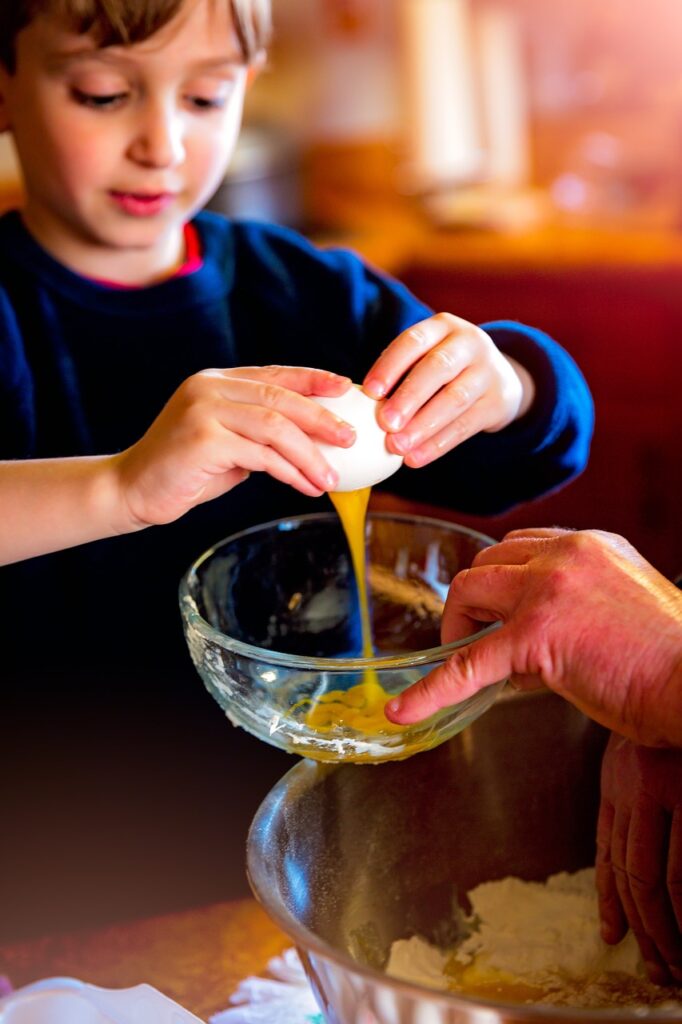
In each incident, a group of people or an individual had demonstrated their foolishness. But saying, “I told you so!” would have added to their feelings of worthlessness. But by giving them a job to do, Jesus is giving them a chance to rebuild their self-esteem by focusing their attention on someone in need. Furthermore, by giving them a task, Jesus shows his trust in people despite their mistakes or poor judgment. The task can be as simple as giving a little girl something to eat or as monumental as becoming the chief shepherd of the Church.
As followers of Jesus, we can strive to remove the words “I told you so” from our vocabulary. More importantly, we can rid ourselves of the attitude behind the words. As Christians, we are called to the work of building people up, rather than tearing them down. As imitators of the compassionate Jesus, we must learn to say to others (as Jesus says to us again and again), “I love you so much, I trust you still!”
(Adapted from an article I wrote for Catholic Digest, April 1981!)
For reflection:
How do you feel when someone tells you, “See? I told you so!”
How do you feel when someone entrusts you with a job or task to do?
What are some of the things we can say to others that help build their sense of self-worth?
What does Jesus need help with in our world today–in our family or workplace or parish or neighborhood or country? How might you help?

PS: Recently a couple of my friends took me out for Sunday brunch for my Jubilee. The restaurant was no ordinary restaurant. It was “Edwins Too,” an upper scale restaurant that employs formerly incarcerated individuals. This means all chefs, wait staff, and other workers, are former felons. It was all started by Brandon Chrostowski who, as a young man got into trouble with the law. As he faced sentencing, (he could have gotten 5 to 10 years), the judge (for some reason) gave him a second chance: parole. Chrostowski says, “I know it was because I had the right skin color.” He resovled to do something with his life to help give others a second chance too. I wrote about him and Edwins previously on my blog. If you want to read that, simply go to the top of the right side bar and type “Edwins Restaurant” in the search box. The restaurant is located in Cleveland Heights, OH. Visit their website for details.
Disclaimer: Please note: when I post a video, I am recommending only the video I post. Often, at the end of that video, other videos come up. Although some of those videos might be fine, others are NOT videos I would recommend. I have no control over what other videos are suggested at the end of the video I post. As with everything we view online, we must be careful. Thank you!
Here is a song entitled, “God, Give Me a Second Chance” by R. Kelly. It captures the theme of Edwins Too and today’s reflection: instead of saying I told you so, entrust the other with a second chance. (click on cc for closed captions)
I welcome your comments below!
The Mystery of Connections

The other day I was going through an old file and came across this story I used in some of my religion classes years ago. It’s a true story by Antoinette Bosco (1928-2020), an award winning journalist and spiritual writer. I will paraphrase her words.
When I was 11 years old, I lived in Albany, NY with my parents and 3-year-old brother Joey. We rented the top floor of a three-story house. An older Italian couple owned the house and lived in the basement. Their young shoemaker son lived on the first floor with his young pregnant wife, Catrina.

My brother and I used to visit Catrina regularly. She always made us feel at home. At times, when her unborn baby kicked, she let me touch her stomach. One time, Joey too felt the baby kick when he touched Catrina’s stomach with his hand. Later, my family moved away to another part of Albany. I became a writer and Joey went to college and eventually worked for the NY Labor Department. Years later, when he was 35, he suddenly learned he had leukemia. Doctors removed his spleen, but they didn’t give him much hope. It was then that Joe met a doctor, a young respected hematologist. This new doctor managed to keep my brother alive until a new drug was developed that finally put Joe’s leukemia into remission. When I visited Joe in the hospital he told me his new doctor was named Frank Lizzi.
“Lizzi?” I asked. “That name is familiar. That was our landlord’s name when we were growing up.”
“Yes,” said Joe. “That landlord was Dr. Lizzi’s grandfather.”
I asked, “Was Dr. Lizzi’s father a shoemaker and was his mother named Catrina?”
“That’s right,” Joe said. “What’s more, I’m only 3 years older than Dr. Lizzi.”
Only then did the realization hit me. The unborn baby who had kicked inside of Catrina those many years ago had grown up to be the doctor who saved my brother’s life!
Antoinette concludes her story with this paragragh:

“Not long ago, I watched Joe and Dr. Lizzi participate in a telethon for leukemia research. At one point, I saw not a doctor and his patient. I saw a little boy, his hand on the stomach of a young mother-to-be, feeling the kicking of her unborn child. And I marveled at the mystery of connections. Never would I have imagined back then that this unborn baby would one day return the touch, carrying with it the same miracle of life.”
PS: I feel compelled to add a footnote to Antoinette’s story. In 1993, she experienced a terrible tragedy. Her son, John, and his wife, Nancy, were shot and killed one night as they slept in their bed. The killer was apprehended, an 18-year-old young man named Shadow Clark. He was tried, convicted, and could have been sentenced to death. Antoinette describes her emotions during this time. When she first heard of the brutal murders, “I wanted the killer dead. I wanted to kill him with my own hands!” But over time, despite her profound grief, she wrote a letter to the judge asking to have the death sentence taken off the table. Clark is currently serving a 150 year sentence in prison. Antoinette tells her story in her book Choosing Mercy. She writes, “Yes, Shadow Clark must be punished, but I could not say, ‘Kill the killer.'” Her respect for life–as shown in the story of her brother and Dr. Lizzi–extended even to the convicted killer of her son and daughter-in-law.
For reflection:
Have you ever had an experience similar to Antoinette’s brother and Dr. Lizzi–a time when you felt “the mystery of conections” in your life? Perhaps it was a time when you found yourself saying, “What an amazing coincidence!” Or simply, “Small world!” If so, I invite you to briefly share your story with us below.
Is there anything in either of Antoinette’s stories that you wish to comment on? Please do so below!
Here is a poem/hymn by British poet, William Cowper (pronounced Cooper – 1731-1800). He set his original poem to music. Cowper suffered from severe depression and once attempted suicide. John Newton (writer of the hymn “Amazing Grace”) befriended him. There are scores of videos online of Cowper’s hymn. Here are two versions for you to choose from. The first is a piano solo of the melody of the hymn with the lines of the poem on the screen with beautiful nature imagery in the background. You can even sing along with the piano. The second is a slightly different version of the poem sung by Lori Sealy with some lovely images. Some of my favorites lines from this hymn include: “the bud may have a bitter taste, but sweet will be the flower… When tears are great and comforts few, we hope in mercies ever new, we trust in you…” I found this prayerful old hymn very faith-filled.
Video #1: piano with lyrics
Video #2: sung by Lori Sealy with lyrics
As usual, I invite you to add a comment to this reflection below. I love hearing from you!
“The Book of Delights”

I was ordering something online. I needed to spend about $10 more to get “free” shipping. So I checked out the books. That’s when I came across The Book of Delights by Ross Gay. I saw that it was a New York Times best seller, a National Book Award Finalist, and only $20. But that’s not what sold me. It’s the basic premise of the book. Ross Gay, a 50-year-old black writer (born in Youngstown, OH, grew up in Levittown, PA), is a professor of English at Indiana University (my old alma mater). A poet and essayist, he decided one day to write a short essay every day about something he found delightful. I thought, “What a neat idea!” And then, “What a challenge!” First, to find a delight in every day! And then to write an essay about it! But after reading the book, I can say Gay succeeded in his goal–and in a delightful way too!
There are 102 essays in the book. (He confesses he didn’t write an essay every single day.) But just the chapter titles piqued my curiosity: “Inefficiency”… Flower in the Curb… Praying Mantis (one of my favorites!)… Writing by Hand… Nicknames… Airplane rituals… Among the Awards of My Sloth… The Sanctity of Trains… Bird Feeding… Babies. Seriously… Bobblehead… Ambiguous Signage Sometimes… Tomato on Board… My Birthday.”

In “Tomato on Board,” essay #80, Gay describes carrying a seedling tomato through the airport and onto a plane. If you do this, he says, it “will make people smile at you almost like you’re carrying a baby. A quiet baby.” (He recalled carrying a bouquet of lilies through the streets of Rome once. People noticed–and smiled “with approval” at him—especially women. In fact, “A woman dressed in a housedress and beating a rug on a balcony shouted Bravo!”) When Gay boarded the plane with his tomato seedling, one worker said, “Nice Tomato.” The flight attendant directed him to an open seat–for the seedling. He set “the li’l guy” in the seat next to the window so it could look out. When he got water, he poured “some of it into the li’l guy’s soil.” And when the plane landed and the pilot put on the brakes hard, “my arm reflexively went across the seat, holding the li’l guy in place, the way my dad’s arm would when he had to brake hard in that car without seatbelts to speak of, in one of my very favorite gestures in the encyclopedia of human gestures.”

In essay #68, Gay muses on the bobblehead toy, saying, “I suspect there will be no apparently superficial delight than this one.” But at the end of his musings, he wonders if “it’s the bobblehead that delights me, or if it is the fact that the toy alerts me regularly to the fact that people are delighted by such goofy and ridiculous things, which reminds me of a fairly common childlikeness, which encourages softheartedness, I think.”
In essay #82, he noticed that a friend of his, Kayte, had a tag in her backback that said, “If you find this please return to.” And Kayte had filled it out with her name and telephone number. Her action strikes Gay “as a simple act of faith in human decency.” He wonders if he found a wallet with $500 in it with identifying material in it, would he return the wallet? Would that depend on the identfying material? What if it was a frequent-gamblers card issued by some big casino? Or a frequent donor card to Oxfam or Amnesty International? He decides he would return the wallet regardness of the identifying material, because at this stage in his life, he “adamantly” believes in common human decency. (I asked myself, “Do I?” And if I do, how do I demonstrate this belief in my life?”)

As I mentioned, one of my favorites (#7) was his observations of a praying mantis. He begins, “There is a praying mantis on the empty pint glass someone left on one of the red outdoor tables at the cafe.” Most days Gay would have been upset with the “jerk” ( my word choice; his is rawer) “who didn’t pick up after him—yes, I’m assuming—self.” But this day, Gay realizes the jerk’s thoughtlessness “has created a gorgeous transparent stage for this beast to perform on.” As he gazes at the insect, it excretes “a tiny near-cylinder of grayish brown scat on the rumpled napkin beneath the glass.” In all my years of reading, I have never read a description of a praying mantis “going to the bathroom.” (Have you?) There’s more. He writes, “This bug seems to be dancing–it kind of pounces on the four legs beneath its abdomen, bouncing and swaying, like it’s hearing a music I’m not yet tuned to.”
When Gay scoots back in his chair, the insect keeps eyeing him, “its little mouth opening and closing.” It’s dancing, he concludes. Then a woman “in a floral pattern dress walks by and the mantis turned its head–its heart-shaped head!–in her direction” until she passes. Then it climbs down from the glass, onto the table, then onto the book Gay is reading. He ends with, “Then the creature rears up on its back legs, extending its arms like it’s looking for a hug. Like it wants, maybe, to dance with me.”

Occasionally The Book of Delights contains language some might find “off color,” but that didn’t prevent me from enjoying the book. I was also impressed by the ton of rave reviews it received. Here are a few: “A reminder of what the personal essay is best at: finding the profound in the mundane.” (Seattle Times) “A prose miracle.” (Maria Popova) “Effectively delightful, surprising, tender, varied, as real joy is.” (Ploughshares) “A kaleidscopic collection of joy.” (Shelf Awareness) And finally, “I am indebted to this book for reminding me, reminding us, that there is so much to celebrate in this world.” (Clint Smith)
For reflection:
Did any of his delights delight you?
I suggest you might want to try this: find at least one delight in each of the next three days. Jot down what the delight was. If you want, you can describe it in more detail. And then come back to the blog and share your findings with us.
Have you experienced a delight recently that you’d like to share with us below?

Here’s something that delights me. It’s the plant my nephew gave me in the spring. I planted it in this pot and put it on my second floor porch. It’s called a “Joseph’s Coat”–as in the the story found in Gen. 37 where Jacob gives his favorite son a coat of many colors! The plant is sometimes called the summer poinsettia too! Both the plant and the name of the plant delight me!
I chose a popular religious song by Marty Haugen entitled “We Remember, We Celebrate, We Believe.” As Christians, we have some good reasons to celebrate every day. In this song, Haugen reminds us of three of them: “You loved us to your death… You are with us now… and we will see you when you come in glory.”
I invite you to leave a comment on this blog–the reflection itself, the video, or the photos…
The Teacher, Her Students, and the Statue of Our Newest Saint
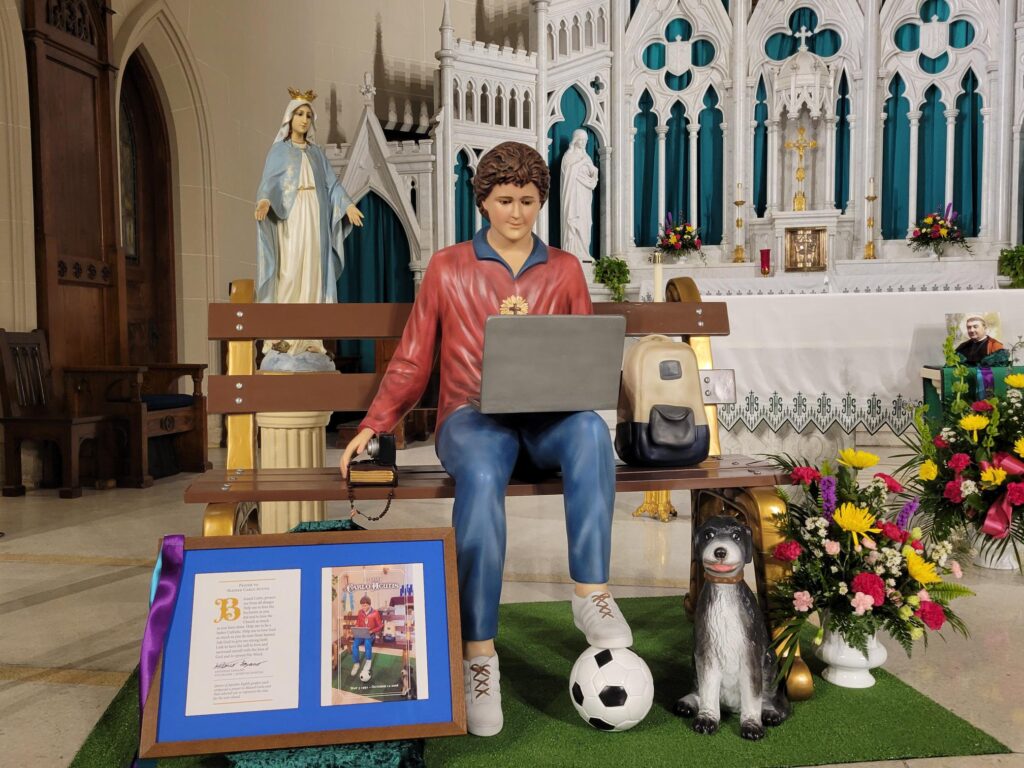
This is the story of a teacher, her junior high students, and the statue of our newest saint in the Catholic Church who will be canonized by Pope Leo on September 7.
The teacher is Sister Frances Marie Penwell, a Sister of Notre Dame in Toledo, Ohio. Sister, a teacher for over 40 years, currently teaches 8th grade at Queen of Apostles School in Toledo. Two years ago she was teaching a unit on the Saints and introduced her students to a 15-year-old boy, Carlo Acutis from Milan, who was going to be canonized. The more her students learned about him, the more intrigued and excited they became. Why?

First, Carlo seemed like a “normal” kid. He wore jeans and sneakers, loved soccer and his dog, and played video-games. By all accounts he was an “average” student, but he had a uncanny knack for computers and excelled in programming. When his pastor asked Carlo to create a website for their parish, he did. When he entered a national contest to design a computer program to encourage volunteering, he won the contest. His friends said he wasn’t “pious,” but he was very kind to people and he had a big heart for the poor.
Carlo also loved his faith. He loved the Eucharist, saying, “The Eucharist is my highway to heaven.” He designed computer programs to promote devotion to the Eucharist. He loved Mary and designed a website for the Marian apparitions approved by the Church. In 2006 when he was only 15, he suddenly became very ill, was diagnosed with acute leukemia, and died within a short time. He had a devotion to St. Francis of Assisi and was buried there as he wished.
Sister Frances’ students liked Carlo so much they asked if they could raise money to buy a statue of him for their school. But they soon learned no such statue existed. So they decided to commission an artist to create a statue of him. When they found out how much such a statue would cost, they redoubled their efforts to raise money. Through their hard work and the generosity of many donors (including even the artist), they raised the money. What’s more, the students had input in designing the statue. It is a life-size image of Carlo sitting on a bench with his computer on his lap. He’s wearing jeans and a red shirt with a symbol of the Eucharist on it. The statue also includes a soccer ball, his dog, his backpack, and his Bible, rosary, and camera on the bench beside him.
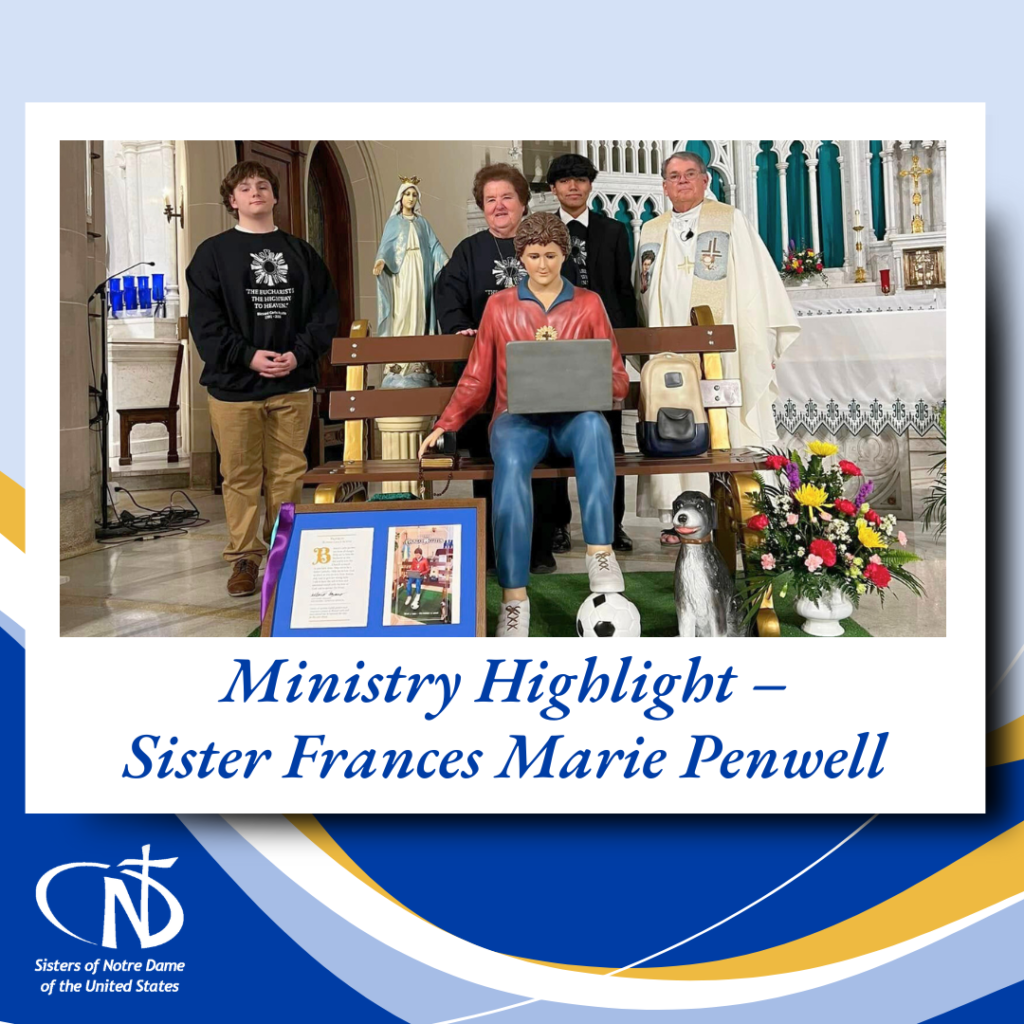
Sister had her students write a prayer to Carlo. Then the class voted on the best one, and it was printed on cards with a photo of the statue on the front. The cards were distributed at the dedication of the statue in Immaculate Conception Church. The students had decided the statue should not be in their school, but rather in the church where they celebrate their school masses. More people could see it that way. To learn more about Carlo, just search his name online and you’ll find many websites and articles. Also watch the news about his canonization on September 7. He’s being canonized with another young man, 24-year-old Pier Giorgio Frassati. Pope Francis was scheduled to canonize both Carlo and Pier, but died before he could do this. So these two canonizations will be Pope Leo’s first ones.
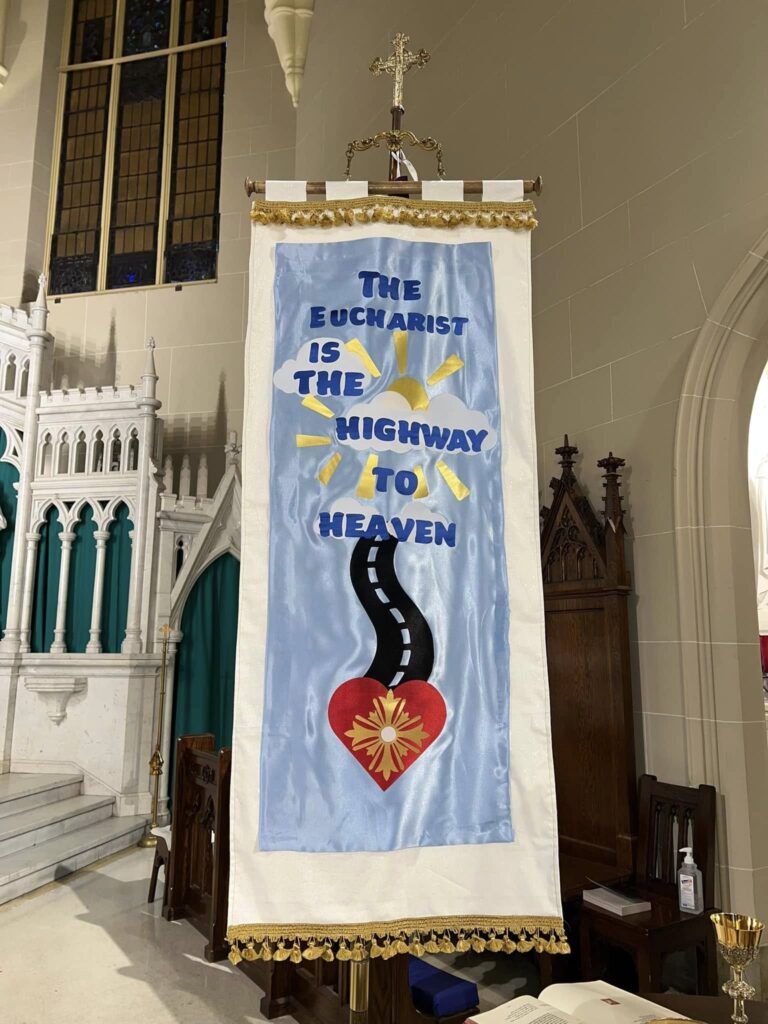
But that’s not the end of the story. Thanks to student-led fundraising, Sister Francis and 6 of her former students are making a pilgrimage to Assisi from July 28 to August 4. Fundraisers and donations are paying for those 6 students. What a special way for Sister to celebrate her Golden Jubilee—in the city of her patron saint, St. Francis. What’s more, the group will have the privilege of celebrating Mass together at Carlo’s tomb.
Carlo is being called our first millenial saint and our new “Cyber Apostle.” He once said, “To always be close to Jesus, that’s my life plan.” Sounds like a beautiful life plan to me! I want to thank Sister Frances for sharing this story with me. What a remarkable teacher she is. In a recent interview, she said she “firmly believes that when young people connect deeply with saints, their faith flourishes in tangible ways.” Let us close with the prayer composed by one of her students, Antonio Lozana:
Saint Carlo, protect me from all danger. Help me to love the Eucharist as you did and to love the Church as much as you have done. Help me to be a better Catholic. Help me to love God as much as you do from heaven. Ask God to give me strong faith. I ask to have the will to love and surround myself with the love of God and spread His Word. Amen.
Did anything stand out for you in this reflection or touch your heart?
Why do you think Sister’s students were so intrigued by Carlo?
Do you have a particular saint that you are inspired by or you pray to? Why do you like this particular saint?
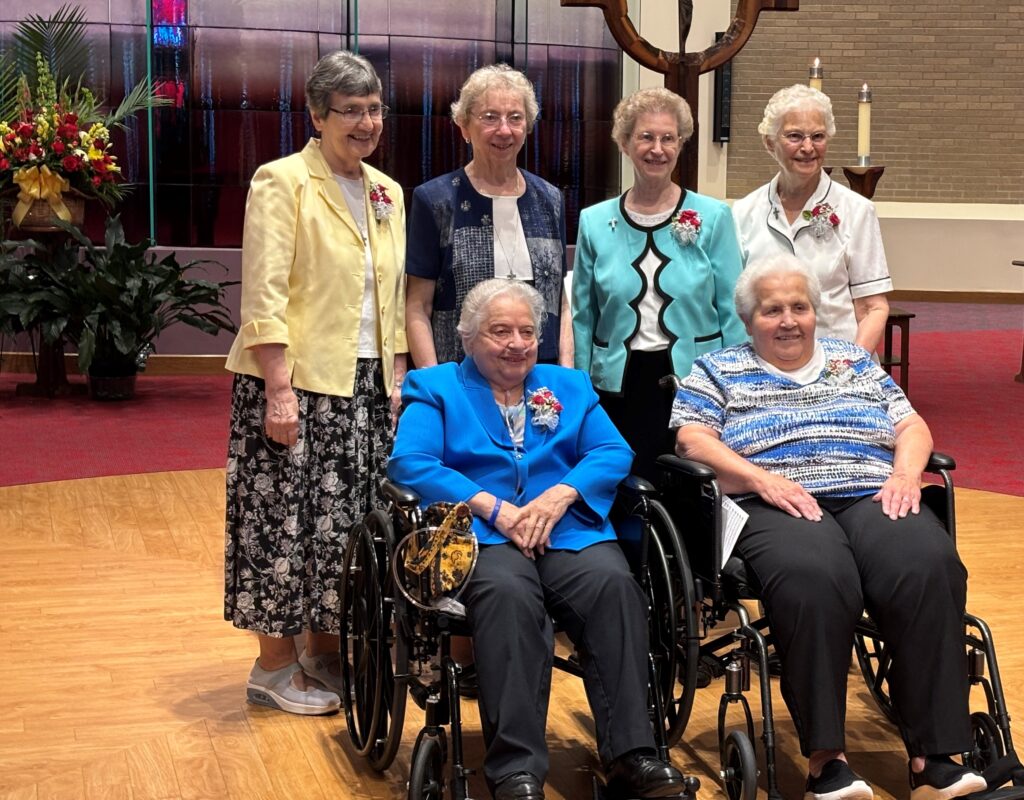
PS: Here’s a picture of the sisters in my “vow group” who are celebrating our 60th anniversary: L to R: seated: Sisters Marilyn, Mary Jo; standing me, Sally, Joanne, and Pat. How much these women mean to me!
Over the centuries, many beautiful Eucharistic hymns have been written. Today I’m offering a 19th Century Hymn “Jesus My Lord, My God, My All” by Frederick Faber. Perhaps some of you are familiar with it.
I invite you to contribute a comment below. Many thanks!