The Teacher, Her Students, and the Statue of Our Newest Saint
This is the story of a teacher, her junior high students, and the statue of our newest saint in the Catholic Church who will be canonized by Pope Leo on September 7.
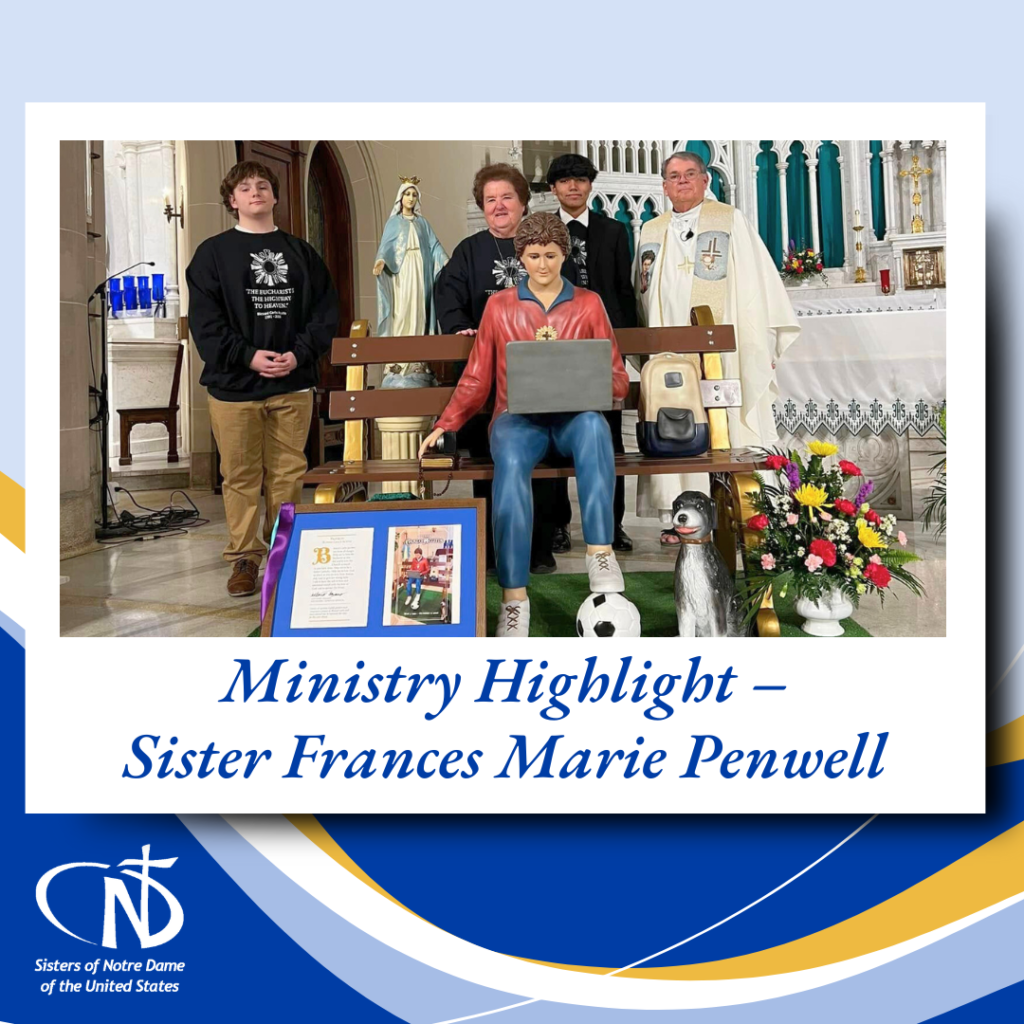
The teacher is Sister Frances Marie Penwell, a Sister of Notre Dame in Toledo, Ohio. Sister, a teacher for over 40 years, currently teaches 8th grade at Queen of Apostles School in Toledo. Two years ago she was teaching a unit on the Saints and introduced her students to a 15-year-old boy, Carlo Acutis from Milan, who was going to be canonized. The more her students learned about him, the more intrigued and excited they became. Why?
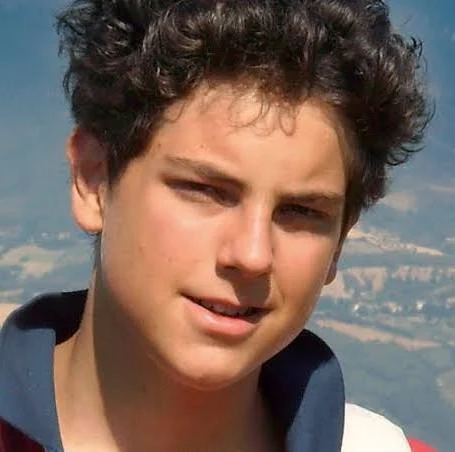
First, Carlo seemed like a “normal” kid. He wore jeans and sneakers, loved soccer and his dog, and played video-games. By all accounts he was an “average” student, but he had a uncanny knack for computers and excelled in programming. When his pastor asked Carlo to create a website for their parish, he did. When he entered a national contest to design a computer program to encourage volunteering, he won the contest. His friends said he wasn’t “pious,” but he was very kind to people and he had a big heart for the poor.
Carlo also loved his faith. He loved the Eucharist, saying, “The Eucharist is my highway to heaven.” He designed computer programs to promote devotion to the Eucharist. He loved Mary and designed a website for the Marian apparitions approved by the Church. In 2006 when he was only 15, he suddenly became very ill, was diagnosed with acute leukemia, and died within a short time. He had a devotion to St. Francis of Assisi and was buried there as he wished.
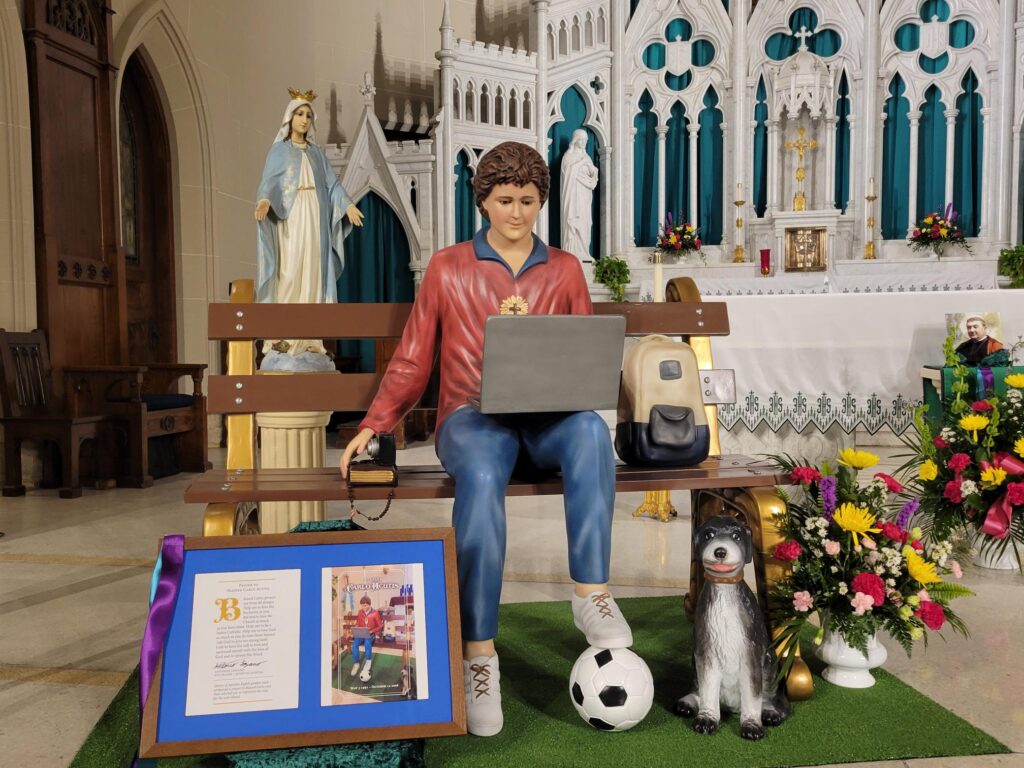
Sister Frances’ students liked Carlo so much they asked if they could raise money to buy a statue of him for their school. But they soon learned no such statue existed. So they decided to commission an artist to create a statue of him. When they found out how much such a statue would cost, they redoubled their efforts to raise money. Through their hard work and the generosity of many donors (including even the artist), they raised the money. What’s more, the students had input in designing the statue. It is a life-size image of Carlo sitting on a bench with his computer on his lap. He’s wearing jeans and a red shirt with a symbol of the Eucharist on it. The statue also includes a soccer ball, his dog, his backpack, and his Bible, rosary, and camera on the bench beside him.
Sister had her students write a prayer to Carlo. Then the class voted on the best one, and it was printed on cards with a photo of the statue on the front. The cards were distributed at the dedication of the statue in Immaculate Conception Church. The students had decided the statue should not be in their school, but rather in the church where they celebrate their school masses. More people could see it that way. To learn more about Carlo, just search his name online and you’ll find many websites and articles. Also watch the news about his canonization on September 7. He’s being canonized with another young man, 24-year-old Pier Giorgio Frassati. Pope Francis was scheduled to canonize both Carlo and Pier, but died before he could do this. So these two canonizations will be Pope Leo’s first ones.
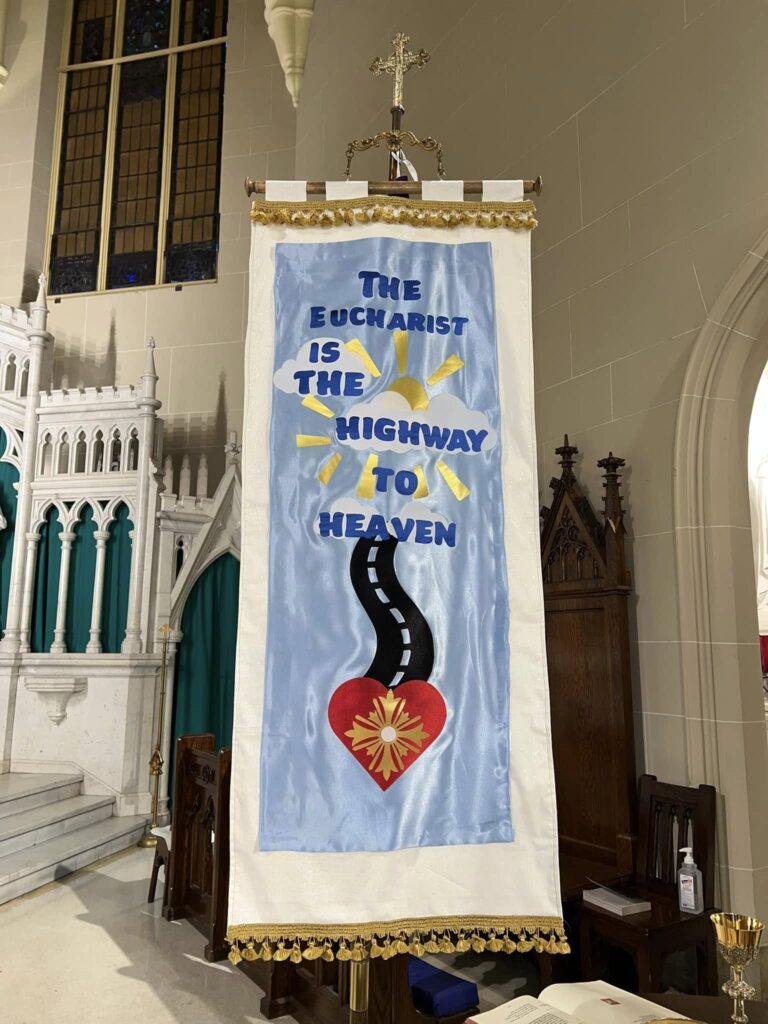
But that’s not the end of the story. Thanks to student-led fundraising, Sister Francis and 6 of her former students are making a pilgrimage to Assisi from July 28 to August 4. Fundraisers and donations are paying for those 6 students. What a special way for Sister to celebrate her Golden Jubilee—in the city of her patron saint, St. Francis. What’s more, the group will have the privilege of celebrating Mass together at Carlo’s tomb.
Carlo is being called our first millenial saint and our new “Cyber Apostle.” He once said, “To always be close to Jesus, that’s my life plan.” Sounds like a beautiful life plan to me! I want to thank Sister Frances for sharing this story with me. What a remarkable teacher she is. In a recent interview, she said she “firmly believes that when young people connect deeply with saints, their faith flourishes in tangible ways.” Let us close with the prayer composed by one of her students, Antonio Lozana:
Saint Carlo, protect me from all danger. Help me to love the Eucharist as you did and to love the Church as much as you have done. Help me to be a better Catholic. Help me to love God as much as you do from heaven. Ask God to give me strong faith. I ask to have the will to love and surround myself with the love of God and spread His Word. Amen.
Did anything stand out for you in this reflection or touch your heart?
Why do you think Sister’s students were so intrigued by Carlo?
Do you have a particular saint that you are inspired by or you pray to? Why do you like this particular saint?
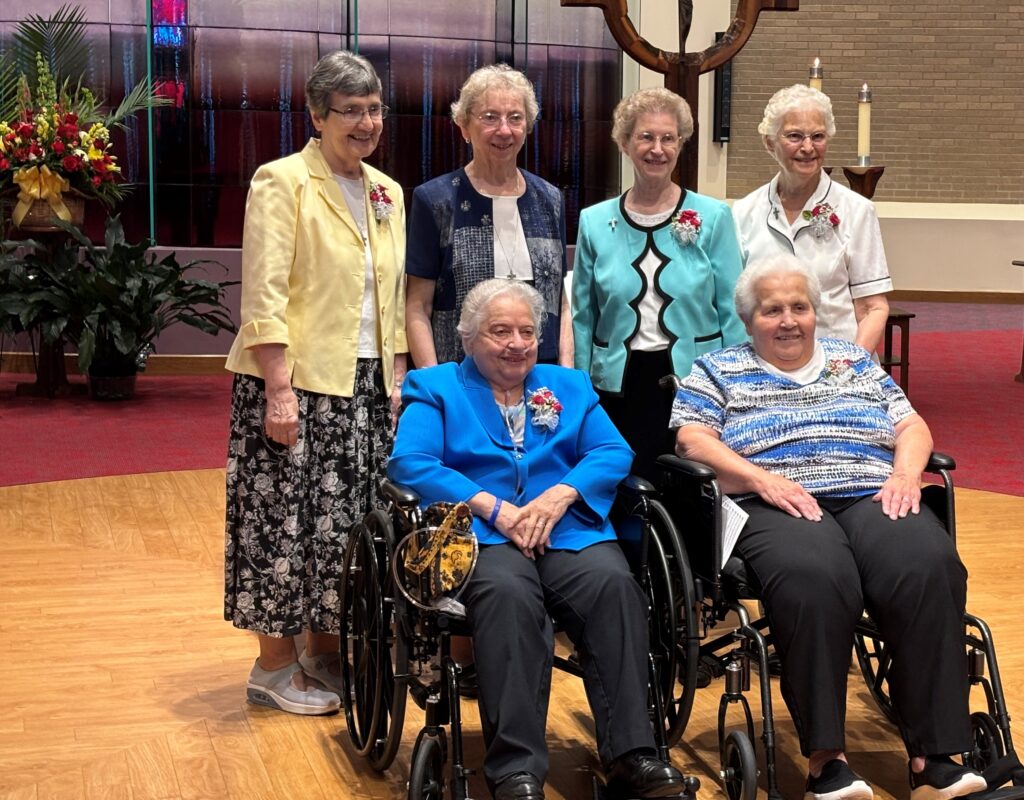
PS: Here’s a picture of the sisters in my “vow group” who are celebrating our 60th anniversary: L to R: seated: Sisters Marilyn, Mary Jo; standing me, Sally, Joanne, and Pat. How much these women mean to me!
Over the centuries, many beautiful Eucharistic hymns have been written. Today I’m offering a 19th Century Hymn “Jesus My Lord, My God, My All” by Frederick Faber. Perhaps some of you are familiar with it.
I invite you to contribute a comment below. Many thanks!
Why Is Church Membership Plummeting in the U.S?

It’s no secret. Church membership has fallen significantly in the U.S. within the past 50 years or so. I am basing the information in today’s blog on three sources: recent Gallup Polls, Pew Research findings, and an article in the Spring 2025 issue of Notre Dame Magazine entitled “Out of Practice.” It is Ken Woodward’s interview with Christian Smith, Professor of Sociology at Notre Dame, about his new book Why Religion Went Obsolete: The Demise of Traditional Faith in America. You might be thinking, “This sounds pretty ‘heady’ to me or even ‘very depressing.’ Why would I want to read this?” Here are two reasons. First, because we are called to be disciples of Jesus in the “real world”–not some La La Land. If these statistics reflect something that is happening in this real world, especially in our country, then shouldn’t we know about it? Second, as Christians, as Catholics, we believe that God is active and alive in this real world–even when God’s activity may seem hidden. A good question to ask ourselves: What might God be directing us to do through these findings?
I’m not giving you a summary of the recent research and polls. You can check those out online yourself. Instead I’m presenting a few select findings–and I’m encouraging you to reflect on and/or react to them. You can be shocked or curious, or you might want to measure these findings against your own experience, or ponder the implications of these findings for your own life of faith. Here goes.

Over the years, Gallup Polls have asked people: Are you a member of a church, synagogue, or mosque?
- In 1975, 71% said yes.
- In 1999, 70% said yes.
- In 2020, 47% said yes.
- The answer to that question was correlated to age. Who answered yes to that question?
- 66% of the people born before 1946.
- 58% of baby boomers (born between 1946-1964)
- 50% of Generation X (born between 1965-1980)
- 36% of Millennials (born between 1981-1996)
A 2021 Gallup Poll showed that 7 out of 10 people said they were affiliated with some type of organized religion. Less than half, however, were affiliated with a particular house of worship. Said the poll, “Churches are only as strong as their membership and are dependent on their members for financial support and service to keep going.” It is estimated that thousands of churches close each year in the U.S.
People were asked, Why do you attend a particular house of worship regularly? Their main answers were: because of the sermons… because of the sports programs geared to children and teens… because of the community outreach and volunteer opportunities… because of the dynamic leadership within the particular house of worship.
Pew Research Poll has regularly asked people if they pray daily. Since 2012, the percent of people who say yes has remained consistent at 44% to 46%.

Of special interest to Catholics: In 1970, weekly Mass attendance was 55%. Today it is 20%. Even though Mass attendance has declined, the percent of people who identify themselves as Catholic has remained relatively stable since 2014 at 20%. But here’s a statistic that raises a question about that “stability.” For every 100 people who come into the Catholic Church annually, 840 leave. How can that percent remain about 20%? One word: immigration. A significant number of immigrants are Catholic, so statistically they are taking the place of those Catholics who are leaving the church. (One wonders what impact our current changes in immigration will have on this statistic.)
Decrease/ increase in church members since 2007: Catholics decreased by 20%. Protestants by 21%. Religious “nones” (those not affiliated with any church) increased by 81%. Muslims increased by 200%. Muslims are still a small percent of the entire population: 1.2%.
Now let’s turn to that article on Christian Smith’s book to answer the question: what are some of the reasons for the decline of church membership in the U.S.? He gives basically three: 1) certain historic events, 2) scandals among clergy and the politicization of evangelical Christianity, 3) the digital revolution which “transformed society, weakening social structures, altering the nature of relationships and turning the fissures already forming within many denominations into outright fractures.” Here are some specific sentences from the interview with Smith.
“September 11, 2001 made many Americans begin to associate “orthodoxy of all kinds with with zealotry and violence.” For many, religion “went from being ‘a nice community thing, it helps raise your children to be moral,’ to “Religion is violent, it’s a source of evil, it gets people to be extremists.”
Women entering the work force had a great impact on traditional churches. Prior to the 70’s, churches relied on women as their main “volunteer labor force.” But women working full-time jobs and coming home to do the housework and cooking, and caring for the kids, “don’t have the time or energy to invest seriously in church.”
Many churches are oriented towards serving the traditional nuclear family. But people who are not in traditional families–“singles, divorced, same-sex couples, people cohabitating, people without children, older couples” can feel uncomfortable, left out, or unwelcome.

Says Smith, there’s so much pressure on parents these days to get their kids “scheduled up” every afternoon and evening: sports practices, sports games, dancing lessons, horseback riding lessons, swimming lessons, helping with homework, sending kids to camps of all kinds. All of these other activities “crowd out religion.”
“People have so much drive and pressure to earn incomes, to go out and spend money, to buy things, to have experiences. It changes the notion of self; the good life becomes the goods life.”
For reflection:
Did anything “jump out at you” in today’s reflection?
Does anything raise questions for you?
If you are a member of a church, synagogue, or mosque, what makes you stay?
If you are no longer a member of a church, mosque, or synagogue, what made you leave?
Did anything here resonate with your personal experience–or seem foreign to your personal experience?
In all this talk about church membership, we must not overlook the essence of our faith: our personal, loving relationship with God. This relationship with God fuels our love for others and for our world. At its best, our membership with a particular church enables us to bond with other members, strengthens our faith, and encourages us to reach out to those in need. Our song today is “Christ Before Us.” It is a traditional Welsh melody with words written in 1990 by Janet Sullivan Walker. I find her words beautiful: “Christ before and beside us to guide us… we strive to live Jesus’ law of kindness, love, compassion, charity… Holy Three in One, come and be our welcome guest… send us to labor for Your Kingdom…”
I eagerly invite your comments below–whether a few words or a few sentences…
Who Is God? What Is God Like?

Some say the two most important questions we can ask in life are these: “Who is God?” And “What is God like?” These are questions we may ponder our entire life. To see how others have responded to one or both of these questions, I consulted my boxes of quotations under the tab “God.” I selected these 20 “answers.” I hope they might stimulate your own reflection on these two vital questions.
1. God has given us three speeches: Creation, Scripture, and the Incarnation. Hans Urs von Balthasar, Swiss theologian
2. Just as God is our Father, God is also our Mother.” Julian of Norwich, 15th Century mystic
3. You can safely assume that you’ve created God in your own image when it turns out that God hates all the same people you do. Anne Lamott
4. A short definition of God: God is an interruption, an experience which ruptures the surface of the commonplace to reveal new intensities, new splendors and terrors, new possibilities within us. Veronica Brady
5. I used to ask God to help me. Then I asked if I might help God. Hudson Taylor

6. While in Mexico, writer Megan McKenna brought lunch for a half dozen street urchins. Before eating the lunch, one boy prayed this grace aloud: “God is great. God is good. God lives in this neighborhood.”
7. I sought Thee at a distance, and did not know that Thou wast near. I sought Thee abroad, and behold Thou wast within me. St. Augustine
8. The best way to know God is to love many things. Vincent van Gogh
9. Home is the definition of God. Emily Dickinson
10. Authentic spiritual language does not confuse the map with the territory, the symbol with the thing…You can starve to death trying to eat a cookbook. Sam Keen

11. God works in strange ways, permitting an infinite number of itineraries on the way to Him. Doris Grumbach
12. We turn to God when our foundations are shaking, only to find that it is God who is shaking them. Charles West
13. With God go over the seas. Without God, do not go even over the threshold. Russian proverb
14. God almost never does things exactly as we expect. Demetrius Dumm, OSB
15. The best word for God is mystery. Richard Rohr


16. God is really only another artist. He invented the giraffe, the elephant, the cat. God has no style. He just keeps trying other things. Pablo Picasso
17. God is here and God is speaking—these truths are in back of all the Bible truths. A.W. Tozer
18. We can’t sin more than God can forgive. Lavonne Neff
19. We ask God, “What are you like?” And God gives us the story of Jesus. Jesus is the parable of God. James Martin
20. God is always just a little in front of us on the road of life. He is looking back at us and saying, “Come on.” God knows the way. We have a chance every day to say, “OK, I’m coming.” (Anonymous)
For reflection:
Did any of these quotes really speak to you today? If so, which one(s)?
Did any of these quotes surprise you? shock you? disturb you? comfort you?
Would you like to add another quote below?
What answers would YOU give to either or both of these questions?
P.S. This past week, our U.S. province of the Sisters of Notre Dame together with some of our Associates and lay staff, met for 3 days in Columbus, OH. About 200 of us were able to be present. Many others watched the live-streaming of this wonderful event. We listened to some fine speakers; reflected on our past, present, and future; engaged in small group discussions; experienced beautiful prayer and Mass together; ate great food; and enjoyed time getting to know each other better and to have some fun together too. Some of us even had our picture taken as a sunflower!

Our song is Bernadette Farrell’s “God, Beyond All Names.” It reminds us that all our words or names for God fall far short of who God is and what God is like.
I welcome you to share a comment with us below.
Praying for Refugees

Today we are going to reflect on and pray for one of the major crises in our world today: refugees. In fact, some historians predict that this current century will go down in history as “The Century of Refugees.” We will begin with a few facts, then listen to a song with lyrics, then pause in silence for a few moments, then listen to a second version of the same song with film clips of refugees. Then we will close with a short prayer.
First a few facts about refugees in our world today. Most of these statistics are from the United Nations:
+ In 2024 there were an estimated 43.7 million refugees in the world…
+ Most are fleeing extreme poverty, persecution, war and violence, natural disasters, and the effects of climate change…
+ 40%-60% of refugees are children under 18. That’s about 22.5 million children…
+ Low and middle income countries host 76% of the world’s refugees. The three countries hosting the most refugees are Iran, Turkey, and Colombia…
+ The largest refugee camp is Kutupalong refugee camp in Bangladesh which hosts more than 880,000 refugees. Most of them have fled Myanmar in 2017 due to ethnic and religious persecution.
+ The greatest challenges for refugee camps are providing food, shelter, and education for the children…
+ The average time spent in a refugee camp is between 10-17 years…
+ “Seeking asylum is a human right”…from the United Nations “The Universal Declaration of Human Rights” adopted in 1948.

Our first video is the song “A Safe Place to Land” sung by Sara Bareillis and John Legend. This lyric video allows us to focus on the words of the song, a song written to raise awareness of our global refugee crisis…
Pause for a few moments to recall some of the words of the song:
… when you can’t hide by closing your eyes… when home is the belly of the beast…
when hope is all you have…
surely someone will reach out a hand and show you a safe place to land…
Be the hand of a hopeful stranger… be the light in the dark of this day…
till the sun comes up… till the sun comes up.
Shortly after becoming Pope, Francis made his first pastoral visit to the small Sicilian island of Lampedusa in the Mediterrainian Sea. It was where thousands of refugees from North African came ashore in small boats, many of them drowning in the attempt. Pope Francis put the refugee crisis at the heart of his pontificate. At Lampedusa he lamented “the globalization of indifference” to this crisis and the causes of it. After his visit, Francis brought 12 Syrian refugees to Rome, housing them in the Vatican where they could begin to be processed.
Here is the same song–only this time we will see boatloads of refugees landing on what I believe is Lampedusa.
Let us pray: Loving God, we pray for all those who have had to flee their homes for whatever reason… And we pray for those who reach out their hands to them when they come ashore or cross a border or beg asylum… We pray for those people forced to live in refugee camps all over the world. And we pray for those who work tirelessly to provide them with food and shelter and help them to find asylum in various countries. We pray especially for the children that they might be cared for with tenderness and be given the opportunity to go to school again and to smile and play again.
We pray for those working to eradicate the causes of our global refugee crisis. Bless them with compassion, knowledge, courage, persistance, and hope. And finally, we ask you to show us how we too may reach out to these refugees, our brothers and sisters–whether through our prayer, our donations, our advocacy, our volunteering. We ask these things through Jesus, our brother, who calls us to “welcome the stranger.” And we ask these things through the power of your amazing Holy Spirit. Amen.

For reflection: Did anything in today’s reflection move you–the facts, the videos, the prayer, the pictures?
Please share a comment below… even if it’s only a few words or a couple of sentences… We love hearing from you.
A Prayer for Spiritual Healing

When we pray for healing, we often pray for healing from physical illnesses of all kinds. But maybe we also need to ask for healing from attitudes and habits that can prevent our faith from being healthy and whole. Here is one such prayer I wrote recently. Perhaps you might find yourself reflected in one or more of these petitions…
Prayer for Spiritual Healing
God of healing and wholeness, aware of those attitudes and habits that interfere with my love for you and others, I ask for your healing:
Heal me from taking the gift of existence for granted…
Heal me from taking my own precious gift of life for granted…

Heal me from the tendency at times to reduce my faith to a project, a set of rules to follow, rather than seeing my faith as a life-long loving relationship with you, with others, and with the world…
Heal me from judging others. Keep reminding me that everyone is carrying heavy burdens and waging battles I do not know anything about…
Heal me from the kind of certainty that shuts doors to greater wonder and knowledge…
Heal me from fears that cripple my ability to do the good you are entrusting me to do during my sojourn here on earth…

Heal me from my need to be right or to win every argument, thus missing out on opportunities for greater personal growth…
Heal me from the need to be in control which can hinder new experiences, surprises, and deeper trust and understanding…
Heal me from a tendency to fear or mistrust those whose faith, culture, skin color, language, and dress may be different from my own…
Heal me from measuring my worth by what I am able to buy and consume rather than what I am able to share with others or give away…
Heal me from a compassion that paralyzes me, from excuses that say, “I’m too old (too young) to get involved… I’m no expert… I’m only one person”…

Heal me from the loss of hope. Help me to believe and say with conviction, that, trusting in you and working with you and others, “A better world is possible!”…
Heal me from rushing around so much, I fail to notice or really engage with the individuals you put into my life every day.
Heal me from my lack of trust in your promises: “The Kingdom of Heaven is in your midst… Fear not, little flock… Behold, I am with you always.”
I ask for these things, Loving God, through the healing power of Jesus and the incredible power of the Holy Spirit. Amen.
For reflection:
Did any petition catch your attention in particular. Do you know why?
Did any picture intrigue you today? Did it say something to you?
Is there anything else you think we need healing from?
I invite you, if you wish, to add another petition in the comments below.
Here’s a song that voices again our prayer for healing. Sung here by Aaron Jeoffrey, it is called simply, “Heal Me.”
I welcome you to add a comment below to connect with all our readers.