Can Curiosity Be a Virtue? Can Questions Be a Grace?
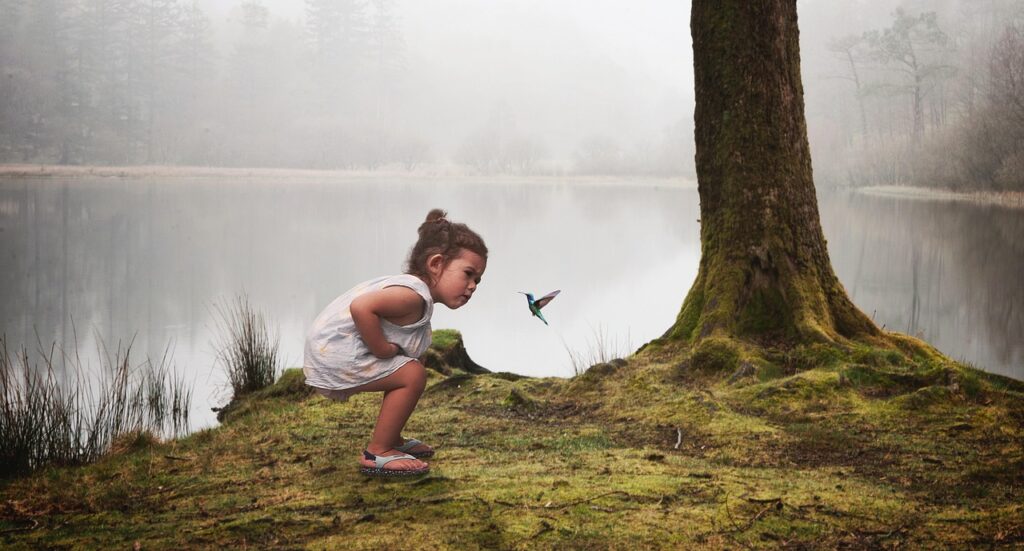
As a little girl, I was curious about many things. As a result, I was always asking questions. Lucky for me, as the youngest in a family of six, I lived with five older people who were a “fount of knowledge” for me: my three older siblings and my parents.
Early on, though, I learned siblings couldn’t always be trusted. Although they often shared their vast knowledge with me, my siblings occasionally tricked me. One day, for example, I refused to eat shredded wheat at breakfast, because my siblings had told me it was burnt string. Mom had to intervene on that one. But both of my parents patiently answered my questions–especially my dad. As far as I was concerned, Dad knew just about everything about everything: science, math, animals, agriculture, mechanics, history. I distinctly remember sitting in the back seat of our car one day going somewhere with my family. Dad was driving. At one point he put on his blinker–which made me ask, “Dad, how do car blinkers work?” Right away he answered my question with something like, “Lights need electricity to go on. The car battery gives the electricity. If the electricity is stopped for a few seconds, the light goes off. The blinker stops and starts the electricity a few times, and the light blinks on and off.” It was enough to satisfy my curiosity.

When I started school, I often asked questions. I had to answer questions too. Later, as a teacher, I was always asking my students questions. And I had to answer their questions too. In fact, I used to welcome my students’ questions–so much so that my students accused me of getting more excited when they asked a question than when they answered one! Yes, I was guilty of that “crime.”
All of these memories drew me to reflect on curiosty–which prompts many of our questions. I have come to believe that curiosity can be a virtue, and questions can be a grace. Even the Bible supports this view. Remember Moses? It was his curiosity about the burning bush that prompted him to leave his sheep and go over to investigate the wonder-filled bush more closely. And when he did WOW! HOLY SMOKES! GOODNESS GRACIOUS! Moses encountered the Living God!

Jesus was curious too. As a twelve-year-old boy he stayed behind in the temple with the wise elders, mostly asking them questions–not how do car blinkers work, but maybe: how does prayer work?… how does scripture work?… how does God work? He probably offered a few answers of his own. When he went back home with his parents, scripture says he “advanced in wisdom.” That implies he retained his curiosity and kept posing questions–even of God. As an adult, Jesus was amazingly curious about many things. This curiosity led to his extensive knowledge in a variety of areas–agriculture, carpentry, baking, wine making, sewing, construction, animals (think chickens, camels, sheep), family relationships, poverty and riches, parties and joys, death and grief, and injustices and goodness of all kinds. Most importantly it gave him wisdom and knowledge of what it means to be a human being AND who God is.

Let us take a few minutes to reflect on our curiosity and our questions today. We can begin by asking ourselves: What am I curious about? What questions do I harbor in my heart? What are some of the BIG questions I have FOR God… or ABOUT God?
We will never have all our questions answered, of course. That’s why I always appreciated what the poet Rainer Maria Rilke wrote:
Be patient with all that is unsolved in your life
and try to love the questions themselves,
like locked rooms and like books that are now written in a very foreign language.
Live the questions now.
Perhaps you will then gradually, without noticing it,
live along some distant day into the answer.

For reflection:
On a scale of 1-10, 1 meaning almost none and 10 meaning VERY much, how much curiosity do you have?
At this time in your life, what are you curious about? What questions are you asking?
Has a question ever been a grace for you? If so how?
What are some of the BIG questions you have ABOUT God and/or FOR God?
PS: Thank you for your prayers for the zoom retreat I was privileged to lead for the Mercy Sisters in Buffalo. And I thank those Sisters for warmly welcoming me into their dining room each day. I especially thank my contact person, Sister Peggy, for all the work she did in organizing us and running the technology. Peggy is a self-described “belts and suspenders” kind of gal! I enjoyed working with her!
This is a song by a young singer/songwriter from Kampala, Uganda named Suubi Namubiru who calls herself “a child of God.” As a little girl, she was a ballerina. But then someone in her church asked her to audition for singing in church. She did. When you hear her sing, you will be glad that she said “yes” to that request. This song, “All Knowing God,” is about being in the wilderness, not a pleasant place to be. We may find ourselves in the wilderness right now. But the words that struck me in this song were: “God, you are enough for me… Life will grow in this place of thorns and briars… He who promised is faithful.” With mesmerizing simplicity, clarity, and poetry of expression, the song exudes hope, peace, and trust in our all-knowing God. I’d love to know what you think of it…
I invite you to leave a comment below… about the reflection itself… the questions… the pictures… or the video…
Praying with Someone Else’s Words
When we pray, should we use our own words or someone else’s words? I believe the short answer is both. There are times we use own words and times when we use the words of others. In addition, there are times when we pray with no words–as when we sit in silence and awe, or when our tears or even dance become our prayer. But in this reflection, we will explore some of the values in praying with someone else’s words.
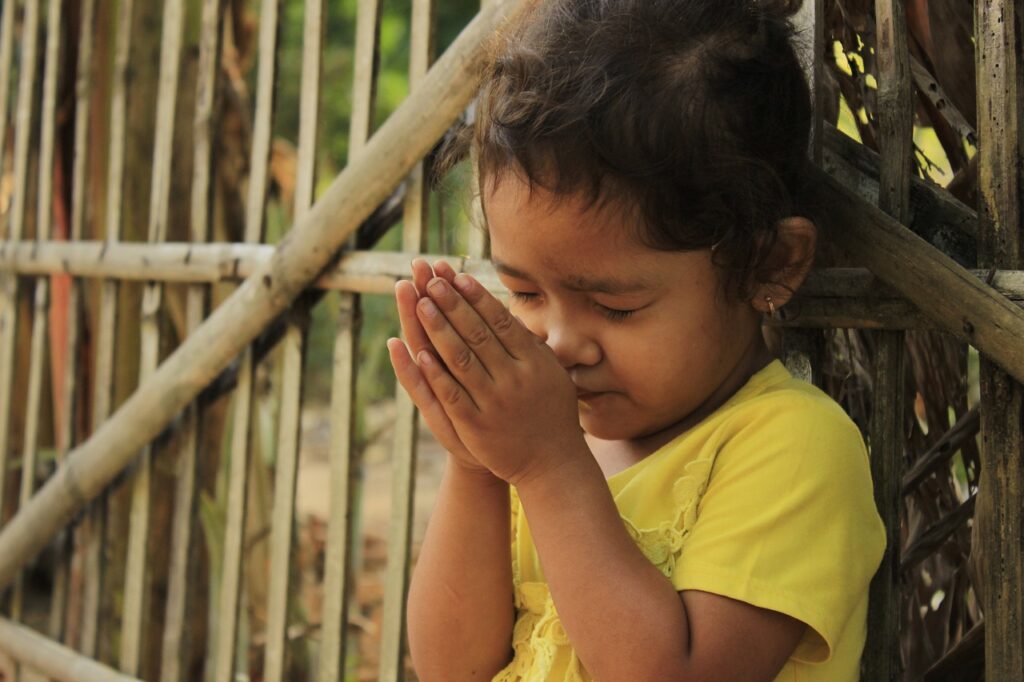
As little children, we might have been taught to pray to God in our own words: “God bless Mommy and Daddy and Fido… God, make Grandma not sick anymore… Jesus, don’t let it rain on my birthday party tomorrow.” But probably we were also taught some traditional “already-made” prayers–like the Our Father, given to us by Jesus himself. Maybe we learned other prayers as well: the Hail Mary, “Now I lay me down to sleep,” or “Angel of God, my guardian dear.”
When we pray at Mass, we are using mostly the words of others. At most liturgies, only the offertory petitions are not prescribed. At the Sunday Mass, even those petitions may be written by someone else. At our liturgies here at our SND center, several sisters take turns writing our petitions. The petitions are excellent–expressing in beautiful language the needs of our local, national, and world communities. I find them very prayerful. (special thanks to those Sisters!) At weekday Masses in some parishes, the congregtion is invited to add their own petitions spontaneously. From various parts of the church, you will hear petitions like, “For the healing for my father… for people suffering from addiction… for world peace.”
So what is the value of praying with someone else’s words? Here are four values:
Formal prayers can unite us to others. There’s a power in praying along with others in the words we all read together or know by heart–for example, praying the Our Father at Mass. It is a great sign that, despite our many differences (just look around the congregation!), we are united in our faith. So too, when we pray the “Lamb of God” together, we are joined with other believers–not only those at our particular Mass, but also those countless individuals all over the world who are praying the same words, each in their own language.
Traditional prayers unite us with Christians who came before us. These days there is a keen interest in ancestry. Reciting traditional prayers unites us with our ancestors in the faith. The Hail Mary, for example, is a prayer from the 6th century. Every time we utter this prayer we are united with our fellow believers from the past fifteen centuries. Fifteen! There’s a strength and consolation that comes with that knowledge. We are not alone in our faith. Praying the Hail Mary helped believers in the past to face their struggles and pains. That same prayer can help us face the challenges of our own times.

To constantly come up with our own words in prayer can be exhausting. Years ago, I lived in a large community of about 50 sisters where we took turns planning our daily liturgies. One day this note appeared on the chapel door for every sister to read as she came for Mass. “Today’s petitions are spontaneous. Please be prepared.” I laughed! I thought, “Even our spontaneity must be prepared?” But the sister who wrote the note was acknowledging that coming up with a petition on the spot, expressing it in good, clear English, and then reciting it aloud–all of that takes energy. Stanley Hauerwas, an advocate for praying other people’s prayers, writes that our religion “is constantly under the burden of re-inventing the wheel and you just get tired.” When we go to Mass or recite the Divine Office, we don’t have to start from scratch. The prayers are there. So too are the prescribed scripture readings and psalms. He concludes, “There’s much to be said for Christianity as repetition.”
Other people’s prayers can expand the width and depth of our own prayer. When we’re searching for a birthday card for a loved one, we look for a card that comes close to saying what we want to say. We rejoice when we find one. But sometimes we are lucky enough to find a card that says BETTER what we’re trying to say. By sending that card, we make the words on that card our own.
In her book, Prayer in the Night, Tish Harrison Warren, an Anglican priest writes, “Inherited prayers and practices of the church tether us to belief, far more securely than our own vacillating perspective or self-expression… When my strength waned and my words ran dry, I needed to fall into a way of belief that carried me. I needed other people’s prayers.” And lucky us! Often we can make the words of others our own!
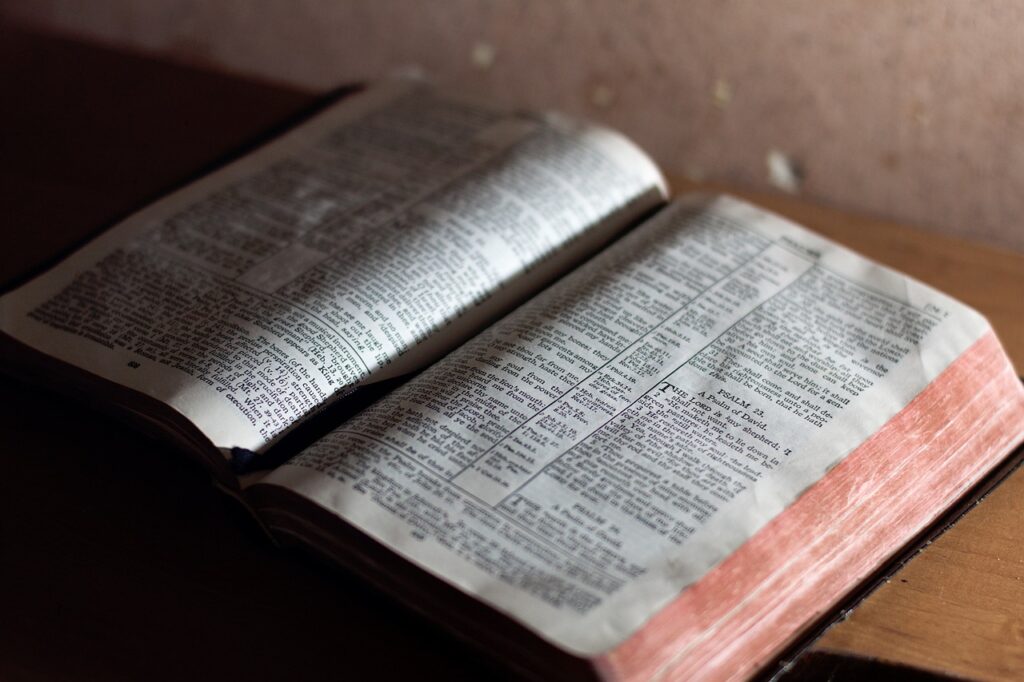
I’ll conclude this reflection with a few short prayers of others that I particularly liked:
Here’s a prayer-poem by Christina Rossetti (1830-1894):
Lord, purge our eyes to see / Within the seed a tree.
Within the glowing egg a bird/ within the shroud a butterfly:
Till taught by such, we see / Beyond all creatures Thee:
And hearken for Thy tender word, and hear it, “Fear not: it is I.”
From Gregory of Nazianzus (325-390):
The morning breaks, I place my hand in Thine,
My God, ’tis Thine to lead, to follow mine.
“Awaken Us” – from Catholic Relief Services (contemporary):
Lord of all hopefulness, awaken us.
Show us the meaning in our toil / That we may ever rejoice in the promise of the seeds we sow.
Lord of all hospitality, awaken us. / Show us the refuge of eagles’ wings
That we may always be people of shelter in times of storm.
Lord of all freedom, awaken us.
Show us the courage that called our forefathers out of bondage.
That we may always stand with the bound and the oppressed, and be their companions.
Lord of all charity, awaken us.
Teach us of the unending return on our sacrifice / That we may rejoice more fully in our giving. Amen.
For reflection:
Do you use your own words in prayer, the words of others, or both? What determines which words you use?
Have you ever experienced strength or connectedness as you prayed aloud the same prayer with others?
Do you have any prayers composed by others that you like to say often? Which prayer(s) and why? Would you like to share the titles of those prayers with us below and/or a few words from the prayer?
PS #1: I ask your prayers for a zoom retreat I am leading this week for the Sisters of Mercy in Buffalo, NY. The retreat focuses on hope and runs from Sunday evening to Friday about noon. I will let the retreatants know you are praying for them. Thank you very much!
PS #2: Some have asked where I’ll be giving retreats that are open to the public. I’ll be in Rochester, MN May 15-21 leading a retreat at Assisi Heights Spirituality Center . This retreat is both in-person and livestreamed on Zoom. In addition, it is divided into two parts: Part I is Thursday May 15 evening to Sunday May18 noon; Part II is May 18 evening to Wednesday May 21 noon. There are two conferences per day: 9:00 AM and 3:00 PM (Central Time). You can sign up for either part or both parts of the retreat. Check the Retreat Center’s website for details: www.rochesterfranciscan.org. Click “News” and then “2025 retreats.” Or call: 507-282-7441.
July 13-20, 2026 I will be giving an in-person retreat at Our Lady of the Snows Shrine in Belleville, IL located about 18 miles east of St. Louis. You can check out their website, but details about my retreat probably won’t be listed until after January 1, 2026: [email protected].
Our video today is a beautiful prayer set to music. The poem was written by St. John Henry Newman (1801-1890), “Lead, Kindly Light.” The singer is Audrey Assad. I’ve used this song before, but it is one of my favorite prayer/poem/songs. And, since I write this blog, I get to pick the songs!… I hope it moves your heart as it moves mine…
I invite you to write a comment below–either to initiate the conversation or add to it! Many thanks! (PS: I do welcome suggestions for songs and videos…)
Bearing the Yoke of Jesus
As many of you know, I write occasionally for Give Us This Day, a wonderful and inspiring monthly booklet published by Liturgical Press. Each issue contains the daily Mass readings complete with reflections by authors both ancient and contemporary. Each reflection is limited to 250 words. Today I’m sharing my reflection for Dec. 13, 2023 on Mt. 11: 28-30:
Jesus said, “Come to me, all you who labor and are burdened, and I will give you rest. Take my yoke upon you and learn from me, for I am meek and humble of heart; and you will find rest for yourselves. For my yoke is easy, and my burden is light.”
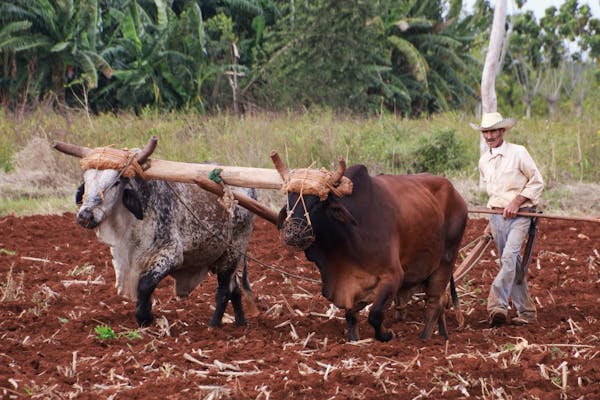
Jesus knew a lot about yokes. Joseph probably made yokes as part of his carpentry work. If so, he would have taught Jesus the art of making good yokes. Select sturdy wood, but not too heavy as to weigh the animal down. Then fit the yoke to each animal. This means measuring the animal’s shoulders, neck, and height from head to hoof. A good yoke eases the animal’s burden. Double yokes enable two animals to work side by side as a team.

Jesus knew about yokes in scripture too. He knew the yoke was a frequent symbol of bondage. His listeners would have known that too. But when Jesus speaks of the yoke in today’s gospel, he gives this old metaphor a new twist: “Take my yoke upon you and learn from me… for my yoke is easy and my burden is light.” My yoke, he says. Take it willingly. My yoke is not a yoke of bondage. It is a yoke of bonding. I will teach you how to bear it. In fact, I will bear the yoke with you.”
Recently, a catechist in Chile told this story. She was teaching a small group of Christians in a rural area. At one point she asked them, “What is your favorite image of God?” One farmer said, “For me, God is the other oxen. We talk to each other every day as we plow the field. The yoke is light when I carry it with my God.”
What burdens are you carrying right now? Are you carrying them with Jesus by your side?

For reflection:
Did anything stand out for you in this reflection. If so, what and why?
Do you talk to God every day–and even throughout your day?
What is your favorite image of God? Why?
If you knew nothing else about Jesus except these words above, what are some of the things you might conclude about the kind of person he was?
PS: International Women’s Month is celebrated in March in the U.S., U.K., and Australia. In Canada it’s celebrated in October. The photo and quote below are posted here in honor of this month’s celebration.

Our video is “Come unto Jesus” by Laura Story, Jordan Kauflin, and Keith and Kristyn Getty. I loved the lyrics of this song, fashioned from Jesus’ own words. And I also loved the stunning video in the background… Toward the end of the song, notice especially the tiny people walking up the giant hill…
Once again I invite you to add a comment below–about the reflection itself, the photos, or the song… or you can respond to someone else’s comment…
Four Kind Strangers I Met along the Way

Last month I flew to Florida for a few days of R&R with two good SND friends living in Safety Harbor. I admit, I had been feeling a little depressed by our news headlines lately–not to mention our extremely cold and dreary weather. So before I left, I asked God, “Please send me some ordinary and kind strangers on my trip to Florida to remind me that there are still lots and lots of good people in our world.” God answered my prayer. Here are three encounters with four strangers I met along the way.
“Josh” the Phone Guy at Cleveland Hopkins Airport
An SND friend, Kathy, drove me to the airport. She is definitely very kind, but I had specifically asked God for some strangers. So I couldn’t count her. As soon she dropped me off, I went inside and proceeded to the kiosk to check my bag. That’s when I realized I had left my purse in Kathy’s car! I was horrified, because my phone and wallet were in my purse! I panicked. How could I contact Kathy who was now driving away from me on the freeway at 60 miles an hour! I didn’t know her cellphone number by heart. It was on my phone! Fortunately, the Southwest check-in desk was pretty quiet at that moment. I went over and explained my plight to the woman behind the counter. She turned and yelled down to a young man at the end of the counter: “Josh, let this lady use your phone.”

I went down to “Josh” who handed me the phone (a landline) from behind the counter. I called one of the few phone numbers I know by heart: the switchboard at our SND Center in Chardon. Sure enough, Kathleen our wonderful (and kind!) switchboard operator answered. I quickly explained my desperate situation and asked her to call Sr. Kathy’s cellphone. Right away she found the number in our directory, called her, and relayed my message. Kathy said she had just gotten onto 271. She’d take the first exit, come back to the airport, and meet me where she had dropped me off. I was greatly relieved! Meanwhile, since my ID and boarding passes were in my carry-on bag, I asked Josh if he could please check my bag. When he saw my last name, he asked, “Are you related to Robin Swoboda?” She was a popular Cleveland TV newscaster a few years back. I said, “No, but people often ask me that.” We continued talking for several minutes. His kindness helped me to relax, and I thanked him again for coming to my rescue. As I walked away, I knew I had encountered a kind and helpful stranger! Under my breath, I said, “Thank you, God, for Josh!”
The Chicken Tender Couple at Midway Airport
God answered my prayer again at Midway Airport in Chicago where I had a two-hour layover. It was lunch time, so I went to get some chicken tenders and fries. I had to use a kiosk to order. I don’t like using kiosks to order. I much prefer to order with a real human being, but the only one I saw behind the counter was a woman busy handing the customers their lunches. When she called “Melannie!” I went to get my lunch. I noticed the bag seemed big, but I had also ordered a bottle of Pepsi, so I thought nothing about it–until I sat down to eat at one of the semi-deserted gates. That’s when I saw I had two lunch boxes in the bag! Had I mistakenly ordered two? Or was it the computer’s fault? Whatever, I knew I couldn’t eat two, and I certainly didn’t want to throw out a good, hot meal. So I looked around at the few people sitting at the gate. Some were already eating. Others were on their phones. A few were dozing.

Then, a few rows away from me, I spotted a young man typing on his lap top. He was tall. Tall men need lots of food, I reasoned. So I grabbed one of the lunches, walked over to him, and asked, “Would you like this free lunch? I got two by mistake. It’s chicken tenders and fries.” His face lit up like a little boy’s. “Sure!” he said. As I handed him the lunch, I was struck by the fact that he was trusting me, a complete stranger! After all, I could have been trying to poison him! But he thanked me enthusiastically. Then I walked back to my row to eat my lunch. It was very good! I glanced up at him. He was enjoying his lunch too. Then a young woman appeared–his wife I later learned. She was surprised to see him eating. He motioned toward me and offered her some of the lunch. She gladly reached in for some fries. About 25 minutes later, I saw them packing up to go. But before they left, they came over to me. Smiling, the woman said, “That was so sweet of you to give my husband your extra lunch.” “I’m happy you enjoyed it,” I said. They thanked me again and wished me a pleasant trip. I knew that my trip had just been made more pleasant because of my encounter with them, two ordinary and kind strangers!
The Young Woman in the Middle Seat next to Me
I had an aisle seat on my flight to Tampa. When a young woman took the middle seat next to me, we exchanged pleasantries, but we didn’t talk to each other during the whole flight. When we landed, she pulled out her cellphone. I heard her say, “We just landed…(pause)… okay, I’ll meet you there… I love you!… (pause)… okay… I love you!… (pause)… yes! do that… ” Then I saw a little boy appear on her screen. (I wasn’t snooping–honest! She was crammed right next to me!) She began talking to the boy, “‘Lenny,’ it’s me, Mommy! I’ll be home in a few minutes, Honey! Mommy missed you SO much!… I love you! I love you!” When the call ended, I asked, “Is that your little boy?” “Yes,” she said. “We named him Lenny after my grandfather, Leonard.” Obviously, she loved her grandfather very much. “How old is Lenny?” I asked. “Thirteen months,” she said. Then added, “I’ve been in Chicago all week, attending business meetings. They were good–but while I was gone, Lenny said his first word: Mama! And I wasn’t there when he said it!” She sounded so sad. I said, “Well, I bet when he sees you again, he’ll soon by saying ‘Mama’ for you over and over again!” She said, “I hope so!”

I had asked God to put some ordinary, kind strangers into my life on my way to Tampa. God did. What did these four strangers have in common? First, they were all younger than I am. I could have been their grandmother or maybe even great-grandmother. All seemed to be hard-working and responsible adults. They were all pleasant and seemed basically happy. They all readily engaged in conversation with me, a stranger. Three of them gave evidence of being involved in strong and loving relationships. It was “chance” that brought us together: My leaving my purse in a car… my getting two lunches by mistake… my happening to sit next to one of them on a packed plane. That night I prayed for each one of them. Then I thanked God for answering my prayer and showing me that there are lots and lots of ordinary and kind and good people in our world. We just have to be on the lookout for them.
For reflection:
Did anything stand out for you in these three little stories?
Have you ever encountered a stranger who was kind and helpful for you? Would you like to share your story below?
Have you ever been a kind and helpful stranger for someone else? Again, would you like to share your story?
When you are feeling depressed or sad, what helps you to connect with the basic goodness in so many ordinary people?
Our video today is a contemporary hymn called “We Are Called to Welcome Strangers” produced by Jubilate. This song challenges me to my core–especially as I listen to it against the background of our refugee crisis in our own country and around the world. I ask myself, “How am I living this scriptural mandate, a mandate cleary expressed in Lev. 19:33-34, Mt. 25, and Heb. 13:2?”
I welcome your comments below!
Lenten Reflection: “Mind Your Own Soul”

I’m reading a new book called Little Detours and Spiritual Adventures: Inspiration for Times When Life Doesn’t Go as Planned. The author is Regina Brett, a local Cleveland area gal (Yeah, Northeast Ohio!), a wife, mother, grandmother, Catholic, and a journalist whose book God Never Blinks made it to the New York Times bestseller list!
Brett knows all about detours in life. She was an unwed mother at 21, a recovering alcoholic since 25, a cancer survivor at 41, and a caregiver for her mother with Alzheimer’s. In her introduction, Brett writes, “This book shares my experiences and stories of other people who faced even bigger detours yet still created a life they love.” Today I’ll share a few thoughts from chapter 12, “Mind Your Own Soul.” I think her words might make a good Lenten practice for some of us.

One day Brett’s older sister sent her an email that updated what was going on in her life. At the end, she wrote, “I am living the life my soul wants to have.” Brett was “wowed” by her words. “They woke up my soul,” she said. As she reflected on them, she asked herself, what kind of life would that look like? What life does my soul want? What is the soul?
For Brett, the soul is the Highest Self… The God within… The Holy Spirit… the Spirit of Truth that abides within all of us. The soul is not your “resume life,” but (in the words of Arianna Huffington) it’s your “eulogy life.” The recent death of Jimmy Carter clearly displays the difference between the two. Yes, he had an extensive resume. But most of the people who spoke at his funeral focused on the qualities that really made him who he was: his humility, his compassion, his ability to befriend a wide range of people, his beautiful marriage and family, his patience, his work for the poor, his simplicity, his humor. Many of us would say that Carter listened to his Highest Self, to the God within. As a result, he lived the life his soul wanted.

So, how do we listen to the wisdom of our own soul? Brett says even before she gets out of bed in the morning, she asks, “Soul, is there anything I need to know today?” We could add, “Is there anything I need to remember today? Or anything I need to do?” We can ask whatever question speaks to us on a given day.
I sometimes do something similar to this–only I usually wait until I’m sitting in my “prayer chair” in my pj’s, cradling a cup of coffee in my hands. Here are a few of the responses Brett has received from her soul. I’ve mingled a few of my own responses with hers. The question is: “Soul, is there anything I need to know today?”
God is here…
be in the moment… just do the next right thing… be patient… pause…
be present to everyone you meet… be gentle with yourself… chose to do the kind thing…
“resign as general manager of the universe” (Larry Eisenberg)…
step outside for a few minutes… if that’s not possible, then find a window and gaze outside for a few minutes…
love your life… pray, “Be still and know that I am God”… smile… pour your love all over the place…
take a deep breath… say “thank you” throughout your day… learn something new today…
help someone in need even if it only means holding the door for them or giving them a break in traffic…
really listen… stay calm… say, “In God I trust” and mean it… count your blessings…
float… enjoy… pray “The Serenity Prayer”… save some of this day for you…
laugh today… turn your wounds into healing for others…
God is here… God is here…God is here.

Brett’s book is filled with wisdom and inspiration. Some of the titles of other chapters are these: “Bravery Takes Practice,” “If You Only Got What You Wanted, You Would Sell Yourself Short,” “God Is Rarely Early, But God Is Never Late,” “Just When You Think You’ve Lost All Hope, Hope Finds You,” “Getting Lost Can Be the Best Part of the Journey.” Let me conclude with what Hoda Kotb (recently retired host of the Today Show) says about the book: “The first day I picked up Regina Brett’s book, my life got a little brighter. Her words are sooooo good… Her books are my go-to gifts for friends and family.”

For reflection:
Did anything stand out for you in this reflection? If so, what? Do you know why?
Name some things that could be on your resume? Name some things that you hope might be in your eulogy?
Does your soul (your highest self, the God within) ever speak to you? If so, what does your soul say to you?
Is your soul saying anything special to you this Lent? Would you be able to share this with us below?
PS: Let us continue to pray for our beloved Pope Francis…
Announcing our Three Raffle Winners!
Here are the three lucky winners of our raffle for a free signed copy of my new book, Sunflower Seeds of Hope. (Drum roll please):
Kitty Pasquale from Belmont, NY. She tells me she has four children “one of whom is with God, and waiting for me.” In addition she has eight granddaughters and eight great-grandkids–“finally some boys.” She loves cats too! Kitty has been reading “Sunflower Seeds” for several years.
Norma. J. lives in Titusville, PA and is a second grade teacher and the mother of “two wonderful daughters.” She has been reading my blog for over five years.
Kathy Donnermeyer is my third winner from Ft. Thomas, KY. Kathy just retired as a legal editor after 45 years! Congratulations to her. She met me about 10 years ago when her friend encouaged her (or maybe dragged her [my words, not hers]) to make my retreat at Mt. St. Joseph on the other side of the beautiful Ohio River. Kathy has been married almost 45 years and has four children and five grandchildren. An avid quilter, she has been reading my blog ever since that retreat.
Altogether there were 396 entries in the contest. Each person, no matter how many comments they wrote between Feb. 10 – 28 got one chance to win. On Feb. 10th, the first day of the raffle, 232 readers wrote comments to enter the contest. That’s the most comments I have ever had on my blog in a single day! I want to thank all of you who entered the contest–and all who read my blog. I’ll have to run another contest again some day soon!
There are so many good Lenten songs out there. For today I chose “Gracious God” by Jesse Manibusan. In this prayer to God, we remember that mercy is God’s name. We also recall Jesus’s life and death in which he gave his life away. As followers of Jesus, we give our lives away too. Lent is a good time to renew ourselves in our sacrificial loving…
I welcome your comments below. My readers and I always enjoy hearing from you!