
A Prayer for February
Good and gracious God,
It’s February.
I don’t mean to be disrespectful (after all, you are the Author of All time),
But February is definitely not my favorite month of the year.
On my worst days, I might even ask you, “What good is February?”—
except that it’s the shortest month of the year,
the days are noticeably longer,
and February gets us a little closer to spring.

I realize, Beloved One, that some people love February—
like little kids who have birthdays in February… or people who love watching
the Super Bowl… or those who get a kick out of Ground Hog Day…
or (if they’re religious) Candlemas Day… or those who look forward to
the third Monday, Presidents Day, a federal holiday.
And I realize February is Black History month and American Heart month.
And that’s good.
But February often marks the beginning of Lent too. Enough said.
Where I live, (that’s Chardon, Ohio, USA northern hemisphere as you well know, God)
February can be the bleakest month of the year
with its freezing temperatures, snowstorms, ice storms,
and a huge canopy of gray sky that hangs over everything.
Slate gray. Almost every day. Depressing.

For me, the only day in February that lifts my spirits is Valentine’s Day,
with its red hearts, scrumptious chocolates, long-stemmed roses,
and its overt celebration of love in all its forms! Now, that’s good. Very good.
But maybe I need to view February differently.
Maybe I should see it as a great symbol of all those times in life
that are dull, gray, sad, grim, barren. Those bleak times when
there seems to be few things to look forward to.
I realize, of course, that it can’t be sunny, warm, and bright all the time.
That’s unrealistic—and maybe even unhealthy.
For we need those times in our life
when there’s little to do but hunker down, hang on, wait, trust, and hope.
Hope. Now that’s the operative word.
Maybe February is the best month of the year
for giving us practice in hoping.
In fact, if lived correctly, February can be a refreshing and welcome space
between the recent rush and bustle of the holidays
and the upcoming busyness of spring:
gardening, yard work, spring cleaning, weddings and graduations.

And so, Dear Creator of All Time,
I will try to welcome and even embrace February this year.
And in doing so, I ask for your grace to enable me to welcome and embrace
all the days of my life,
knowing full well that all time is a precious, precious gift.
And if I find myself getting bogged down this month,
I will recall those beautiful words of sacred scripture:
“Behold, now is the acceptable time.
Behold, now is the day of salvation” (2 Cor. 6:2). Amen.
For reflection:
What are your thoughts and feelings about February? (Where do you live? Does that influence your attitude?)
What are some of the ways you “weather” those times in your life that are dull, grim, bleak?
Do you celebrate Valentine’s day? If so, how?
Here’s today’s video: “Now is the Acceptable Time” written by Barbara Bridge. This choral version has not only the lyrics, but some beautiful pictures to brighten your February day!
I welcome you to share a comment below or respond to someone else’s comment. We all would love to hear from you. Thank you!
What Good Are Fruit Flies?
I was praying in my living room a few mornings ago, sitting comfortably in my chair with my journal on my lap, when all of a sudden out of nowhere a lone fruit fly showed up. “Where in the heck did you come from?” I asked incredulously. He (or she) hovered over my hand for a brief moment and then disappeared, causing me to ask, “Where in the heck did you go?” Ordinarily I expect to see fruit flies in the heat of summer. But January?
This fruit fly’s appearance aroused my curiosity. So later, I did a little research. After all, even the lowly fruit fly is a part of God’s vast creation and deserves attention. But when I searched “fruit flies” on the internet, these headings came up: removal, home remedies, traps. It was easy to see that fruit flies are viewed primarily as pests. But I knew fruit flies had to be more than pests, so I continued reading about them and learned some fascinating things. (I hope you find these fascinating too.)

But before I get to those, let me tell you what you should do if you have a fruit fly “problem.” I’ll be brief. When you bring fresh fruit into your home, you’re probably bringing in fruit flies too. Most likely, your fruit already has fruit fly eggs on it. So the best thing to do is wash your fruit carefully, even using a small brush if possible. Then keep your fruit in an air tight container or refrigerator. WikiHow gives several ways to get rid of fruit flies. 1) Put out a small dish of apple cider vinegar. It’s a trap for them. 2) Make a sticky swatter by coating a paper/styrofoam plate in cooking oil, let it dry a bit, and then swat away. The flies will stick to the oil. I’ll spare you the details of other methods. One involves burning incense, another a blow dryer.

Now to the some fascinating facts about fruit flies. Fruit flies belong to the drosophila melanogaster family of insects. This family has over 4,000 different species! Since the 20th Century they have often been used in scientific research. Why? First, they are cheap to raise. Obviously, fruit flies don’t eat much and they don’t require a lot of space. Second, fruit flies proliferate very quickly. (That raises the question: Do fruit flies have more fun?) Fruit flies mature rapidly too, going from an embryo to an adult in just two weeks! This enables researchers to study multiple generations in a short time.
Sometimes scientists need to tell fruit flies apart for their research. Ordinarily fruit flies have red eyes. But one researcher bred a mutant strain with white eyes so he could tell which fruit flies were his. Another researcher needed virgin females for his experiments. This entailed careful examination of his fruit flies—first to separate the females from the males. How do you examine such teeny weeny creatures? By anesthetizing them and very gently examining them under a powerful microscope—using a tiny feather!
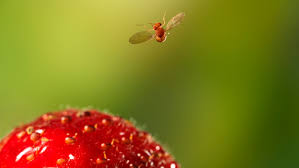
Other fun facts: 1) Fruit flies don’t actually eat fruit. They are attracted to the fermenting fungus or rot on overly ripe fruit. 2) Fruit flies live fast and hard. Their life span is 30-50 days. During that time, the female fruit fly can lay 500-2,000 eggs! 3) Fruit flies are “the stars of genetic research.” What we have learned from fruit flies in 30 years, would have taken us 200 years with mice. Fruit flies are more like us humans than we might imagine. Humans have 24,000 genes; fruit flies have 14,000! 4) The brain of the fruit fly has 100,000 neurons that can direct complex behaviors like sleep, courtship, learning, memory, aggression, grooming, and flight navigation. 5) Fruit flies are like us in other ways. They prefer beers with a fruitier base yeast just as humans prefer. And, if a male fruit fly has been sexually rejected, he often drowns his sorrow in alcohol.
We humans owe much gratitude to the humble fruit fly. Scientific research involving fruit flies have led to six Nobel prizes in Physiology and Medicine. Such research has shed light on genetics, embryonic development, immune disorders, and a whole host of diseases. As one researcher put it: “The fruit fly’s contributions to science are multitudinous!”

For reflection:
Did you learn anything new about fruit flies? What stands out for you?
Did you learn anything about the Creator of fruit flies? If so, what?
Our song today is the old hymn “How Great Thou Art.” This is Susan Boyle’s version of the refrain with beautiful photos chosen by Giula Zarantonello. When we sing this hymn, we often visualize mountains and oceans and stars and galaxies. But we must remember, God’s greatness is shown not only in the humongous, but also in the wee… like the fruit fly!
I invite you to add a comment below! We (my readers and I) love hearing from you!
God Gives Matching Grants
Most of us are probably familiar with the concept of “matching grants.” They can work in a variety of ways. If we contribute $100 to a non-profit like PBS, for example, they will sometimes have a company or donor who will match that donation. In other words, that company or donor will also contribute $100 to PBS to match yours. Or sometimes the grant organization will say to a non-profit’s request: We will award you the grant to build that children’s playground, but first you must raise 20% from other donors. Matching grants are a way to broaden fund raising efforts. In simple terms, it also means no one—not the requester, not the donor, and not the grant awarder—has to do all the work!
In her new book, A Little Book of Light: Sparks of Hope, Moments of Prayer, Alice Camille (a favorite writer of mine) implies that God gives us matching grants. Before Jesus ascended into heaven, he gave his disciples a daunting task: “You will receive power when the Holy Spirit comes upon you, and you will be my witnesses… to the ends of the earth” (Acts 1:8). To the ends of the earth?! Yikes! Sometimes I can’t even be a witness to Jesus in my own house!

But the key part of this evangelization mission is the power of the Holy Spirit. Camille writes, “If it were strictly up to you and me, Christianity would hardly make it down the block.” She says that this vital role of the Spirit in our lives “doesn’t mean we get to relax in our rocking chairs” and let the Spirit do all the work. No, the Spirit lives in us. “It moves in concert with our efforts.” I do my part (which might be 10% or at times even only 1%), and the Spirit does the rest. Says Camille, “It’s the best matching grant in the universe!”
Perhaps no story in the gospel illustrates “God’s matching grant” better than the story of the multiplication of the loaves and fishes. In Mark’s version, Jesus has just finished talking to a huge crowd—4,000 people. He is moved with pity for them, because they are hungry. His disciples share his concern. They moan, “Where can anyone get enough bread to satisfy here in this deserted place?” Jesus asks them, “How many loaves do you have?” They answer, “Seven.” We know what happens next. Jesus tells the people to sit on the ground. Then he takes the loaves in his hands, offers thanks, breaks them, and hands them to his disciples to distribute. Jesus does the same with the fish. The people eagerly eat and “are satisfied.” And there are even leftovers—seven baskets worth!
This story doesn’t merely describe something that happened over 2,000 years ago. It describes something that continues to happen today in our world, our church, our parishes, our homes. We do not have to do all the work to make our world a better place. We have only to begin, only to do our small part, only to give what we can—and the Spirit will do the rest. Sometimes the Spirit will act through others who join our efforts, and sometimes the Spirit will act in ways we can only marvel at.
I often see the Spirit acting in my talks and writing. Sometimes a listener will tell me how much they appreciated something I said, and I don’t even remember saying it. Or if I do remember saying it, this listener heard it in a way I didn’t intend, but in a way she needed to hear it and draw encouragement from it. Or I write an article, and someone tells me their favorite sentence, and that sentence might be the one I almost deleted because I thought it was superfluous.
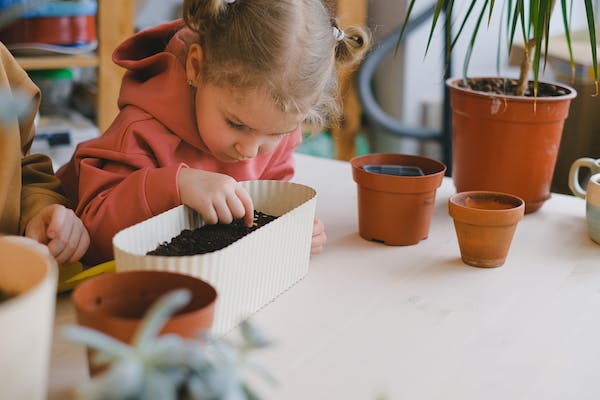
Alice Camille concludes with another allusion to scripture. She says, “Even though the yield of the soil to one hundredfold comes from God, the sower still has to get off the recliner and plant the seed. We do our little part, so the Spirit can multiply it.”
What seed might I plant today?
For reflection:
Have you ever experienced the Holy Spirit “multiplying” something little that you gave?
Can you think of anything which is now big and beautiful that started out as something small?
Here is a song by Dan Feiten called “Seed, Scattered and Sown.” Perhaps you may have sung this song in your church.
Once again I invite you to write a comment below! Don’t be shy… Thank you!
The Penance of Inconvenience
When we hear the word “penance,” we usually think of sacrifices we freely make for love of God: fasting during Lent, helping out at the parish fish fry, making a donation to the local food bank. But some penances seem thrust upon us by circumstances: working through difficulties in a relationship, caring for an elderly parent, putting up with daily aches and pains. One such “unchosen penance” I call the penance of inconvenience.
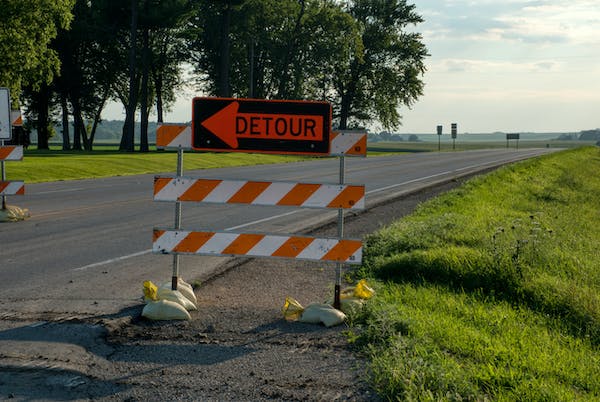
The etymology of the word “inconvenience” is interesting. It comes from two Latin words; in meaning “not,” and convenire meaning “to come together.” Thus, inconvenience happens when things do not come together for us, or when things don’t go as we want them to go or as we planned. We get to our doctor’s appointment early, for example, only to learn there’s been an emergency and the doctor is running two hours late. Or we’re coasting along on a three-lane highway when we suddenly see an orange sign that says, “left two lanes closed ahead.”
In the big scheme of things, most of these inconveniences are pretty small. Yet, they can help us grow spiritually if we deal with them “graciously.” First of all, daily inconveniences can help keep us humble. Every time we are inconvenienced by circumstances, we are reminded how little control we have over our lives. This realization can deepen our awareness of how much we depend on other people—and (ultimately) on God. With every inconvenience, a little light bulb flashes in our head: “You are not in control of everything—and that’s okay.”

Inconveniences can also nourish our spiritual lives because they almost always make demands on our love. In fact, most inconveniences are directly related to loving others. For example, we put up with a job that is not ideal because we are supporting our family whom we love. We “waste” valuable time listening to an elderly neighbor because we feel compassion for her. We even clean the cat’s litterbox because we love the cat.
Jesus experienced inconveniences throughout his life. First of all, Jesus traveled mostly on foot. By our standards, this would be a great inconvenience. Yet Jesus seemed to accept this inconvenience “in stride.” And how many times was he on his way to somewhere, when he was interrupted? Individuals stopped him begging for his attention: a blind man, some lepers, a distraught parent.

I think our daily little inconveniences help prepare us to face those major inconveniences which can be life-altering: A critical health issue, a natural catastrophe, the death of a loved one. In Gethsemane, Jesus faced his imminent death by crucifixion—talk about a life-altering catastrophe! In his prayer he begged, “Abba, Father, all things are possible to you. Take this cup from me.” But then he added those words rooted in his trust in the Father: “… but not what I will but what you will.” My prayer for all of us is this: May all the little and major inconveniences in our lives lead us to greater love of one another and greater love and trust in God.
For reflection:
What daily inconveniences do you find most challenging? Why?
What helps you to deal more graciously with inconveniences—both little and major ones?
I looked for a song that spoke of love of God and peace of soul. Here’s what I found. It’s the beautiful song, “Be Still My Soul,” sung here by Kari Jobe. The melody is the haunting “Finlandia” by the Finnish composer Jean Sibelius.
I welcome you to add a comment below.
“Two Strangers Who Meet Five Times”: A Short Film
Today I’m offering you a short film (12 mins.) entitled “Two Strangers Who Meet Five Times.” It’s a British film by Marcus Markou. It tells the story of two men, seemingly very different from each other, who happen to meet five times over the course of several decades. I really, really love this film! I wouldn’t post it for you if I didn’t think it was worth your valuable time. For me, it’s one of the best films I’ve seen on racism/prejudice. It’s won numerous awards (I counted 17 first place awards from film festivals all over the world.) Following the film, I’ve written a few questions for your reflection. I thought they might help you “process” the film. If they help, fine. If not, that’s okay too. I suggest you don’t read the questions until you have viewed the film.
Please note:
If you have trouble with the British accent, click on the closed caption (cc) icon.
The film starts with “The second time” the two men meet. The first time comes later in the film.
In England, an ATM is called a “cash point.”
Now, here’s the movie:
Now that you have watched the film, here are a few questions for reflection/sharing below:
What did you think of the film? (Did you like it? Why or why not? How would you describe the film in one word (or a few)?
When Alistair and Sam meet at the ATM, how does Alistair immediately reveal his prejudice/racism? Does the film offer any clues as to the origin of his prejudice?
When the two men meet in the office, Sam remembers Alistair, but Alistair doesn’t seem to remember Sam. How could this be?
When the two men meet again on the street, Alistair remembers Mr. Aziz, but Sam doesn’t seem to remember Alistair. What stands out to you about their exchange? What affect does Mr. Aziz’s generous gift have on Alistair? What “advice” does Mr. Aziz give Alistair right before he leaves?
What stands out to you when the two young boys meet for the first time? What does Alistair’s mother say to him as she abruptly pulls him away from Sam?
What stands out to you in their fifth meeting in the senior assisted living facility? Do they recognize each other? How have both men changed since their previous meetings? Do you think there’s a possibility that they can actually become friends? Why or why not?
Does the film shed a light on your own prejudices or racist attitudes or behaviors?
Miscellaneous questions:
Did you notice what the first two words are in the film? Any significance?
Are the two men really “strangers”? Explain your answer.
The filmmaker, Marcus Markou, says he wanted to make a short film about racism—but not the glaring kind that we see in our history of slavery or in the holocaust. He wanted to make a film about the “low level everyday” kind of racism that “poisons” our society. Do you think he achieves this?
Have you ever experienced (or contributed to) the “low level racism that poisons society”?
Interesting note: The two lead actors actually attended the same school growing up. But this is the first time (I think) that they were ever in a movie together.
Now it’s your turn to share some of your responses to the film below. Please comment on what you thought about the film, what you noticed, and any other comments you wish to make. My other readers and I would LOVE to hear from you! THANK YOU!