
Quotations about Jesus
One of the goals of Lent is to deepen our personal relationship with Jesus. To help all of us to do this, I have once again visited my vast collection of quotations and pulled out some quotes filed under “Jesus.” They are from a wide variety of authors. I hope as you prayerfully read these words of others, they might inspire your own personal love for Jesus.
1) Nowhere in the Gospels does Jesus urge us to adore him. Rather, he calls us to follow him and thereby to partake of his life, his energy, his spirit. Michael Downey
2) Jesus’ sayings are not rules to live up to but challenges to live into. Rather than impossible ideals imposed on us, they are provocations to grow step-by-step, trial-and-error learning, into the best possibilities of our nature. Robert Corin Morris
4) A kindergarten girl said, “Jesus is God’s show and tell.”
5) What is the meaning of Jesus’ ministry? It is “liberating, healing, and inclusive love.” Sallie McFague
6) The most important question concerning Jesus, then, is simply this: Do we think he is dead or alive? If Jesus is dead we can learn about him. But we cannot reasonably expect to learn more from him. If he is alive, everything changes. He is not a figure of the past, but a person in the present; not merely a memory we can analyze, but an agent we can confront. If Jesus is dead, then his story is completed. If he is alive, then his story continues. Luke Timothy Johnson
7) When Satan is knocking at your door, simply say, “Jesus, would you get that for me, please?” anonymous
8) Jesus had all kinds of opportunities to tell people what to think, but instead he told them what to do. Wash feet. Give your stuff away. Share your food. Favor reprobates. Pray for those who are out to get you. Be the first to say, “I’m sorry.” For those who took him as their model, being fully human was a full-time job… a vocation in itself. Barbara Brown Taylor
9) Jesus lives without anesthesia. He is numb neither to the joy nor the pain of the world. Part of his character is that he has not developed defenses to keep both happiness and sorrow moderate. John Shea
10) Christ is my music, my horizon, my sea, and my green woods. Miriam Pollard, OCSO
11) It is a great experience to go to the Holy Land and walk where Jesus walked. But it is far better to return home and walk as Jesus walked. Anonymous
12) For Jesus there was no “us” and “them.” No Jew and Samaritan… no man and woman… no northern and southern Irish… no blacks and whites… no Republicans and Democrats… no gay and straight. Jesus taught that our neighbor is everyone—especially everyone who is hurting. adapted from William Bausch

13) The message of Christ is not Christianity. The message of Christ is Christ. Gary Amirault
14) Jesus’ communion with the Father is the true center of his personality. Without it, we cannot understand him at all; and it is from this center that he makes himself present to us still today. Pope Benedict XVI
15) Would you be any different if Jesus Christ did not exist? Anthony de Mello
16) Jesus came for a far more radically transforming purpose than merely to serve as a role model. Jesus came to invite us into a living relationship with him, to abide, live, and move in his spirit, as the branch abides in the living vine… We are to live in Jesus and Jesus lives in us. Flora Slosson Wueller
For reflection:
Did any of these quotes touch your heart? If so, which one(s)? Why?
What stands out for you about the person of Jesus?
In your prayer, do you think or read about Jesus OR do you talk with him?
Do you have a favorite quotation about Jesus that you would like to share with us?
PS: Exciting News!

John Hopkins, one of our “Sunflower Seeds” readers and frequent responder, has just had a book of poetry published entitled Make My Heart a Pomegranate. John is a high school English teacher from Whitman, Massachusetts. Over the years I have featured a few of his poems on this blog. I gladly wrote the foreword to John’s book because I really like his writing. I find his poetry to be a beautiful blend of the profound and the simple. His poems are rooted in real life: walking on a beach, eating a piece of apple pie, raising children, teaching teenagers, cleaning the dryer vent, planting a shrub, and reading the last twenty pages of a book you don’t want to end. John masterfully draws from his many experiences as a son, friend, husband, father, teacher, landscaper, nature lover, and a man of deep faith and prayer.
Make My Heart a Pomegranate is available on Amazon.com. Check it out!
Our song for today is entitled “You Alone,” written by Sarah Hart and Dwight Liles. It seems like an appropriate song for the theme of today’s reflection as well as for our Lenten journey.
I welcome your comments below!
A Few Words about Complaining
Are you a complainer? Or do you follow of the rule: “If you don’t have something nice to say, don’t say anything at all”? Do you find yourself avoiding complainers? Or do you think complaining can be a good thing sometimes? To get help answering these questions, I’m turning to an article in Notre Dame Magazine (Autumn 2022) by Andrew Santella entitled “Eight Complaints.” Let’s begin with what some famous people have said about complaining.

Aristotle claimed that complaining was “typical of the weaker sex.” (I suspect many women would complain about his words!) Kant wrote that complaining was “unworthy” of the dignified, virtuous person. (Does that mean saints never complain?) And Nietzsche wrote: “Complaining is never of any use.” (Really, Friedrich?)
Now a few words about the history of complaining. In the twelfth century, a Benedictine monk in France helped support his monastery by writing songs about things that annoyed him. What things? Here are a few: “I can’t stand a long wait… or a priest who lies… or the hoarse man who tries to sing… or too much water in too little wine… or little meat in a large dish.” (Any of these sound contemporary?)
What is the oldest surviving customer complaint? It was made in Mesopotamia around 1750 B.C. and still survives on a cuneiform tablet. It seems a dissatisfied customer named Nanni wrote to a supplier called Ea-nasir who not only delivered the wrong grade of copper to his customer, but delivered it late. Nanni wrote: “What do you take me for that you treat me so badly?… I have sent messengers to collect my money, but you have sent them back empty-handed.” Anyone who has registered a complaint about getting the wrong sandwich at the drive-thru or the wrong sneakers from amazon is following in Nanni’s shoes (or maybe I should say his sandals!)

Why is complaining so universal? Writes Santella, “Because there has always been so much to complain about.” He dubs New York City (where he lives) as the “World Capital of Complaining.” He lists some of the most frequent complaints: high rent, slow subways, garbage strewn sidewalks, rogue car alarms, illegal parking, residential noise. He adds that democracies seem to “thrive on complaints.” Just think of how complaints are posted on social media or sent to the editors of newspapers or to government officials. (But I was thinking: I bet Putin doesn’t get many complaints!)
And now the question: Can complaining be a good thing? Santella says that psychologists tend to be ambiguous on the benefits of complaining: “It can be healthy, they say, except when it’s unhealthy.” The fact is, sometimes we just need to vent. And whining or complaining or moaning or groaning is one way we vent. Hopefully we have some trusted friends in our lives who are willing to listen to our complaints. So, it’s okay to whine—from time to time. But if our whining is chronic, than that’s not healthy. At the same time we must remember that some serious complaints throughout history have lead to serious changes for the better. Says Santella, “Female suffrage, the Civil Rights Movement, and South-Africa’s anti-apartheid campaign all grew from the seed of complaint about wrongs needing correction.”

Have you noticed that there’s a lot of complaining in the Bible too? The classic example is the Chosen People. After their miraculous deliverance from the slavery of Egypt, what do they do? They grumble! They were just given their freedom, they saw water gush from a rock and bread come down from heaven. But they still complained that the manna “didn’t taste quite right.” Others in the Bible complain. Moses complains about the Israelites complaining! Job and Jeremiah both wish they had never been born. And we have an entire book in the Bible called “Lamentations.” (I wrote about that book on my blog June 11, 2021.)
At the end of his article, Santella notes: “Complaint does not equal unhappiness.” That French monk who wrote all those songs of complaint “seems to have been very jovial—and a pretty welcome party guest.”
For reflection:
On a scale of 1 to 10 (1 meaning “I never complain,” and 10 meaning “I always complain”) how would you rate yourself?
What are your most frequent complaints?
What are the most frequent complaints you hear?
Can you give other examples of how a “seed of complaint” led to a better world?
Do you complain to God? Why or why not?
P.S. Thank you for your prayers for this past weekend’s retreat for the alumnae of Regina High School. The Holy Spirit was very active throughout our time together. I want to thank Sister Kay and all the wonderful women who participated! The retreat was a blessing for me personally!
Believe or not, I found quite a few songs that deal with complaining. Here’s a simple one by Jessica Rose called “Quit Complaining.” I especially liked the lines: “we don’t know how long this ride goes” and “I’ve got air in my lungs and someone to love.”
I would love to hear from you. Any comments—even very short ones—are welcome below!
Lenten Reflection: From “The Chosen”
Have you watched any of the episodes of “The Chosen”? It is a multi-season TV show about the life of Jesus. The show has received high praise in some circles (I like it!) and has garnered a vast audience all over the world. The series was created by Dallas Jenkins who wanted to do a series on Jesus that would show not only his divinity, but also his humanity. In the program we see Jesus preaching and working miracles, but we also see him telling jokes, fixing his own meals, dancing with his friends, conversing naturally with people, and saying his evening prayers. Jenkins had three religious advisors while making the film: a Rabbi, a Catholic priest, and a Protestant minister.

“The Chosen” is now in its third season. And you can watch it for FREE on “The Chosen” app, the Angel app, and the show’s website. It’s also available on Netflix, Peacock, Fox Nation, and Amazon Prime. The show stars Jonathan Roumine who, as one critic said, captures Jesus’ “masculinity and gentleness.” The series makes familiar people in the Gospels come alive: Peter, Andrew, Matthew, and the other apostles as well as Jesus’ mother Mary and Mary Magdalene.
I chose one 7 l/2 clip from the series for us to view and reflect on. It is the cure of the hemorrhaging woman (Mk. 5:25-34). Jesus is on his way to see Jairus’ 12-year-old daughter who is dying. The crowds push him from all sides. A nameless woman appears who has had a serious (and embarrassing) menstrual problem for 12 years. According to Mosaic law, she is “unclean” and anyone she touches is unclean too. After being crushed by the crowd, the woman finally succeeds in touching the tassel of Jesus’ garment. Instantly she is healed. Here’s the video. Click on closed caption if you wish. A few reflection questions and thoughts follow the video.
The video has been blocked. Sorry. But you can find it by searching: “The Chosen – cure of the bleeding woman.” Click on the excerpt that is about 7-8 minutes long. It is well worth the search!
What is your general reaction to this short clip from the film? (Maybe describe your thoughts/feelings in a word or two.)
Did anything stand out for you? If so, what?
For 12 years, this woman has been cut off from community because of her condition. What effect do you think Jesus’ words, touch, and healing will have on her life?
What did you think of this portrayal of Jesus? Is he realistic? approachable? strong? compassionate? Can you relate to this Jesus? Why or why not?
Here are some of Jesus’ words to the woman. Can you hear Jesus saying any of these words to you?
She calls herself “unclean,” but he calls her “daughter.”
“It was not my garment that healed you. It was your faith.”
“My daughter, you have been fighting for so long, you must be exhausted.” (What effect would these words have on her?)
“You have blessed me today.” (What do you think Jesus means by these words? Can we humans actually bless God? bless Jesus?)
“I’m so glad we found each other.” (What did they give to each other?)
“Go in peace.”

This week we begin our Lenten pilgrimage. On Ash Wednesday we are reminded that “we are dust.” Yes, but we are also the daughters and sons of the Living God. We are brothers and sisters to one another. We are one world community. During Lent we traditionally focus on three practices: prayer, fasting, and alms giving. As we do these things, let us remember that at the heart of our faith, is our personal relationship with Jesus. How might we strengthen that personal relationship this Lent?
My prayer for all of us is this: May we hear Jesus call us by name… May be feel Jesus’ loving gaze upon us… May we experience his profound understanding of where we are at this particular time in our lives… May we feel him grasping our hands and saying to us: “You have blessed me… I’m so glad we found each other.” And may we hear his words, “Go in peace.”
I hope many of you will share a few of your thoughts, feelings, insights, and questions below. Or you might share your Lenten “practices” this year. I also invite you to comment on what someone else has said. I would love to hear from you! So would our other readers!
P. S. I ask your prayers for a retreat I’ll be leading this coming weekend for graduates of Regina High School. The 24 women will be gathered at Bethany, our retreat center here in Chardon from Friday evening until Sunday noon. Thank you for your prayerful support!
Our song is a gentle yet strong Lenten hymn, “Gracious God” by Jesse Manibusan.
You can leave a comment below. Thank you!
Bishop Peter Storey: A Candle at Midnight
Recently I watched an interview with Bishop Peter Storey, the former president of the Methodist Church of South Africa. Bishop Storey, who is white, lived under South Africa’s brutal system of apartheid. He worked closely with Bishop Desmond Tutu and others to dismantle apartheid. He was also involved in the hard work of reconciliation that eventually transformed South Africa into a democracy.
The interview, held in Raleigh, NC, was conducted by journalist John Drescher who is a former student of mine. I have featured John on this blog before (see May 29, 2022: Hall of Fame Speech that Inspires Hope.) Today I will share some of Bishop Storey’s comments that really spoke to me. The topic of racism is very important for us now. First, February is Black History month in our country. Second, we can learn much from Bishop Storey’s vast experience (he’s now 84) that can help and inspire us do the hard work of dismantling our own racist attitudes and systems.

John asked the Bishop why he entitled his memoir Protest at Midnight? Bishop Storey said the phrase is from a poem by a Jesuit Indian priest, Samuel Rayan, who wrote, “A candle-light is a protest at midnight.” The candle says to the darkness that surrounds it, “I beg to differ.” Apartheid was overtly racist: residential areas were designated by race, most social contact among people of different races was forbidden, all non-whites had to carry identification papers at all times, and they were denied many kinds of jobs. During this time, many churches protested apartheid by placing on their altars a candle with barbed wire around it. The barbed wire symbolized the violent police state they were living in. The candle was their belief that all people were created equal and were children of one God.
As a young minister in 1962, Storey was assigned as chaplain to the notorious maximum security prison on Robben Island where Mandela and other political prisoners were held. Mandela was serving a life sentence. (He served 27 years of his sentence!) John asked, “Where did Mandela, you, and so many others get the courage to go up against the powerful South African government?” Storey said, “Maybe it’s not so much about courage as it is about love.” What motivated Jesus was his deep, deep love for people—especially those living on the margins. If we are filled with love and compassion for the marginalized of our day, we will find the courage to work for their good. “Perfect love casts out fear.”
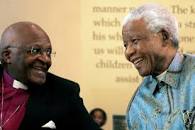
How was it possible, John asked, that Mandela, Tutu, and other leaders did not seek revenge on their opponents once they won the struggle for freedom? Said Storey, “Winning isn’t everything.” Winning an election, for example, isn’t everything because your opponent is still there—perhaps plotting revenge against you. The real work is reconciliation, that is, to find ways to make your opponent your friend. (I recalled Abraham Lincoln who chose several of his fiercest opponents to be members of his cabinet! See Goodwin’s book, Team of Rivals.) At his presidential inauguration, Mandela personally invited three of his prison guards. He said to them in Afrikaans, their language: “Wat is verby, is verby. What is past, is past.”
What qualities should we demand of our leaders? Said Storey, “Far-sighted magnanimity and integrity.” He reminded the audience that Jesus spent only 2% of his ministry in Church. The rest of his time was spent on the streets. Too often, he said, our Churches focus on things like attendance and fund raising. Instead we must follow Jesus’ example and focus most of our time and energy engaging with the outside world.
Storey highlighted the importance of education. Many of the Black leaders fighting apartheid were educated in the multi-racial Methodist mission schools. The apartheid government did not like these schools because they “produced people who had dignity and a sense of their rights”—rooted in the belief that they were “made in the image of God.”

Storey believes that Christians are engaged in two journeys: the inward journey and the outward journey. The inward journey is our “soul work” which we do by prayer, worship, study, and sharing faith with others. The outward journey is the compassionate work we do for others mostly beyond our congregations. There’s no way to sustain the outward work without nourishing the inward work.
Other comments: “As a white person, I can only touch the fringe of Black pain.”… “Christians should have hope as they work for greater justice. After all, we know how the story ends.”… Bishop Storey said something like this: When South Africa was in profound turmoil fighting against apartheid, he and other leaders came to the US to ask Congress to support their work to end apartheid—especially by boycotts and other means. Members of Congress on both sides of the aisle agreed to help. In fact, most of the countries in the world supported their pro-democracy movement. Storey said he is speaking now in the US as a way of thanking our country for our help in ending apartheid in South Africa. It is his way of supporting us in our efforts to secure greater freedom and justice for all in our country today.

For reflection:
Did anything stand out for you in today’s reflection? If so, what?
Storey says we need leaders with “far-sighted magnanimity and integrity.” Can you name any elected officials—current or past—who possessed these qualities?
What are some of the ways your parish or church congregation reaches out to those in need?
What are some ways you try to balance your work on your inward journey with your work on your outward journey?
After writing this reflection, I learned there were restrictions on the video of John’s interview with Bishop Storey, so I could not embed it on my blog. But if you click learn more below, the video comes up. (At least it did for me.)
You you can also get John’s article based on his interview. Just click Home below. Then click issues. Then click culture and scroll down to A Minister’s Protest at Midnight:
Home
I chose the song “We Shall Overcome” for our prayer today. It was the “anthem” of the Civil Rights Movement in our country, especially in the 1960’s. Written by Pete Seeger, the song has been recorded by scores of singers and groups. Here are three versions. Pick the one you want—or listen to all three throughout the week:
Bruce Springsteen:
Joan Baez singing at the White House during the Obama administration:
The Morehouse College Glee Club: (Morehouse is a private traditionally Black men’s college in Atlanta, GA. One of its most famous alumnus is Martin Luther King Jr.)
I invite you to comment on anything in this blog today. Other readers and I LOVE hearing from you!
A Prayer for February
Good and gracious God,
It’s February.
I don’t mean to be disrespectful (after all, you are the Author of All time),
But February is definitely not my favorite month of the year.
On my worst days, I might even ask you, “What good is February?”—
except that it’s the shortest month of the year,
the days are noticeably longer,
and February gets us a little closer to spring.

I realize, Beloved One, that some people love February—
like little kids who have birthdays in February… or people who love watching
the Super Bowl… or those who get a kick out of Ground Hog Day…
or (if they’re religious) Candlemas Day… or those who look forward to
the third Monday, Presidents Day, a federal holiday.
And I realize February is Black History month and American Heart month.
And that’s good.
But February often marks the beginning of Lent too. Enough said.
Where I live, (that’s Chardon, Ohio, USA northern hemisphere as you well know, God)
February can be the bleakest month of the year
with its freezing temperatures, snowstorms, ice storms,
and a huge canopy of gray sky that hangs over everything.
Slate gray. Almost every day. Depressing.

For me, the only day in February that lifts my spirits is Valentine’s Day,
with its red hearts, scrumptious chocolates, long-stemmed roses,
and its overt celebration of love in all its forms! Now, that’s good. Very good.
But maybe I need to view February differently.
Maybe I should see it as a great symbol of all those times in life
that are dull, gray, sad, grim, barren. Those bleak times when
there seems to be few things to look forward to.
I realize, of course, that it can’t be sunny, warm, and bright all the time.
That’s unrealistic—and maybe even unhealthy.
For we need those times in our life
when there’s little to do but hunker down, hang on, wait, trust, and hope.
Hope. Now that’s the operative word.
Maybe February is the best month of the year
for giving us practice in hoping.
In fact, if lived correctly, February can be a refreshing and welcome space
between the recent rush and bustle of the holidays
and the upcoming busyness of spring:
gardening, yard work, spring cleaning, weddings and graduations.

And so, Dear Creator of All Time,
I will try to welcome and even embrace February this year.
And in doing so, I ask for your grace to enable me to welcome and embrace
all the days of my life,
knowing full well that all time is a precious, precious gift.
And if I find myself getting bogged down this month,
I will recall those beautiful words of sacred scripture:
“Behold, now is the acceptable time.
Behold, now is the day of salvation” (2 Cor. 6:2). Amen.
For reflection:
What are your thoughts and feelings about February? (Where do you live? Does that influence your attitude?)
What are some of the ways you “weather” those times in your life that are dull, grim, bleak?
Do you celebrate Valentine’s day? If so, how?
Here’s today’s video: “Now is the Acceptable Time” written by Barbara Bridge. This choral version has not only the lyrics, but some beautiful pictures to brighten your February day!
I welcome you to share a comment below or respond to someone else’s comment. We all would love to hear from you. Thank you!