
A Little Easter Laughter
The Catholic Church has an ancient and venerable tradition that designates the Monday after Easter as “Joke Monday” or “Laughter Monday.” It was a day when Christians were supposed to tell jokes to each other in honor of Jesus’ resurrection from the dead—when Jesus had the “last laugh.” I’m extending that tradition to the week after Easter! So, here are a few jokes, riddles, comics, and puns. I hope some of these bring a smile to your face!
1. If you can call a librarian a bookkeeper, then can you call a referee a game warden?
2. Did you hear about the guy who sued the airline for his missing luggage? He lost his case.
3. What do you call an ordinary potato? A commentator.
4. I invented a new word! Plagiarism!

5. A priest went to a yard sale and bought a lawn mower. When he got it home and tried pulling the rope to start it, it wouldn’t start. Angry, he went back to the yard sale and told the man, “This mower won’t start no matter how many times I pull the rope.” The man said, “You have to curse to get this mower to start.” Said the priest indignantly, “I’ve been a priest for over 30 years. I have forgotten how to curse.” Said the man, “Father, you keep pulling that rope, and it’ll come back to you!”
6. When a kid says, “Daddy, I want Mommy,” that’s the kid version of, “I’d like to speak to your supervisor.”
7. What do you call a bear with no teeth? A Gummy bear!
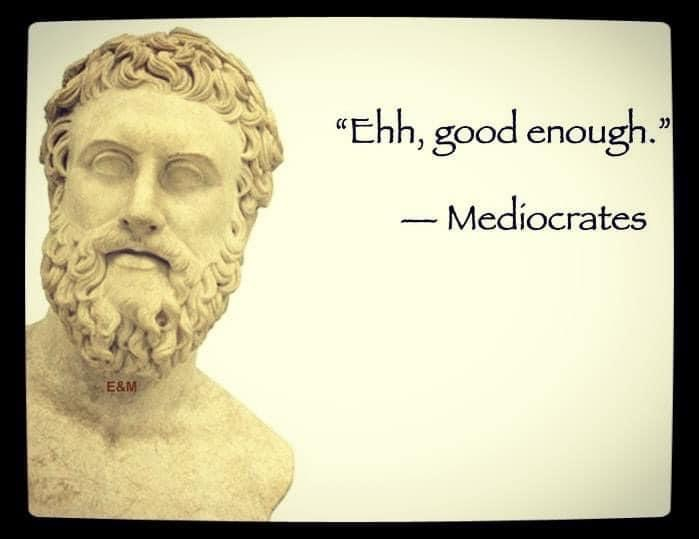
8. Last night the internet wasn’t working, so I spent a few hours with my family. They seem like nice people.
9. You know you’re getting old when “friends with benefits” means having a friend who can drive at night.
10. For those of you who don’t like Alexa or Siri listening in on your conversations, they are making a male version… It doesn’t listen to anything.
11. What did the 0 say to the 8? Nice belt!
12. What do you call a magic dog? A labracadabrador!

And now a little something from Reader’s Digest:
13. A Mom texts her son: “What does IDK, LY, and TTYL mean?” Her son texts back: “I don’t know. Love you. Talk to you later.” His mother texts: “That’s okay. Don’t worry about it. I’ll ask your sister.”
14. When I read about the evils of drinking, I gave up reading.
15. I tried to organize a hide-and-seek tournament. It was a complete failure. Good players are hard to find.
16. When do cows go to sleep? Pasture bedtime!

17. A man was being tried for armed robbery. He waited nervously as the jury foreman read the verdict: “Not guilty,” he said. The man let out a hoot, jumped up, raised his arms in triumph, and then he asked, “Does that mean I get to keep the money?”
18. After the death of a good friend, my wife and I went to a Chinese restaurant to try to cheer ourselves up. The feel-good meal was fine–until I read my fortune cookie. It said, “You will soon be reunited with a good friend.”
19. The first young snake asked the second young snake, “Are we poisonous?” Said the second snake, “I don’t know. Why do you ask?” Said the first snake, “Because I just bit my lip.”

20. Some of my friends exercise every day. Meanwhile I am watching a TV show I don’t like because the remote fell on the floor.
21. Red Skelton’s tips for a happy marriage: “Two times a week we go to a nice restaurant, have a little beverage, good food and companionship. She goes on Tuesdays, and I go on Fridays.”
22. George Burns said: “The secret of a good sermon is to have a good beginning and a good ending; and to have the two as close together as possible.”
Before I go… here’s one last picture for you:

Did any of these tickle your funny bone?
P.S. #1: I will be leading a retreat next week (from Sunday April 23 through Saturday April 29) for the Mercy Sisters in Rochester, NY. The theme of the retreat is “Hanging onto Hope in our Beautiful and Imperfect World.” I ask for the support of your prayers! Thank you very much!
P.S. #2: I realize many of you are NOT receiving my blog anymore. And I know when you try to re-subscribe, you are told you are already a subscriber. And some of you tell me you can no longer write a comment. Your comments are blocked. This week we SND bloggers are meeting with the individuals who are responsible for managing our blogs. We have hopes that they will be able to “fix” these problems soon. We will also be working to update our blogs with new designs. Thank you for your patience–and your prayers!
Our song is Matt Maher’s Easter song, “Because He Lives.” May all of us continue to savor the good news of Easter!
I invite you to comment below or add another joke or funny story:
A Few Details about the Easter Story
Today I’d like to share with you a few thoughts about the Resurrection of Jesus, one of the greatest mysteries of our faith. These thoughts are gleaned from the Gospel accounts of that very first Easter. The first thing that strikes me about the Easter story is how shocked the disciples were on that Easter morning. When Peter and John enter the empty tomb, they are stunned. It seems as if Jesus’ rising from the dead was not something they—his closest friends—expected. Ironically, Jesus’ enemies thought he had predicted rising after three days. They were the ones who asked Pilate to put guards by the tomb so Jesus’ disciples didn’t try to steal his body.
Jesus’ empty tomb that morning also filled the early followers of Jesus with great fear. In Mark’s gospel, the women who come to anoint his corpse, are so terrified by their experience of the empty tomb and the angels, they run madly away. Peter and John are also so afraid, they high tail it back to the other disciples and huddle together with them behind locked doors.

What moves Jesus’ followers beyond shock, fear, and disbelief? Bishop Thomas Gumbleton says it was one thing: their encounters with the risen Jesus. He writes, “What brought resurrection faith were the in-the-flesh appearances of the resurrected Jesus.” He goes on: “Slowly, gently, through these appearances, Christ built up their faith until they no longer needed these appearances.” We too are built up in the faith through the appearances of Christ in the flesh. Where does the resurrected Christ have flesh in our world? Says Gumbleton: in people who make our hearts “burn within us.” Who might such people be? Here are some on my short list:
+ those who remind us that there’s so much more to life than what can be seen with our human eyes only…
+ those who show us that happiness consists essentially in loving and serving others…
+ those who remind us that bitterness leads only to death, while forgiveness leads to life
+ those who show us that pain and tears can be redemptive
+ those who remind us that cynicism is a form of despair
+ those who love us despite our failings and shortcomings
+ those who lead us to believe that God is alive and active in our world
+ those who remind us that, in the end, the only thing that really matters is that we love
+ those who, despite their struggles and trials, hang on to their sense of humor

Another detail that is seen in the Easter story is this: The disciples didn’t recognize the risen Jesus. Mary Magdala, who knew him so well, mistook him for the gardener. The two disciples on the road to Emmaus, took him for a stranger. Only in the breaking of the bread did they realize he was Jesus. Later, on the shore, most of his disciples also didn’t recognize Jesus and assumed he was a cook. What lesson here? The Risen Jesus in the flesh can look quite ordinary. He could be the woman who slices your cheese at the deli… the man who gives you a break in traffic… your daughter’s third grade teacher… your kind and competent hair stylist… the meteorologist on the local evening news… the person who gives your car an oil change… the priest mingling with people after Mass… the police officer on night patrol in your town… Maybe to detect the risen Jesus among us, we have to look more closely at the faces of the people we meet every day—and appreciate their simple goodness.
I find great consolation in these details. First, the first Easter reminds us that our God is a God of surprises. We do not control our lives—let alone control our God. On the contrary, much of our life is “given to us.” As some have said: “Life is what happens to us while we’re making other plans.” In the Easter story we also see that fear is not an emotion to be ashamed of. It is often a perfectly human response to danger or bewilderment. Easter shows us that God can come to us no matter what we may be feeling—even shock, fear, confusion, shame, despair. No human emotion can prevent God’s love from breaking into our lives.
And so I want to wish all of you:

With much love and many prayers, Melannie
For reflection:
Is there anything in this reflection that struck you?
Is there anything else in the story of the first Easter that you find particularly meaningful, memorable, or intriguing? If so, would you want to share it with us?
Here’s a gentle but beautiful Easter song written by Sarah Hart, Sarah Kroger, Josh Blakenley, and Trey Heffinger. It’s called “Hallelujah Is Our Song” and is sung here by Sarah Hart. My favorite line is: “What hope we have, even in the longest night, for the light will overcome.”
I welcome your comments or other Easter thoughts below.
What Makes Jesus’ Sacrifice Special?
As we enter into Holy Week, let’s take a few minutes to answer the question: What makes Jesus’ sacrifice special? I gleaned many of the ideas here from a March 21, 2009 column by Father Ronald Rolheiser.
Father begins by saying it is one thing to love when you are surrounded by love. But it is another thing to love when you are surrounded by misunderstanding, jealousy, cruelty, and hatred.
It is one thing to hang on to your ideals when those ideals are shared with others around you. But it is another thing to hang on to your ideals when you feel you are standing alone.
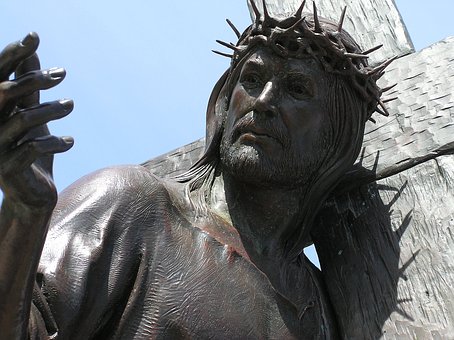
It is one thing to keep your balance when the rhythm of life supports it. But it is another thing to keep your balance when life is unfair and, when, like on Good Friday, it gets dark in the middle of the day.
It is one thing to be kind and gracious when others around you are kind and gracious. But it is another thing to be kind and gracious when everyone is criticizing you, mocking you, or saying terrible things about you.
It is one thing to forgive others when “the wound dealt you is not mortal.” But it is another thing to forgive someone when the wound that is dealt you is mortal.
It is one thing to give your life to your family, community, or God when you feel loved and supported by them. But it is another thing to give your life to them when you don’t feel love and supported by them—or anyone.

Says Rolheiser, “These contrasts capture, in essence, what Jesus did in the Garden of Gethsemane and on the cross. His passion was a drama of the heart, not an endurance test for the body.” Perhaps we have emphasized Jesus’ physical sufferings to the detriment of his deeper suffering. Rolheiser calls this deeper suffering: Jesus’ moral loneliness.
The Gospels emphasize Jesus’ aloneness. He was betrayed, misunderstood, and humiliated. Those who loved him fell asleep in the garden, his darkest hour. Then, when he was arrested, they ran away, deserting him in his time of need. Says Rolheiser, this moral aloneness “tempted him against everything he had preached and stood for during his ministry in life.” What made his sacrifice special was not that he was a victim of violence. No, what made his death so special was that, despite his aloneness and darkness, despite being surrounded by a sea of injustice and cruelty, Jesus “gave himself over, without bitterness, without self-pity, holding his ideals intact, gracious, respectful, forgiving, without losing his balance, his meaning, his message.”
Writer Alice Camille also underscores the specialness of Jesus’ sacrifice in an article she wrote for Living with Christ, March 2023 issue. She writes, “Jesus accepted death on a cross for sinners, not for perfected souls. At our most unlovable, then, God chooses to love us. Sound crazy? Only because we are not very good at loving people who are not on their best behavior.”
Prayer: Jesus, your sacrifice on the cross was special. I desire to love others as you love us. So I ask for these graces: To love even when I don’t feel much love around me… To live my ideals even when I feel I am standing alone in them… To keep my balance even when life seems unfair… To be respectful and gracious even when I encounter disrespect, coldness, and hatred… To forgive others even when it seems impossible to do so. I ask for your divine help to follow you “more nearly” in your way of sacrifice and love. Amen.
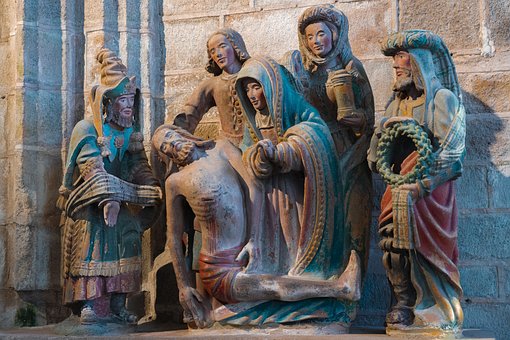
For reflection:
Do any words or phrases in this reflection stand out for you? If so, which–and why?
Have you ever felt “moral loneliness”? If so, what was that experience like for you?
Do any of today’s pictures touch your heart today?
When we light the Easter candle at the Holy Saturday vigil Mass, the priest says these words: May the Light of Christ rising in glory dispel the darkness of our minds and hearts. Then the priest or deacon takes the candle and processes to the altar, singing three times: The light of Christ! To which the people respond: Thanks be to God! The song I chose for this week is Bernadette Farrell’s beautiful “Christ, Be Our Light.” This version has some beautiful and challenging images to accompany our words.
Once again, I invite you to respond below to anything in this reflection… or to add your own thoughts on Jesus’ sacrifice and love.
Stay Awake: A Hallmark of Christian Spirituality
Several years ago, a priest friend and I were discussing this question: What are some of the hallmarks of a genuine Christian spirituality. Almost immediately, he gave me one. “Stay awake!” he said. We went on to have a great conversation about this hallmark. In this reflection I will share why this injunction “Stay awake!” is so important for our Christian Spirituality. And I will do this by weaving together the wise words of a variety of philosophers, spiritual writers, and poets.
Jesus invites us to the fullness of life every day. Unfortunately, many of us slumber, not fully awake to the offer. We just don’t pay attention to what is happening around us and inside of us each day. The spiritual writer Alice Camille says some of us “spend many waking hours like sleepwalkers, moving through routines with eyes closed to the possibilities for greater, deeper life being held out in every moment.”

I am reminded of a character in the movie Postcards from the Edge who sends a postcard home from vacation with these words scribbled on it: “Having a wonderful time. Wish I were here.” The sad truth is we can sleepwalk through not only our ordinary days, but even through our vacations! The basic question to ask ourselves is this: What do I pay attention to on any given day? The Spanish philosopher Jose Ortega y Gasset wrote, “Tell me what you pay attention to, and I will tell you who you are.”
Father Anthony de Mello, SJ, tells this little story that also points to the importance of taking stock of what gets our attention and what does not. A wife was sitting across the breakfast table from her husband whose face was buried in the newspaper. She asks him, “Has it ever occurred to you that there might be more to life than what’s going on in the world?” The sad truth is, sometimes we know more about what’s going on in far away places than we know about what’s going on in our own house! Or we
pay more attention to that famous celebrity than we do to our spouse, our child, our coworker, our friend.

St. Ignatius formulated a practice to counteract our tendency to sleepwalk through life. He called it, the examen. He encouraged his followers to take time each day, often at the end of the day, to reflect on what really happened that day. I sometimes use a couple of questions such as these: What were the highlights of today? What were the lowlights? What did I respond to well? What could I have done better? When did I feel close to God? When far away? Did I help anyone today? Did anyone help me? What am I most grateful for today? What or whom do I want to pray for today?
More than one spiritual writer has said that people often think the basic command of religion is “Do this!” or “Don’t do this!” But in reality, they argue, the basic command of religion is “Look!… Behold!… Wonder!” Didn’t Jesus himself call his disciples to pay attention to flowers, birds, and the needs of the poor? If we truly stay awake to our everyday, Sam Keen says, we might encounter Divinity. He says, “Epiphanies are as common as forget-me-nots. The eternal is curled up in the heart of the here and now.”

And finally, let’s listen to the wise words of the poet Mary Oliver: “To pay attention, this is our endless and proper work.” Or, in my words, “To stay awake, this is our endless challenge and proper work that can lead us to a deeper, happier, and more meaningful spiritual life!”
For reflection:
On a scale of 1 to 10 (10 being VERY attentive), how attentive are you to what is really happening in your daily life?
What helps you to ‘stay awake’ to the here and now?
Do you ever practice St. Ignatius’ ‘examen’?
Can you think of any other hallmarks of Christian spirituality?
I chose a beautiful choral Lenten hymn for today. It’s called “God So Loved the World” by John Stainer. It’s the first hymn on this video.
I invite you to add a comment below. We all love hearing from our readers!
“When Breath Becomes Air”: A Book Review
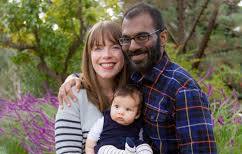
If you’re looking for an autobiography that weaves together great literature, fascinating medical science, a love story, and one that explores the meaning of life, then this is the book for you: When Breath Becomes Air by Paul Kalanithi. It’s the story of a doctor on the verge of completing ten years of training as a neurosurgeon who is suddenly diagnosed with inoperable lung cancer. At age 36, he goes from being a top-notch doctor treating the dying, to being a vulnerable patient facing his own death.
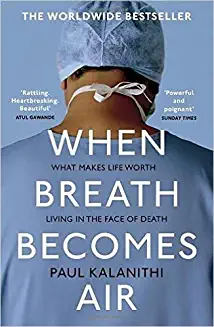
First, a little background. Until the age of ten, Kalanithi lived in New York with his parents and two brothers. When he was about 10, the family moved to Arizona. His father was a cardiologist whose devotion to his work sometimes made him a “passing mirage” at home. His mother, a Hindu, was trained as a physiologist. She insisted that her sons read “great books” and often drew up a reading list for them. Kalanithi credits her with instilling in him his love for literature. Both parents were tremendously supportive of him throughout his life—and especially as he faced his death.
Kalanithi earned degrees in English literature, biology, history, and philosophy, before switching to science and medicine. He studied medicine at Stanford, Cambridge, and Yale eventually deciding to become a neurosurgeon. He chose this field for several reasons. He felt neurosurgery “seemed to present the most challenging and direct confrontation with meaning, identity, and death.” By operating on a person’s brain, neurosurgeons “work in the crucible of identity.” Because the brain “mediates our experience of the world, any neurological problem forces the patient and the family, ideally with a doctor as a guide, to answer the question: What makes life meaningful enough to go on living?”

(Photo by Norbert von der Groeben)
While at Yale, Kalanithi meets another medical student, Lucy, who becomes his wife. Though very much in love, their relationship encountered serious trouble at the end of his residency. They weathered that storm together, and, in the epilogue, Lucy writes, “I am glad Paul wrote about it. It’s part of our truth.” The entire epilogue is quite beautiful.
Some aspects of the story that stood out for me are these:
The grueling work of the medical profession–especially neurosurgery. He vividly describes the long hours, the constant striving for perfection, the difficult decisions, the heart wrenching deaths.
His relationship with Emma, his oncologist. At first they are two doctors treating his cancer, their conversations steeped in medical jargon. But then comes the day, close to the end, when he relinquishes his “doctor role” and simply becomes her patient. Emma is such a caring and wise doctor. When a new tumor appears in his brain, she says to him, “This is not the end. Or even the beginning of the end. It is just the end of the beginning.” His reaction to her words: “And I felt better.”
It isn’t until he becomes a patient himself that he realizes what it feels like to be a patient. He regrets that he didn’t have this knowledge earlier in his career.
I found intriguing Kalanithi’s account of his journey from staunch atheism back to the Christian faith he had been raised in as a child. Though he loved science, he found that science was unable “to grasp the most central aspects of human life: hope, fear, love, hate, beauty, envy, honor, weakness, striving, suffering, virtue.” He says, “I returned to the central core values of Christianity—sacrifice, redemption, forgiveness—because I found them so compelling.” In the epilogue, Lucy describes how, a few months after his diagnosis, “we sang the hymn ‘The Servant Song’ while standing side by side in a church pew, and the words vibrated with meaning as we faced uncertainty and pain together: ‘I will share your joy and sorrow / Till we’ve seen this journey through.'”
His and Lucy’s decision to have a child. Little Elizabeth Acadia (Cady) was born eight months before his death. The last paragraph of his story is addressed to her: “… you filled a dying man’s days with sated joy, a joy unknown to me in all my prior years, a joy that does not hunger for more and more but rests, satisfied. In this time, right now, that is an enormous thing.”
For reflection:
Did anything stand out for you in Dr. Kalanithi’s story?
If you have read the book, what is your opinion of it? Is there anything you would add?
If you have had to face your own mortality in a striking way—or the mortality of a loved one—what helped you during this time?
Lucy describes standing side by side with Paul at Mass, singing “The Servant Song.” It seems appropriate to choose that song for today’s reflection. It was written by Richard Gillard, described as a British New Zealander. It is sung by the “Sunday 7 pm Choir.”
I invite you to add a comment below…