“God’s not Finished with Me Yet”
I like Brandon Heath’s song, “God’s not Finished with Me Yet”—also known as “Wait and See.” It is a reminder that God is still at work in my life.
I know, in one way we can use those words as an excuse for our faults and shortcomings. We can say, “I know I was crabby… I know I was unkind… I know I was mean…but God is not finished with me yet. I’m not perfect. So just put up with me the way I am.”
But I think the words can have deeper and wider implications. God is not finished with ME yet. God is not finished  with US yet. God is not finished with THE WORLD yet. God is still actively involved in our lives and in our world. God is still creating, is still at work—with us—bringing about that better world we are longing for.
Yet, sometimes we act as if God were finished working. We live as if Divine Revelation ended with the Resurrection and Ascension of Jesus. The Catholic Church formally teaches that Divine Revelation ended with the death of St. John, the last apostle. The Catechism of the Catholic Church states: “no new public revelation is to be expected before the glorious manifestation of our Lord Jesus Christ.” But the Catechism adds, “Yet even if Revelation is already complete, it has not been made completely explicit; it remains for Christian faith to grasp its full significance over the course of centuries.”
But I like what Barbara Brown Taylor says about God not being finished with us yet. She is an Episcopal priest and one of my favorite writers:
God is not through with us yet. At our worst moments, both individually and corporately, we act as if that were so. We act as if creation had all been finished a long, long time ago and encased in glass, where we may look at it through the  grime of the centuries but may not touch. Nothing could be further from the truth. The Holy Spirit still moves over the face of the waters, God still breathes life into piles of dust, Jesus still shouts us from our tombs. The deep river of revelation still runs strong from the fresh headwaters of its source to its jewel-encrusted banks in the heavenly city, with power to drench our days along the way. (The Preaching Life, p. 53)
Brown’s slant on this topic increases our personal responsibility to stay connected with God—consciously–especially through our personal prayer, our pondering of the scriptures, our reflection on our personal life, our appreciation of creation, and awareness of the needs of others in the world. The fact that divine revelation continues, means I must be open to new insights or to new applications of “old” insights. It means I must try to partner with God—using my specific gifts and my unique personality—to respond to the current local, national, and world situation in order to help bring about a world of peace, justice, and love.
What are some of the ways you consciously stay connected with God?
Name one specific gift you have that you are using to partner with God to “bring about a better world.”
Be on the lookout today for signs of the Holy Spirit moving over the waters, God breathing “piles of dust” into life, and Jesus shouting someone from their tomb.
PS: A big “Thank you” for your prayers for our SND gathering last week in Columbus! It was an important step in choosing our new leadership and becoming one USA province in 2020. And please remember in your prayers the weekend retreat I will be leading in Syracuse, NY July 19-21 at Christ the King Retreat Center. I really appreciate your prayerful support in these endeavors!
Our song today is Brandon Heath’s “He’s not Finished with Me Yet,” also known as “Wait and See.”
What are some of your thoughts on this reflection? Please respond below!
Quotations about Life
It is time for another visit to my quote collection. Those of you familiar with my blog, know I have a huge collection of quotes I have amassed since I was a college student! Every now and then, I like to share some of these quotations with you. Here are 18 quotes I have filed under life:
1. “Life is not a spelling bee, where no matter how many words you’ve gotten right, if you make one mistake, you are disqualified. Life is more like a baseball season, where even the best team loses one-third of its games and even the worst team has its days of brilliance.” (Rabbi Harold Kushner in How Good Do We Have to Be?)
2. “The ordinary acts we practice every day at home are of more importance to the soul than their simplicity might suggest.” (Thomas Moore)
3. “How we spend our days is, of course, how we spend our lives.” (Annie Dillard in The Writing Life.)
4. “Seek not for fresher founts afar, Just drop your bucket where you are.” (S.W. Foss)

5. “Be the person you want to marry.” (Jason Evert)
6. “When the pond dries up and the fish are lying on the parched earth, to moisten them with one’s breath or damp them with spittle is no substitute for flinging them back into the lake. Don’t enliven people with doctrines; throw them back into Reality. For the secret of life is to be found in life itself—not in doctrines about it.” (Fr. Anthony de Mello, SJ in Taking Flight.)
7. “When order crumbles, Mystery rises.” (John Shea in Stories of God.)
8. “It is sad to grow old, but nice to ripen.” (Brigitte Bardot)
9. “Just pray for a tough hide and a tender heart.” (Ruth Graham)
10. “Dreams and dedication are a powerful combination.” (William Longgood in Voices from the Earth)
11. “See everything. Overlook a great deal. Improve a little.” (Pope John XXIII)
12. “Why wait? Life is not a dress rehearsal.” (Marilyn Grey)

13. “It is easier to reject a hurting world than to embrace it with compassion.” (Eugene Kennedy in A Time for Being Human)
14. “Most of us have an idea how we think our days should go. We want nights of undisturbed sleep, regular meals and calm homes with a certain amount of order. But in our quest to keep order, sometimes we overlook the fact that some of the most important moments in our lives are unplanned. Through the cracks in our days often come life and love and moments of connection. (Mary Beth Danielson)
15. “Beyond ideas of wrong doing and right doing, there’s a field. I’ll meet you there.” (Rumi)
16. “Your life must be one wild birdsong of praise, one wildflower’s face looking up to God.” (Janet Stuart)
17. “Life is a luminous pause between two great mysteries (birth and death), which themselves are one.” (Carl Jung)
18. “We have loved the stars too fondly to be fearful of the night.” (Inscription on an astronomer’s grave, Allegheny Observatory, University of Pittsburgh.)

Did any of these quotations speak to you today? If so, which one(s)?
Do you have a quotation about life that you’d like to share with us below?
PS: I ask your prayers for a gathering of the four American provinces of my congregation the Sisters of Notre Dame July 9-12 in Columbus, Ohio. Next year we are becoming one province–something we have been working towards for several years. Sisters from California, Kentucky (Covington), and Ohio (Cleveland and Toledo) will be meeting to discern leadership, to share faith, to get to know each other a little better, and to have some fun. Thank you for your prayers!
Our song today is called “Human Way” by the Canadian singer/songwriter Declan Donovan. (I thank a good friend for calling my attention to this song.) The song asks some good questions for all of us to reflect on: “Is there still time to live your life?… Have you been holding back so long, so long, so long?”
As usual, I encourage your responses below:
A Word about Wheelbarrows
I was watching the landscapers working at the new house next door. They were planting small trees and shrubs, and were moving soil and rocks. I noticed they were using a wheelbarrow. That got me to thinking: how far back do wheelbarrows go? And how do they work? This reflection is based on my “research.”
 First, a definition: a wheelbarrow is a hand-propelled vehicle (usually with one wheel) designed to be pushed by a single person using two handles at the rear. Wheelbarrows distribute weight between the wheel and the operator. Thus, it makes it possible for one person to move heavier loads. The name wheelbarrow comes from the Old English bearwe which meant a device for carrying loads. Sometimes people mistakingly say wheelbarrel but there’s no barrel in the word.
The earliest known wheelbarrows were depicted in murals dating back to the second Century Han Dynasty in China. Artistic drawings of wheelbarrows were found in several emperors’ tombs. In ancient China the wheelbarrow was nicknamed the “wooden ox.” There is no archeological evidence of the wheelbarrow in ancient Greece or Rome.
But the wheelbarrow appeared in Europe in the twelfth Century. It was used in construction work, mining, and farming. Sometimes wheelbarrows have two wheels for greater stability. But a one-wheel wheelbarrow has better maneuverability especially in tight spaces. In the 1970’s the British inventor James Dyson introduced the “ballbarrow,” a molded plastic wheelbarrow with a ball at the end instead of a wheel. The ball makes it easier to maneuver and to use on soft soil. In 1998 the Honda HPE60 electric power-assisted wheelbarrow was introduced. It made it possible to carry much heavier loads.
What do wheelbarrows have to do with spirituality? Wheelbarrows have been around for thousands of years because they are a marvelous invention. They distribute the weight of our loads so we humans can bear them more easily, more gracefully.
In the spiritual life, we all have burdens we are carrying: fear, anxiety, illness,  difficult family situations, loneliness, discouragement… What or who helps us to bear our burdens? Friends and family can certainly ease our burdens. Seeking professionals can help too—a doctor, spiritual director, counselor. Prayer and scripture often can make our burdens lighter. Maybe even reading a reflection on wheelbarrows can help!
Ultimately, of course, we hand over our burdens to Jesus. We ask for his wisdom, his love, his strength to bear our burdens with greater faith, trusting in his words: Come to me, all you who labor and are burdened, and I will give you rest. Take my yoke upon you and learn from me, for I am meek and humble of heart; and you will find rest for yourselves. For my yoke is easy, and my burden light” (Mt. 11:28-30).
For reflection:
Have you had any experience with wheelbarrows?
As a child, did you ever play with a wheelbarrow? (My siblings and I certainly did!)
Who or what helps you to bear the burdens you are currently bearing? How do you help others to bear their burdens?
PS: One of our responders below, Tom, sent in this picture. He calls it “Wheelbarrow by the Cuyahoga.”

I want to wish my American readers a very Happy Fourth of July! May we never take the gift of freedom for granted!
I have three short videos today. The first two are just for fun. The third one is our song for today.
This video is from the annual Hungarian Olympics. This is a fun competitive race called “girls in the wheelbarrow.” (1 min.)
This second video is called “extreme wheelbarrow tricks.” You might want to try some of these at home. (1 min.)
Here is our song for the day. It’s Chris Tomlin’s “Jesus” and is appropriate for this reflection. Jesus is eager and able to help us carry our burdens. I especially like the line: Jesus “carries my healing in his hands.”
Do you have any thoughts about this reflection? I welcome your response below:
Why Did Jesus Die on the Cross?
Today we are going to tackle one important theological question: Why did Jesus die on the cross? I am basing much of what I say on an interview with the theologian, Elizabeth Johnson, in U.S. Catholic (Dec. 2018). Her latest book is Creation and the Cross: The Mercy of God for a Planet in Peril.
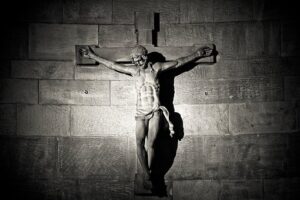 Let’s start with the question: why did Jesus die on the cross? The 11th Century Archbishop of Canterbury, St. Anselm, taught that Jesus (in Johnson’s words) “had to die a bloody and horrible death on the cross in order to save us from our sins, because God was offended by our sins and had to receive satisfaction.” God had “to receive a payback in order to forgive us.”
Where did Anselm come up with such a theory? He lived in a feudal society. If you broke the law, you had to pay back something to the Lord. You had to make satisfaction in order to restore the honor of the Lord and to restore civic peacefulness. Anselm concluded that, if this is the way the world works, this must be the way God works. We humans have offended God by our sins. We need to make satisfaction before we can be forgiven. But because we are human, our satisfaction would not be adequate. We need a sinless person—namely Jesus—to make satisfaction for our sins. Jesus did this by dying on the cross. Jesus atoned for our sins.
What’s wrong with this theory? Says Johnson, “No one had to die for God to be merciful.” In fact, Anselm’s theory goes completely against the teaching of Jesus in the gospel. If you look at the parable of the prodigal son, for example, the father displays complete mercy toward his son. He runs out to meet him, he hugs him, he restores his standing in the family. He even throws a party for him. According to Anselm’s theory, the father should have told his son to go and work in the fields for a certain number of years until he paid back to the father what he owed him.
In addition, Anselm’s theory goes against the Old Testament teachings. God is not presented as a Lord demanding restitution, but as “a God merciful and gracious, slow to anger, and abounding in steadfast love and forgiveness (Ex. 34:6)” Those words were God’s self-description given to Moses. Scripture scholar Walter Brueggmann calls that text, “a credo of adjectives about the character of God.” When we reflect on those adjectives, we see that this is the God Jesus believed in.
Johnson also says, if Anselm’s theory is right, we need only one chapter out of each Gospel—the one that describes Jesus’ death on the cross. But what about Jesus’ LIFE? What about his TEACHINGS? What about the RESURRECTION? If you leave these out and focus only on the cross and suffering, what “the Christian life should be disappears.” Johnson searched Anselm’s writings for the mention of the resurrection and could find it nowhere. She maintains that if you leave out the Resurrection, there is no Christianity.”

Other theologians, including Thomas Aquinas, criticized Anselm’s theory, but the theory persisted and continues to persist to this day. It influences our practice of the Sacrament of Reconciliation (Confession) and still permeates some of the Church’s devotions, prayers, sermons, and hymns. Look for it. It’s there.
In the person of Jesus, God chose to be one-with-us. What we go through in life by way of suffering and agony is known to God. “God, who created everything, chose to join the world’s suffering, to undergo it, and know what it means from the inside.” But that’s not all. The Resurrection shows God overcoming this horrific violence through love and God bringing new life out of tragedy.
The life, death, and resurrection of Jesus, therefore, underscore God’s unimaginable mercy, all-encompassing love, and everlasting faithfulness. This is essentially the Good News we live and proclaim!
Is there anything in this reflection that stood out for you?
Do you ever feel you have to earn or win God’s mercy?
If we really believed in God’s all-encompassing love and unending mercy would we be better or worse human beings?
How do you try to love others as God loves you/us?
PS: Thank you for your prayers for last week’s retreat with the Youngstown Ursulines. And I want to thank these Sisters for their gracious hospitality, prayerfulness, and joy! I appreciated my time with them—and my stay in the “Pilgrim Suite,” Also, while there, I was very happy to connect with my friends, Angela and Joe of Canfield.
Reminder: I’m giving a weekend retreat at Christ the King Retreat Center in Albany, NY from July 19-21 in case you’re interested. Check their website for details.
This past Sunday we celebrated the feast of the Body and Blood of Christ (Corpus Christi), so today’s song is “We Are the Body of Christ” or “Somos el Cuerpo de Cristo” by Cortez and Hurd. This version is sung in both English and Spanish. (I’m sorry but I could not find a version with the lyrics.) Today 34% of U.S. Catholics identify themselves as Hispanic/Latino. As we listen to this song, let us pray for openness to diversity in our Church and world…and for a just and compassionate immigration reform in the US.
I encourage you to respond to today’s reflection below. We all love hearing from you!
Learn a Lesson from Fido
Sometimes I envy dogs. I’m speaking of dogs with good homes, mind you. Such dogs have it made. They are fed, petted, walked, and played with every single day—and they do virtually nothing to deserve it. Oh sure, they provide companionship, they guard the house when we’re gone, they fetch the paper, or they bark when a stranger comes to the door. But other than that, most dogs don’t do an ounce of real work—unless they fall into the category of “working dogs,” like sheep herders, drug sniffers, sled pullers, therapy dogs, etc.

The primary reason I envy dogs is because they are exceptionally wise. In his book, How to Argue and Win Every Time, Gerry Spencer puts it this way: “The wisdom of my dog is the product of his inability to conceal his wants.” How true that is!
When dogs want to go outside, for example, they’ll stand by the door and keep fussing until someone lets them out. When dogs aren’t feeling well, they don’t conceal this fact. Instead, they droop their head and go lie down in the corner or under a table. When dogs need affection, they tell you by plopping their heads on your lap and looking at you with those pleading eyes until you give in and pet them. If only we humans were a little more like Fido. If only we were better at revealing our wants.

Children are pretty good at revealing their wants. I was in a grocery store checkout line once. Behind me was a young mother and her small son. As soon as he saw the candy display, his eyes got real big and, pointing to one of the candy bars, he announced, “I want that, Mommy.” He had clearly expressed his want. His mother tried to distract him, but he was persistent. Finally, she said, “You can’t have that. It costs money.” To which the little boy replied, “Use your credit card!” I thought, “How quickly they learn!”
If we don’t reveal our wants appropriately to others, then they have to try to guess what we want. And they might

guess wrong. When this happens, we end up with dialogues such as these:
“But I thought you wanted to go away for the weekend.” “No, I would have preferred a quiet weekend at home.”
“Why do we have to go to that restaurant again?” “But I thought you liked that restaurant.”
“How come we never have fish for supper?” “I thought you didn’t like fish.”

There is a real danger in concealing our wants from others: we run the risk of concealing our wants even from ourselves. Several years ago I was in a bad space. I had too much work to do, I was discouraged, and I was exhausted. I went to see a counselor. She was great. In the midst of our conversations, she asked, “If you had two days completely to yourself, what would you want to do?” I had to think for a bit because I hadn’t thought about MY wants in a long time. I was too busy trying to meet the wants of others.
But I finally said, “Sleep.” She said, “Okay. The first day you sleep as much as you want. You can stay in your pj’s all day if you choose. Now, what do you want to do on the second day?” Slowly, I began to name some things… I’d like to see a good movie… I’d like to read a novel… I’d like to go out to dinner with a friend or two… I’d like to visit the wild animal rescue shelter in the park…” And the list went on. The counselor had gotten me back in touch with my own wants. In future sessions, we figured out how I could work some of my wants into my regular schedule.

There’s another reason why it’s important to stay in touch with our wants. It can make us more sensitive to the needs and wants of others. In addition, It’s one way we get in touch with God, for our deepest wants and desires are put into us by God. If we follow them, they will lead us ultimately to God.
How do you stay in touch with your personal needs and wants?
How do you share these with others?
How sensitive are you to the needs and wants of others?
Has there ever been a dog in your life that imparted wisdom to you?
PS: This week I am facilitating a retreat for the Ursuline Sisters in Youngstown, Ohio. Please say a little prayer for us. I will let them know you are holding them in prayer. This will mean much to them I’m sure, Thank you!
If we follow our deepest wants, needs, and desires we will ultimately find God. I chose Matt Maher’s beautiful song, “I Need You, Lord.”
I welcome your responses to this reflection. Don’t be shy!