Advent Reflection: Love as Free Self-giving
We use the word love frequently in our lives. We say we love our spouse, our children, and even God. But we also say we love our pets, pizza, Lady Gaga, and our favorite sports team. Obviously, the word love doesn’t always mean the same thing.
As we begin the Advent season, let us reflect on the true meaning of love, love as free self-giving. Some of the ideas here are from the book Radical Optimism by Dr. Beatrice Bruteau, a pioneer in the integrated study of science, mathematics, philosophy, and religion.
What does free self-giving love mean? It can mean to give our time, attention, or emotional response to another. It can mean to share our creative gifts or part of our material life to help someone else. Self-giving love can also mean to procreate, to nourish, to teach. Bruteau says that self-giving love means to give what we are, and not merely what we have. She writes, “in order to give it, you yourself have to go along and be present—you can’t send it by messenger.”

Self-giving love must be absolutely free. According to Bruteau, this kind of love is not the result of something else. It is not necessitated by anything nor is it done under compulsion. In addition, self-giving love “is not even done for some good and sufficient reason.” This is the way God loves us—not because we deserve God’s love or we are lovable. And not because we don’t deserve it and are not lovable. God’s love does not operate in terms of “deserving” at all. Jesus himself taught this and lived this.
Remember his parable about the workers in the vineyard? (Matthew 20) They came to work at different hours, but all received the same wage. We operate under the belief that rewards are proportionate to merit. But the owner of the vineyard brushes that notion aside and replaces it with the notion of generosity—pure generosity. In the Sermon on the Mount Jesus also says that God’s rain falls on both the just and the unjust. And he directs us to love as our Heavenly Father loves (Mt. 5:45-48).
Looking at God’s love in this way has several implications. First, we have no grounds for thinking that God does not love us because we are unworthy. If we could just accept the fact that God loves us independent of our worthiness, we would rid ourselves of a lot of our angst. Furthermore, if we want to love as God loves, then we must disconnect our loving from the idea of deserving. I recall what the humorist Erma Bombeck wrote: “Our children need our love the most when they deserve it the least.”
What are some practical ways we can love as God loves, as Jesus loves? We can begin by not classifying people as deserving or not deserving of our love. We must also realize that our presence—and not things—is the greatest gift we can give to someone. (Hint: don’t just buy the game for your child; play the game with your child.) And finally, we must avoid turning our love into a quid pro quo contract: “I’ll help you out today, but I expect you to help me out tomorrow.”

Have you ever seen someone loving as God loves? I have. Every time I attend a wake or funeral, I see people loving in this way. Their simple presence in time of great sorrow is self-giving love. Similarly, when most young couples get married, they aren’t marrying because they have drawn up 10 rational reasons to do so. No. Their love for each other transcends logic. They are in love with each other. Period. Likewise, when a child is born, parental love gushes toward that child even though that child has done nothing to merit it. On the contrary, that baby will do some very unlovable things: cry in the middle of the night, poop on a regular basis, and cost a lot of money to raise. Still, good parents love their children in a free and self-giving way.
Free self-giving love is hard. Very hard. But it is possible. At the Last Supper Jesus said, “Love one another as I have loved you.” This Advent let us ask Jesus for the grace to love others in a free and self-giving way.
Is there anything in this reflection that stood out for you? What was it? And why?
Can you give any other examples of free self-giving love?
Our music today is an instrumental version (piano and cello) of “O Come, O Come, Emmanuel,” played by two of the Piano Guys. I hope you find it both soothing and moving…
What is your response to today’s reflection and/or music? Please respond below. We all would love to hear from you!
What Constitutes Our True Wealth?
The familiar ad asks, “What’s in your wallet?” A better question to ask is this: “What constitutes your true wealth—on a personal and a communal level?”
Scott Russell Sanders, distinguished professor emeritus of English at Indiana University, has written an article that explores that question. The article, “An Economy of False Profits,” appeared in the Notre Dame Magazine, Summer 2018 issue. Sanders argues that “our national allegiance to the monetary bottom line” threatens to negate other important values in society. In this country (and elsewhere) we have been conditioned to think of value in overwhelmingly  economic language, that is, in terms of what can be measured in money—whether it is stock markets, salaries, profits and losses, sales figures for the holiday, box office yields, or auction prices for paintings.
We have been taught to believe that the higher the Gross Domestic Product, the better. But the GDP is misleading since it measures only the market value of goods and services produced in a given period. Sanders says, “As gauged by its effect on the GDP, the opioid epidemic has been good for the economy, and so has the Iraq War.”
Sanders maintains that owners of financial wealth look after their interests “ruthlessly.” For example, the health care industry has nearly 3,000 lobbyists on Capitol Hill. The pharmaceutical and health services industry over the last 20 years spent nearly $4 billion in lobbying. Similar facts could be said about the oil and gas industry, insurance companies, telecom services, and other major sectors of the economy.
It is logical, Sander writes, that if financial wealth is our greatest good than “any constraint on the pursuit of money is bad.” He gives the example of the burning of coal, a major industry in his home state of Indiana. Since the 19th Century physicians have known that “coal smoke is toxic.” It poses numerous health risks:  black lung disease, asthma, neurological damage, cardiovascular disease, kidney dysfunctions, and various cancers. Given this knowledge, why hasn’t government banned the burning of coal? One elected official opposed regulations against coal, saying, “low-cost energy is vital to our economy. We must continue to oppose overreaching schemes of the EPA until we bring this war on coal to an end.” Is our economy more important than our environment?
What other values are we sacrificing to the “cult of money” or to the economy besides health? Sanders lists a few more:
+ We are sacrificing beauty. “We are treating Earth as a warehouse of raw materials for exploitation and as a dump for waste.”
+ We are sacrificing democracy. The Supreme Court in 2010 ruled that political spending by corporations was protected by the First Amendment. Says Sanders, we are “handing our elections to the highest bidders.”
+ We are sacrificing community. By allowing gross inequalities in financial wealth, we are losing our sense that we are living in a shared world with responsibilities for one another.
Sanders expresses concern for tax cuts that drain funds for schools, parks, libraries, and other public goods. Financial wealth matters, of course, says Sanders, but it already has “more than enough advocates. It is the wealth we share that needs defenders.”
Sanders’ words made a deep impact on me. They raised questions like these:
* Who lobbies for public goods such as schools, parks, clear air, clean water, the arts, wildlife? Who lobbies against legal injustice, the suffering of animals, the extinction of certain species?
* Do I give any evidence that I have bought into the “cult of money”? What constitutes my wealth?
* What would Jesus say about these things? OR what has he already said about these things? Do Jesus’ teachings and example have relevance for these issues?
* What does the Catholic Church (most recently Pope Francis) say about economic and environmental issues?
I encourage your reflection and I welcome your comments!
A retreatant recently directed me to a singer from Minnesota, Sara Thomsen. Today’s song, “By Breath,” is from one of her CD’s. The refrain is: By breath, by blood, by body, by spirit we are all one… The verses sing of air… water… earth… and fire. I think her music is quite beautiful. And the photos are lovely too.
Please feel free to respond below to this reflection, the questions, or the song. I love hearing from you!
Thanking God for the Miracle of Our Existence
Soon we will be celebrating Thanksgiving in the U.S. Let’s give thanks today for something we seldom reflect on: the miracle of our own existence. I’ll begin by reviewing how you (and I) came to be. (I’m indebted to Fr. William O’Malley’s book The Wow Factor.)
 The being you are was composed of two components who had never even met before: your mother’s ovum (egg) and your father’s sperm. (I know, I know, it might be hard to talk about your parents in terms of eggs and sperm, but let’s face it: your parents were young once and hopefully in love when they created you.)
Your mother had about 450 ova (eggs) in her ovaries. One day, about 9 months before you were born, one of your mother’s ovaries released an egg. It contained 23 chromosomes as it began its journey toward a Fallopian tube. Unbeknownst to this ovum, about 250 million sperm from your father (each also containing 23 chromosomes) were racing toward it at 28 mph, vying with each other to be the first to find it, enter it, and fertilize it. In your case, one sperm succeeded. Tada! (Often none succeed). Instantly a new creation came into being, one with 46 chromosomes and a unique DNA: you! (Tada!)
In the beginning, you were infinitesimally small. Despite this, you were soon carried down the Fallopian tube by tiny finger-like villi. O’Malley compares this transport to a person being carried over a crowd at a rock concert! Then you came to a ledge overlooking a huge cave, your mother’s womb. When you fell into that cave, you had a 50-50 chance of snagging onto the wall and embedding yourself. If you are reading this, you succeeded in snagging onto that wall. (Big Tada!)
Then the miracle of growth and development began in earnest. At 18 days or so, your heart began to beat. And it hasn’t stopped since (unless you had a heart attack, were put on a heart machine, or received a heart transplant). At seven weeks, you were the size of a blueberry. At eleven weeks you were hiccupping, kicking, and stretching while your fingerprints were formed. At fourteen weeks, you were sucking your favorite thumb. At nineteen weeks, you could hear your parents’ voices for the first time. At 24 weeks, you were pretty much formed but only the size of an ear of corn. At 27 weeks, you were sleeping and waking.
The last months in your mother’s womb, you were getting bigger and putting 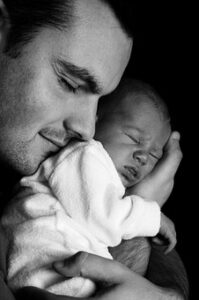 on body fat to prepare you for the world beyond the womb. And finally, about week forty, your mother’s contractions began, and you were ceremoniously pushed through the birth canal and into the delivery room with all its lights, sounds, smells, and chill. Someone announced your gender, made sure you were breathing, cut your cord, and perhaps gently placed you into the arms of your exhausted mother. If you are now relatively young, your father might have witnessed the birth or even coached your mother during the delivery. If you are old (like me) your Dad was probably out in the waiting room pacing.
What a miracle you are! As O’Malley writes, the whole marvelous you unfolded in the womb “gratuitously, with no cooperation or certainly no merit on your part. Wow! Thanks!”
Here are a few more facts:
1) What I described above, is an “ordinary” conception and birth. There are variables, of course: Multiple births, preemies, C-sections, births in a car or war zone, or babies entering the world damaged by their mother’s use of alcohol or drugs.
2) You have two parents, of course, and four grandparents. Each individual contributed to your genetic makeup: your bone structure, eye color, love for music, susceptibility to heart disease, distaste for beans. If you go back just ten generations, though, you have a whopping 1,024 great-great-great-great-great-great-great-great grandparents! And every single one of them was healthy enough and lived long enough to mate and produce a child!
3) Historically, royal births were often “public events.” When Marie Antoinette gave birth, there were 200 people in attendance. This was to make sure the baby was healthy and hers.
4) You and every other human being were once a single cell for about 30 minutes after conception.
5) Babies cry with an accent.

When reflecting on the miracle of our conception and birth, it seems appropriate to say a little prayer:
Creating God, we give you thanks for the miracle of our existence. We give thanks to our parents, grandparents, and distant ancestors who contributed to making us who we are. We pray for all parents and parents-to-be. Give them courage, wisdom, and love. We pray that all babies may be welcomed into our world and be tenderly cared for. And finally, may we use our precious gift of life to bring more life and love into our world. Amen.
What amazes you most about conception and birth?
Was there anything memorable about your conception and/or birth? (For example, I was conceived near Christmas. In February there was a big snowstorm. My mother shoveled part of our long driveway so my Dad could get into the driveway after work. She almost lost me, she said, but somehow I managed to stay in her womb until September. Otherwise you wouldn’t be reading this!)
Our “song” today is Psalm 139 recited by individuals who are wonderfully made. They remind us that we don’t have to be perfect to be precious.
I invite you to respond to this reflection, the questions, or the video below:
All about Woolly Bears
Where I live, it’s woolly bear season! Woolly bears (or woolly worms) are those cute little black and orangish-brown striped caterpillars you see crawling around in fall (depending on where you live). Found in the U.S. and southern Canada, wooly bears are really the caterpillar stage of the Isabella tiger moth.
Every woolly bear has 13 distinct segments. Their ends are black, but their center is that orangish-brown. Legend has it that woolly bears can predict the type of winter we are going to have. The more brown, the milder the winter. The more black, the more severe the winter.

In 1948 Dr. C.H. Curran, an insect expert, went to Bear Mountain north of New York City to see if that legend could be proven scientifically. For eight years he studied a small sampling of woolly bears. His conclusion: there seemed to be some truth to the legend. However, being a good scientist, he admitted his sampling was too small and his time frame was too short to prove or disprove the legend. Since then, other scientists have discovered that the width of the brown color can tell you the caterpillar’s age. The wider the brown, the older the caterpillar. This means, he (or she) hatched earlier in the season—which means the previous winter was milder! (You might have to read that sentence a couple of times!)
Woolly bears are gentle. They don’t bite, bark, or spit. Their only defense is to curl up into a ball. (There are some days I can identify with that posture!) Also, woolly bears always seem to be scurrying somewhere. Where are they going? They’re searching for food, of course. Wooly bears are “generalist eaters,” which means they aren’t picky. They eat a wide variety of plants.
More importantly, woolly bears are scurrying because they are searching for a suitable place to sleep for the winter. They like to nestle behind the bark of a tree or burrow under some dead leaves. Woolly bears don’t have to worry about freezing either because they have their own “anti-freeze”! When spring comes, the magic happens. Those cute caterpillars spin their cocoon and presto! They are transformed into Isabella tiger moths!
 Some places have woolly bear festivals. Vermillion, Ohio (just west of Cleveland) celebrates the woolly bear every year with costume contests for children and pets as well as 500 caterpillar races. It may not be the Kentucky Derby, but it’s great fun. Other places have festivals too in North Carolina, Kentucky, Pennsylvania, New York, and Ontario, Canada.
Here’s a story about my personal encounter with a particular woolly bear many years ago. I was waiting for a bus in Perrysville, PA, north of Pittsburgh. I was standing on a very busy street when, I looked down and saw a woolly bear heading straight towards the street. Aghast, I reached down, cupped him in my hands, and carried him away from the street. When I put him down, I carefully pointed him toward the west—away from the traffic. I went back to the bus stop. A few minutes later, I saw the same woolly bear heading for the street again. A second time I carried him to safety and directed him to “go west, young man (or young woman)!”
But a third time, he disobeyed my wise counsel and was heading for the street. Frustrated, I picked him up, checked both ways for traffic, and then ran across the street with him cupped safely in my hands. I then gently deposited him in some grass on the other side. When I put him down, he continued east, away from traffic, and headed toward a yard with an expansive lawn with big old trees. I remember admiring his determination. He knew exactly where he was going and was not deterred by the well-meaning nun who was frustrating his plan! In a way, I envied him, and wished I was always as clear about the direction of my life!
Woolly bears are cutest when they’re moving. So here’s a 90 second video that focuses on woolly bears moving. It’s appropriately called “Woolly Bears on the Move.”
Have you had any experience with woolly bears? As a child? As an adult?
Is there any other creature in God’s vast creation that intrigues you? or puts a smile on your face?
PS: This week I am making my annual retreat. I promise to hold all of you, the readers of my blog, in special prayer. I really appreciate your “patronage” to “Sunflower Seeds” and your beautiful and insightful responses.
The song today is “Holy Now” by Peter Mayer. I used it a few years ago, but I love it so much, I’m using it again. Mayer says we used to limit “holy” to specifically religious things like scripture, Mass, and holy water. But now he believes everything is holy—including all water, trees, a tiny chirping bird, and (we would add) even a scurrying woolly bear!
Now it’s your turn. Do you have anything to say about this reflection and videos? If so, please respond below!
The Spirituality of Shredding
I’ve been doing a lot of shredding lately. I’m cleaning out some of my storage boxes. I don’t want to leave all this “stuff” for someone else to have to deal with once I’m gone.
Most of my boxes are related to my years as a writer. I sold my first article on September 4, 1974. A writer remembers particulars like that. Other boxes are related to my retreat work and to those many talks I’ve given over the past four decades. I already pitched most of my teaching materials. One day (about 15 years ago) I realized I would never be teaching “The Rime of the Ancient Mariner” or the history of the English language again. So swoosh! I threw out my notes.
 So what is in my boxes that I am shredding now? Here’s a sampling:
1) acceptance letters for articles I’ve sold.
2) rejection letters for articles I didn’t sell. (I used to have hundreds of them. Early in my writing career I would post my rejection letters all over my office. They were of varying sizes, shapes, and colors. When a visitor would ask what they were, I’d say, “Rejection letters.” Then I’d add, “Notice how diverse they are. Yet, they all say the same thing: NO!” (I always remembered that Dr. Suess’s first book was rejected by 26 editors before the 27th one bought it.)
3) correspondence with editors (over the years I’ve had many wonderful, talented, and helpful editors.)
4) duplicate copies of my unpublished poems, short stories, and articles
The shredder we have here in our convent is a small one. I knew the volume of materials I was going to shred would demand a heavy-duty shredder. Fortunately, we have such a shredder at our provincial center. It shreds about 10-12 sheets at a time. The manual claims it can shred even staples, paper clips, and credit cards—though I’ve never tested that claim.
The shredder sits in a small windowless room in the basement. The only other things in the room are a two-drawer file cabinet (where the large plastic garbage bags are kept) and two small chairs to put your stuff on while you stand and shred. When you turn the shredder on, it makes a loud noise—like a hungry dinosaur. When you begin feeding the paper into its jaws, the noise gets even louder as it devours your pages and then spits them into the attached garbage bag. Here are a few of my thoughts while shredding…
1) Shredding is a violent act. Shredding entails a deafening racket and a brutal ferocity. The shredded paper is indecipherable. The pages are virtually gone. Of course, I’ve seen police dramas where forensic detectives glue the shredded paper back together and solve the crime. But my shreds are destined for a recycling center.

2) Shredding is a painful act. It’s not easy to shred certain materials. As I feed the machine, I glance at the pages and find myself saying, “This is my life! These pages represent years of my work and ministry. And in one instant, they’re all gone! Wow!” At times I feel as if I am being shredded. So painful is shredding, I often won’t even look at the papers I’m feeding into the machine so I can’t see what I’m shredding.
4) Shredding is a freeing act. Ironically, shredding also gives me a sense of exhilaration. Shredding is a profound act of letting go. When I shred, I find myself saying, “I don’t need this stuff anymore. That part of my life is over.” I find this extremely freeing.
5) And finally, shredding is a grateful act. As I shred, I find myself thanking God for my life that these pages represent. “Thank you God, for my editors… for my readers… for my students… for the gifts of writing and speaking… for your consistent inspiration… for my little successes… for my disappointments and failures which (I hope) have made me more humble and compassionate and trusting of You… Thank you, God, for my whole life which has led me to where I am now and who I am today. Amen.”
Have you ever used a shredder? If so, do you have any thoughts about shredding?
Have you ever had an experience where you felt God was asking you to let go? (perhaps you were downsizing… or cleaning out a deceased loved one’s belongings… or clinging to a relationship… or hanging on to the past.) What was that experience like for you? How did you feel? How long did the letting go take? What helped you to let go?
PS: I ask your prayers for two presentations. On Monday Nov. 5 I will be talking on Mary for the RCIA group at our parish, St. Mary Chardon. Then on Friday Nov. 9 I’ll be leading a retreat day for the pastoral staff of St. Noel Parish in Willoughby Hills, OH. Thank you for your prayers.
Our song today is called “Let Go,” and it’s by Matt Hammit. I think it captures well some of our fears about letting go.
Now it’s your turn! I invite you to respond to the reflection, the questions, or the song. My readers always tell me how much they look forward to reading your responses!