Ordinary People Doing Good Things
We hear enough these days about people doing mean or bad things: bullying a classmate, stealing from the elderly, driving recklessly, cheating the government, throwing garbage in a river, vandalizing a historic building. People doing bad things often makes the news. So today, let’s focus on true stories about ordinary people doing good things.

Food for firefighters
Two firefighters were waiting in line to order at a fast food place. Suddenly their siren sounded in their truck. They went to leave when a couple who had just received their orders, handed them their food. The firefighters accepted gratefully. The couple got back in line to order again. When they placed their order, the manager declined to take their money.
My mother’s flowers
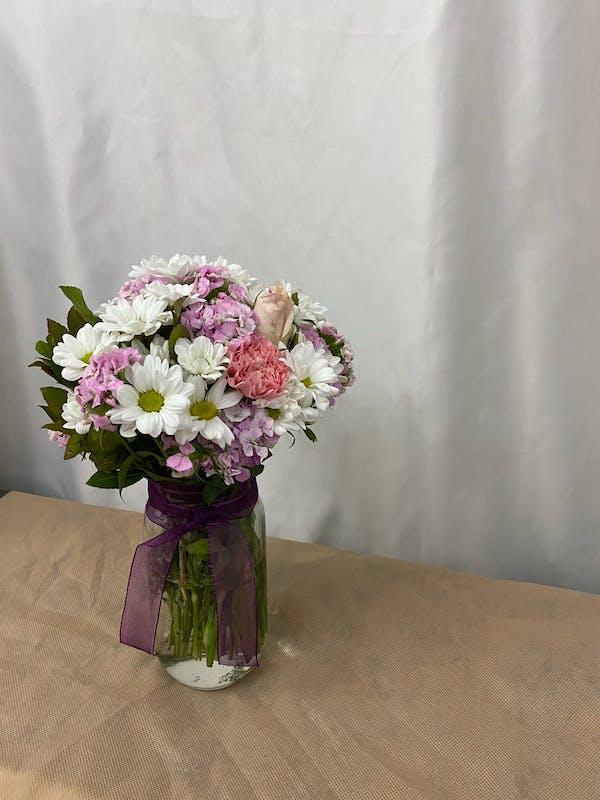
When the clerk in the supermarket tallied my groceries, I was $12 short. I began to remove some items from the bags, when another customer stopped me and held out a $20 bill. I started to protest, but he said, “Please let me do this. My mother is in the hospital with cancer. Everyday I visit her and bring her flowers. She insisted that I stop bringing the flowers and do something worthwhile with the money. So please accept this. It’s my mother’s flowers.”
My favorite blanket

When I was seven, my family was driving to the Grand Canyon. As we drove along the highway, my favorite blanket suddenly flew out the car window and was gone. I was devastated. A little while later we stopped at the service plaza. My mother and I sat on a bench to eat our sandwiches. But I continued to mope. Suddenly a motorcycle gang pulled into the parking lot. One big man, complete with a dark beard, got off his bike and walked toward us. He asked us, “Is that your blue Ford?” My mother nodded nervously. From his jacket pocket, the man pulled out my blanket and handed it to us. As he headed back to his bike, I ran after him and thanked him the only way I knew how: I gave him my sandwich.
Young hero on a bicycle

One day I locked both my car keys and my phone in my car parked in front of the grocery store. Angrily, I kicked one of the tires and muttered a few choice words. A teenage boy on a bike saw me, stopped, and asked if something was wrong. I explained the situation. “I can’t even call and ask my wife to bring me her car key, because this is our only car.” The boy said, “Here, use my phone to call your wife and I’ll get the key and bring it to you.” I protested, “But it’s at least a seven mile roundtrip.” He insisted. About an hour later he returned with the key. I offered to pay him, but he declined, saying, “That’s okay. I needed the exercise.” And he rode away.
Special needs cats
This last story is about a man named Terry. He volunteers at the Safe Haven Pet Sanctuary, a no-kill cat sanctuary, in Green Bay, Wisconsin. Every day he comes in and brushes the special-needs cats. Often he falls asleep. Safe Haven wrote an appreciation post on Facebook for Terry. Immediately people started donating money to the sanctuary in Terry’s honor. The donations soon exceeded $10,000. Safe Haven said, “We are lucky to have a human like Terry.”
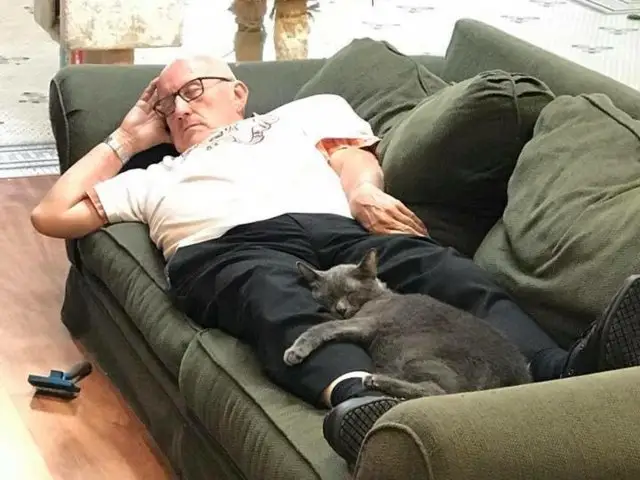
We could add: And the world is lucky to have human beings like the ordinary people doing good things in these true stories!
(Photos by Valeria Boltneva… Fatma Gul… Kevin Bidwell… and Tnarg at Pexels)
For reflection:
Do any of these stories speak to you today?
Have you ever been a recipient or a witness of an ordinary person doing a good thing? Would you like to share your story with us below?
Have you ever been an ordinary person who did a good thing to help someone else?
Our video is the song “Kindness” by Steven Curtis Chapman. I think he makes a good point in this song…
I welcome you to add a comment below. We all love to hear from you!
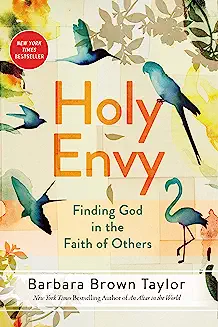
“Holy Envy: Finding God in the Faith of Others”
Holy Envy: Finding God in the Faith of Others is another inspiring book by Barbara Brown Taylor. You may recall, she is an Episcopal priest who, after years as a pastor, moved into the world of Academia beginning with Piedmont University in Demorest, Georgia. There for years she taught a course in world religions. She reminded her students that by taking them on field trips to other places of worship, she was not trying to convert them from their own religious beliefs. On the contrary, by studying other believers she hoped they might come to a new understanding of their own faith.
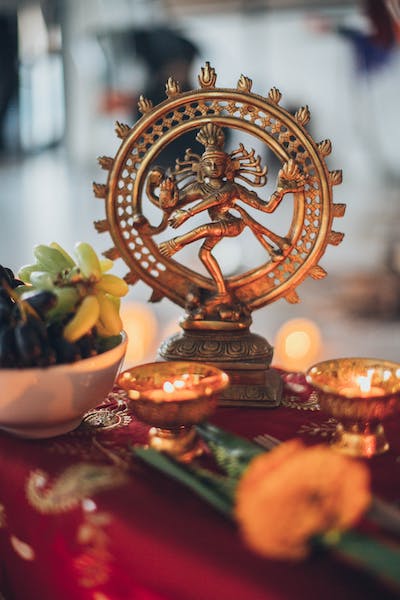
She reminded her students that the United States is a pluralistic society. She added that it always has been. Muslims were in this country by 1528, Jews in 1654, Hindus by 1851, and Buddhists in the mid 1880s. In 1860, for example, 10% of the population of California was Chinese. The restrictive immigration law of 1924 was an attempt by Congress to limit or deny immigration to certain groups of people “to preserve the ideal of American homogeneity” (which didn’t really exist!) American homogeneity in 1924 usually meant white, Christian, and of northern or western European descent . This law, based on the 1890 census, established a quota system for immigration. It also essentially excluded immigrants from Asia (except from the Philippines) and severely limited immigrants from southern and eastern Europe (where my grandparents came from in about 1905). The 1924 law was modified over the years and dramatically changed by the Immigration Act of 1965, signed by President Lyndon Johnson at the foot of the Statue of Liberty. Currently, the U.S. (and, indeed, many other countries in the world) are more pluralistic than ever. Taylor says, “Religious illiteracy is a luxury we cannot afford.”
The phrase “holy envy” can be traced back to a Biblical scholar named Krister Stendahl, a Swede who taught at Yale and eventually became Bishop of Stockholm. In 1985 he became aware of the mounting opposition to a new Mormon temple being built in his diocese. He attempted to defuse this tension by proposing three rules of religious understanding:
- When trying to understand another religion, you should ask the adherents of that religion and not its enemies.
- Don’t compare your best to their worst.
- Leave room for holy envy. (In other words, is there anything you envy about this other religion—something its adherents believe, have, or do that you would wish for your own faith? Or, can you find God in the faith of others?)

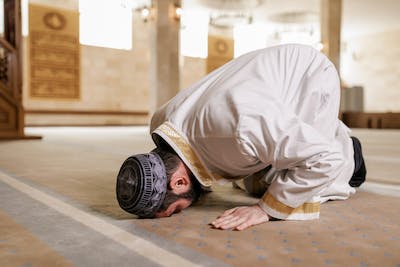
Sometimes this holy envy changed the way students viewed the practice of their own religion. For example, when the class learned that Muslims pray five times a day, many of her students were impressed. One Protestant student said she wanted to incorporate more regular “talking with God” into her daily life. When they learned about the Muslim Ramadan, a month of fasting, prayer, and community, one student said he never paid much attention to the observance of Lent in his Catholic tradition, but now he wanted to.
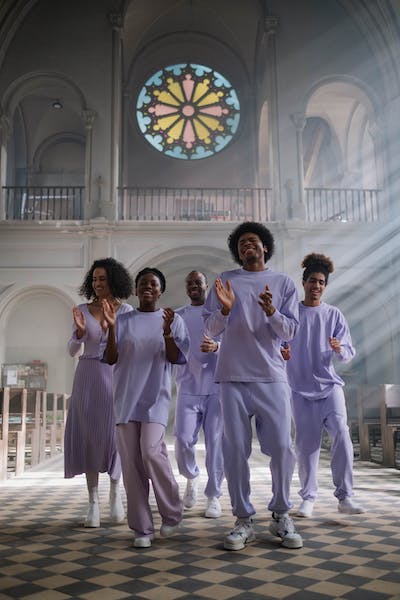
Taylor shares some of the things she herself envies in other religions. She envies Buddhism’s stress on “human ability and responsibility.” Buddhism does not talk about God. And Buddha himself is not God. As he lay dying, his followers asked how they could possibly go on without him? Buddha replied, “Be lamps unto yourselves. Rely on yourselves, and do not rely on external help. Hold fast to the truth as a lamp.” This reminded Taylor of Jesus’ words: “You are the light of the world.”
She also found it intriguing that neither Judaism nor Islam has a doctrine of original sin. She pondered how the absence of this doctrine impacted Judaism and Islam—and how the presence of this doctrine impacted her own Christian faith. She also found it striking that Judaism is not interested in making converts. What a contrast to some other faiths. For even a cursory reading of history is filled with so-called “religious wars” where one religious group resorted to violence to convert (or destroy!) those who did not share their religious beliefs.
I found chapter 7, “The Shadow-Bearers” to be one of the best. As you may recall, 9-11 occurred on a Tuesday. Taylor had already lined up her class field trip to a local mosque for Friday. Sixteen students had signed up to go. But after 9-11, eight dropped out. One said her father told her to drop the course “before you get recruited to ISIS.” Taylor quotes from Jonathan Sacks book, Not in My Name, who says it is not our religion that makes us violent. “It is our penchant toward violence that gives rise to our religious impulse.” He believes humans are born with two sets of instincts: “altruism toward those in our own group and aggression toward others.” We develop psychological mechanisms such as projection and scapegoating that allows us to assign goodness to our group and badness to the other group. Says Taylor, “This relieves us from having to deal with the badness in our group; it also frees us to believe that our violence against the other group is essentially altruistic.”
I agree with Fr. James Martin’s assessment of Taylor’s book: “By turns inspiring, enchanting, and provocative, Taylor reminds us that God is bigger than any one religion. Prepare to be surprised and, best of all, come to know God in a new way.” Let me conclude with Taylor’s description of what happened during one the her class field trips to a local Mosque:
The imam ended his meeting with the students by saying, “Our deepest desire is not that you become Muslim, but that you become the best Christian, the best Jew, the best person you can be. In the name of God, the Most Gracious, the Most Merciful. Thank you for coming.” Says Taylor, “Then he was gone, leaving me with a fresh case of holy envy.”
For reflection:
Did anything in this reflection stand out for you? Do you know why?
Have you ever had a conversation with someone not of your faith to learn more about their faith? If so, describe that experience.
Have you taken a course, read books, attended talks, or listened to podcasts on world religions? If so, what did you learn?
Have you ever visited a place of worship other than that of your own faith? What was that experience like for you?
PS: As I’ve mentioned before, I realize many of you are no longer receiving my blog even though you are subscribers. I’ve been told that I have too many subscribers for the current system to deal with. The IT people are looking for a solution. Meanwhile, my blog is being updated with a new design. In fact, this week I am zooming with the artist who is offering me several designs to choose from. If you are no longer receiving my blog automatically every Monday, just search “Melannie Svoboda blog” and my blog should come up for you. Thank you for your patience.
For our video today, I chose a reading of Psalm 23 in Hebrew with an English translation. Most scholars say Jesus spoke Aramaic and Hebrew and perhaps some Greek. I love listening to the reciting of this beautiful psalm in perhaps the very words Jesus would have prayed. The pictures that accompany this reading are lovely too.
I invite you to respond below to anything in today’s reflection: words, pictures, video, reflection questions. I always enjoy hearing from you! (And my readers do too!)
Consider the Dandelion…
Consider the lowly dandelion. Is there any other plant more detested by gardeners, lawn-lovers, and golf-course keepers? Just search “how to get rid of dandelions” online and dozens of products come up from highly toxic weed killers (one warns that their product, if not used correctly, can kill bushes or even nearby trees!) to the “Garden Guru Dandelion Weeder Tool with Ergonomic Handle.” (Try saying that fast three times!) In short, dandelions are often labeled invasive, unwelcome, intolerable, loathsome. They are a good-for-nothing weed.
Or are they?
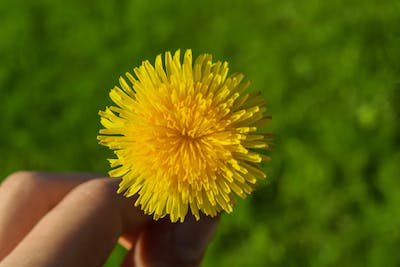
If you take the time to look at a dandelion flower up close, you will see it is quite beautiful–especially its bright golden color. And another beautiful thing about the dandelion, is its magical transformation from a silky yellow flower to a round seed head of white fluffy little parachutes—with a single seed attached to each one. When the conditions are right, these parachutes are so highly effective that they can be dispersed by the wind to distances almost a mile away!
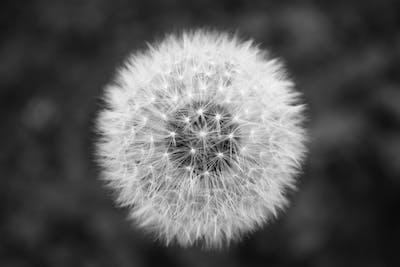
The popular name dandelion is a corruption of the French dent de lion (tooth of the lion) which refers to their jagged leaves. As a child, I thought their name was really “dandy lion” because the flower resembled a lion’s mane! Writer Howard Hanger, in his book Drink Deeply with Delight, says this about dandelions: “That lowly, bad-mouthed weed is one of the gutsiest and most amazingly beautiful and prolific plants in all of creation.” No matter what poisons we humans pour on them, no matter how often we mow them down or dig them up, dandelions just seem to keep coming back.
Maybe what dandelions need is a better public relations firm, one that will highlight their good qualities. For example:
1. Dandelions evolved 30 million years ago in Eurasia. Since the entire plant is edible, they have been an important food source for both humans and other animals for thousands of years.
2. Some ancient peoples (such as the Chinese) used dandelions for medicinal purposes.
3. Their raw leaves are high in Vitamin A, C, and K.
4. Some farmers plant fields of dandelions to attract pollinating insects for their crops. Dandelions also release ethylene gas which helps to ripen fruit.
5. Their yellow flowers can be ground into a powder and used as a yellow dye.
6. And folklore tells us if you make a wish while blowing on a dandelion seed head, your wish will come true!
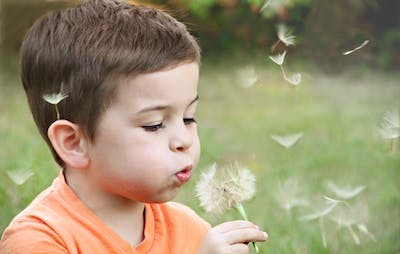
When writing about the dandelion, Howard Hanger makes a good point: maybe we should think of ourselves as dandelions: “imbued with creative power and resilience. Capable of great beauty and magical transformation… Or, if you have trouble with that comparison, simply remember that you’re made by, and of, the same spirit as that magically poetic, courageous and goofy little plant.”
For reflection:
What has been your experience with dandelions? Have you ever waged war against them? Have you ever eaten them or made wine or honey from them? Have you ever put them in a vase in your house?
Have you ever showed the resilience of the dandelion in your life? In other words, have you ever shown courage, gutsiness, or perseverance?
PS: Thank you for your prayers for the retreat I led last week at Villa Marie Pauline Retreat Center in Mendham Borough, NJ. We had about 32 Sisters from various religious communities. How much I enjoyed being with them! I also want to thank Sister Monique, SCC, for taking care of all our needs during the week. She was kind, gentle, and generous to all!
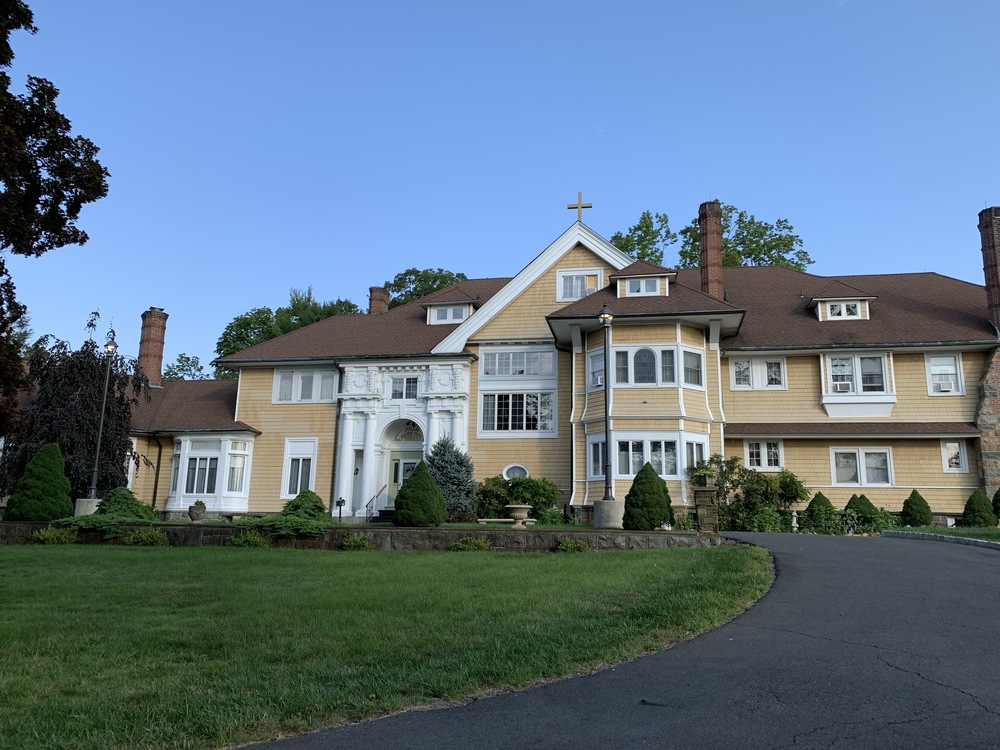
Here is a picture of Villa Marie Pauline sponsored by the Sisters of Christian Charity. It is absolutely beautiful! And the view of the valley from the back porch is awe-inspiring. If you’re looking for a retreat center, you might want to check it out on line.
I have two good videos for you today. The first, using time lapse photography, shows (in1min.) the magical transformation of the dandelion from golden flower to white puffy seed head. The second (9 mins.) is a captivating contemplative video called “The Beauty of an Ordinary Life.” It features a woman in the English countryside, a lover of dandelions, who enjoys making dandelion honey syrup.
Request for prayers: I just received word that four Sisters of Mercy of Rochester, NY, were in a terrible car accident this morning, Sunday. One sister, Audrey, was killed. Another, Joanne, is in critical condition. The other two do not have life-threatening injuries. They were at their community’s vacation house and were on their way to Mass. Please pray for everyone involved in the accident as well as all the Sisters of Mercy. My heart goes out to all their Sisters. You may recall, I gave a retreat to this congregation in April. Both Arlene and Joanne were on that retreat… I thank you for your prayers.
Time lapse photography of a dandelion (1min.)
“Beauty of an ordinary day… making dandelion honey. (9 Mins. with closed captions available)
I would love your comments on this post: the reflection itself, the pictures, the two videos, your additions or insights. Please share some of your thoughts below. My readers (and I!) enjoy reading what you have to say!
Widening and Deepening our Human Perception
A few weeks ago, I mentioned a book I was reading, Jennifer Ackerman’s Notes from the Shore. For my June 5th post, I wrote about the “homing instinct,” an instinct so beautifully exemplified in ospreys. Ackerman shares many other facts in her book that amazed me. Here’s another one. Astronomer Harlow Shapely said that human beings “lie midway between the sun and the atom, in both grams of mass and centimeters of diameter.” As a consequence, “narrow is the world” to which we humans are attuned. He adds, “So much that matters is invisible by the yardstick of human life.” This means many things are just too vast or too small for our perception, or they occur too fast or too slow for our perception.

Ackerman asks, how can we “shatter (our) scale-bound thinking” and perceive more deeply and widely? That’s an important question—on many levels. First of all, we must realize that we live with a perception that is restricted not only by our size and the limits of our senses—and the instruments we have invented to expand our perception. But also our perception is restricted by things such as our experience, imagination, curiosity, education, and sensitivity. Ackerman demonstrates this limitation by opening the readers’ eyes to the world in a few grains of sand on the beach.
When she examines a handful of damp sand, she notes that there is much more there than meets the eye. The grains themselves are composed of granite, quartz, pink feldspar, crushed shells, silica, tiny fragments of heavy metals—and much more! If you spread a few grains under a microscope and “an exotic world is revealed.” Each grain is surrounded by moisture that is filled with life: insects, copepods, ostracods, nematodes, protozoa, gastrotrichs, tardigrades—each organism measured in microns (a mciro is 1/25,000 of an inch!) and perfectly suited for this teeny-weeny habitat in which it swims, feeds, and multiplies.
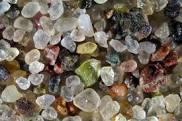
Ackerman then describes even smaller forms of life living between and on the grains of sand (See microscopic image of sand on the right.) Among these small forms of life are bacteria and diatoms. She writes, “A single grain of sand can support hundreds of colonies of bacteria, each composed of hundreds of individuals, as well as twenty or thirty diatoms of different varieties—all residing in the craters, scarps, and troughs of the grain.”
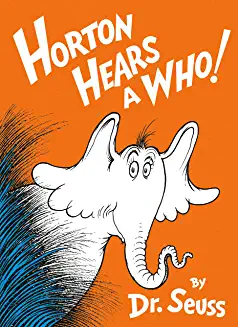
Her description reminded me of the Poet Blake’s “a world in a grain of sand, eternity in an hour.” It also recalled one of my favorite children’s books by Dr. Seuss called Horton Hears a Who. Written in 1954, this book has been translated into 30 languages and has sold hundreds of millions of copies. It became an animated movie in 2008. The book tells the story of Horton the elephant who discovers a tiny planet called Whosville located on a speck of dust on a clover blossom. When Horton shares his discovery with some of the other animals, they mock him and try to destroy the speck. But Horton does all he can to defend the planet. His mantra is, “A person’s a person no matter how small!”
We might not be able to spend hours peering through a microscope or viewing pictures from the Webb telescope. But there are other ways we can regularly expand our vision: by reading a book we wouldn’t ordinarily read… by listening to music that lies outside our comfort zone… by worshiping in a parish very different from your own… by dining in a restaurant we have never been to—like an Ethiopian restaurant perhaps… by conversing with someone who is unlike us in age, gender, political leaning, religious background… or by driving home by unfamiliar roads. Such practices can remind us of two great truths: How vast is the world in which we live! And what must God be like—the Origin of this universe—with all its vastness and teeny-ness, its diversity and unity, its mystery and magic?
For reflection:
Do you remember looking through a microscope or a telescope as a child, as an older student? What was that experience like for you?
Name one aspect of nature that fascinates you today? Why?
Did you read Horton Hears a Who as a child—or have you ever read it to a child? If you have, reflect on these experiences for a few moments.
I’m offering two videos today. The first is a beautiful song, “Open My Eyes, Lord” by Jesse Manibusan. The second is a fun reading by Miss Jeannie of Dr. Seuss’ book, Horton Hears a Who.
Video: “Open My Eyes, Lord.”
A reading of the book, Horton Hears a Who. Treat yourself to this 12 minute reading. Bring a child with you!
I invite you to respond below to today’s blog—the words, the pictures, the videos…
What Is Freedom?
As we celebrate the Fourth of July in the USA, let us reflect on the gift of freedom.
What is freedom? I like this definition: “Freedom is nothing else than the chance to be better.”
Why have we been gifted with freedom? Only this: to love.
We might think, “I want to be free to do what I want to do.” Yes, but we are truly free only if what we want to do is the loving thing.
We might say, “I want to be free to be myself.” Yes, but only if that self is a loving person.
Or we might say, “I want to be free to be whole.” Yes, but only if our wholeness leads to loving.

None of us is completely free.
And blessed are those who recognize their servitude, whether it be fear, compulsion,
self-centeredness, laziness, pettiness, arrogance, pride.
Servitude takes many forms.
But, as St. John of the Cross reminds us,
a bird tethered by a gossamer thread
is just as unable to fly as one held by a steel cable.
Freedom is not very neat.
It can be messy at times.
Tyranny is always bettered organized.
Freedom is never achieved once and for all either.
From conception to death we are all engaged in the process of personal liberation.
Those individuals are most free who tread this earth lightly
with open hands
and with joy.
Freedom is collective and communal too.
A threat to freedom anywhere is a threat to freedom everywhere.
Conversely, the more free I personally become,
the greater the potential for freedom for all of us.
Freedom costs. One cost is “eternal vigilance.”
Another is perseverance,
perseverance in the daily wrestling with light and darkness
that leads to the coming of the Reign of God in my soul,
in my country,
and in the world.
Jesus was free. Utterly so.
He was free to come, free to go.
Free to speak, free to remain silent.
Free to give, free to receive.
Free to teach, free to listen.
Free to be gentle, firm, angry, surprised.
Free to laugh, free to cry.
Jesus was never more free than when he was nailed to the cross on Good Friday—
except, perhaps, when he danced out of that dark tomb
as the sun was rising on that first Easter morning!
On this Independence Day, let us thank God for the precious gift of freedom we share in this country. And let us work tirelessly for all those within our borders who do not yet enjoy the freedoms that are rightfully theirs.

Is there anything that stands out for you in today’s reflection?
Would you add anything to this reflection on freedom?
PS: I ask your prayers for a retreat I will be leading from July 6-13 at Villa Pauline Retreat Center in Mendham Borough, NJ. I know your prayers mean a lot to the retreatants—and to me! Thank you!
As we celebrate our Independence Day, I was drawn to post two videos for your inspiration today. The first one is music by Max Richter. (I thank my friend Diana for introducing me to his music.) This piece is entitled “All Human Beings” and it includes the recitation of the United Nations Universal Declaration of Human Rights, written in 1948! (Captions are available.) It is good to reflect on how far the world has come since 1948, but how much further we still need to travel to make these beautiful words a living reality.
Our second video is “A Tribute to All Nations” based on “Finlandia” by Jean Sibelius. I know I’ve used this video before, but it is so beautiful and very appropriate for our holiday.
As usual, I invite you to comment below to anything on today’s blog—words, pictures, and especially the two videos! We all love hearing from you!