“You’ll Be My Arms, I’ll Be Your Eyes”
Today I’d like you to tell you the remarkable story of two men: Jia Haixia and Jia Wenqi. They live in a small village in rural China and have been friends since they were boys. Haixia was blind in one eye at birth from a cataract. Then he lost his sight in the other eye in a factory accident. When his friend Wenqi was only three, he lost both arms when he touched a downed power line. When Haixia became blind, he became severely depressed. Wenqi knew he had to find something for the two of them to do that would give his friend (and himself) a sense of purpose in life. That’s when they decided to plant trees together in their village greatly polluted by industrial emissions from the local quarry.
These two videos tell their amazing story. I recommend the first one, because you hear their story from the men themselves. I hope you can afford the time to watch this inspiring 11 minute video. But if you’re cramped for time, then you can watch the second video which is less than 5 minutes. As usual, I will offer a music video at the end for our prayer.
Video #1: “A Blind Man and His Armless Friend Plant a Forest in China” (10 min. and 58 sec.)
Video #2: “Armless man and blind friend plant over 10,000 trees” (4 min. 22 sec.)
Our music video today is one of my favorites. It’s the song “Stand By Me” sung by people all over the world. It is produced by “Playing for Change.” You might enjoy looking up some of their other songs.
I welcome your comments about anything in today’s blog that touched you or caught your attention.
20 Quotes for Hard Times
This week I want to share some quotes from an article I wrote many years. If you’re experiencing some hard times, I hope these quotes might speak to your heart.
1. Good is never done except at the expense of those who do it. (John Newman)
2. Do not let what you cannot do interfere with what you can do. (John Wooden)
3. Failures aren’t failures if you learn from them. (Anne Morrow Lindberg)
4. There are no shortcuts to anyplace worth going. (Beverly Sills)
5. When God closes a door, God opens a window. (Gerald Bath)
6. God gives every bird its food, but God does not throw it into the nest. (Josiah Holland)
7. The rower reaches the shore, partly by pulling, partly by letting go. (Egyptian proverb)

8. The person who makes no mistakes, never makes anything. (English proverb)
9. To live is to adapt. (Goethe)
10. The greatest discovery of my generation is that a human being can alter their life by altering their attitude. (William James)
11. The lowest ebb is the turn of the tide. (Anonymous)
12. Pessimists complain about the wind. Optimists hope it will change. Realists adjust the sails. (William Arthur Ward)
13. There are some things you learn best in calm, and some in storm. (Willa Cather)
14. Where you stumble and fall, there you will find pure gold. (Carl Jung)
15. No Christian escapes a taste of the wilderness on the way to the Promised Land. (Evelyn Underhill)
16. For every complex problem there’s a solution that’s clear, simple, and wrong. (H. L. Mencken) Adversity introduces us to ourselves. (George W. Bush)
18. See all, overlook much, improve a little. (Pope John XXIII)
19. Love and suffering are the primary spiritual teachers. (Richard Rohr)
20. Life is never so bad at its worst that it is impossible to live; it is never so good at its best that it is easy to live. (Anonymous)

For reflection:
Do any of the quotes speak to you today? Why?
Do you disagree with any of the quotes? Or would you modify any of them? Why?
Our song today is a song by Carey Landry: “Peace Is Flowing Like a River.” This is a gentle version with lyrics and nature pictures. I hope it brings you peace…
I welcome your comments below! I always love to hear from you!
Asking for What We Need
Here’s a quote I’ve been carrying around with me for almost 27 years. It’s from the book How to Argue and Win Every Time (1995) by Gerry Spence. He writes:
Wisdom does not usually fall from high places. The mighty and splendid have taught me little in life. I have learned more from my dog than from all the great books I’ve read. The wisdom of my dog is the product of his inability to conceal his wants. When he yearns to be loved, there is no pouting in the corner. There are no games entitled “Guess what is the matter with me.” He puts his head on my lap and looks up at me with kind eyes, waiting to be petted. No professor or sage ever told me I might live a more successful life if I simply asked for love when I needed it.

These words made me ask: why is it sometimes so hard for us humans to express our needs to others? I came up with several reasons. First, we may lack the humility to admit that we even have needs! Our current culture stresses independence and self-reliance so much, we may be embarrassed by our simple needs for attention, tenderness, and companionship. Or maybe we assume (incorrectly) that our loved ones should already know our needs. And if we have to tell them what we need, they somehow don’t love us very much.
But perhaps there’s a third reason we don’t express our needs to others: We don’t even know what our needs are! How important it is, then, to live a reflective life, that is, a life when we regularly pause and ask ourselves questions like these: “How am I doing?… How am I feeling?… How are things going in my life right now?” Many well-adjusted and essentially happy people reflect on such questions during their prayer time, that is, during their regular communion with God.
Jesus encouraged his followers to know and to express their needs. In fact, if we look at the prayer he taught his disciples, the Our Father, we see it is a prayer composed of seven petitions addressed to God. In Matthew’s version of the prayer, the first three petitions are “thy” askings: Hallowed be thy name… Thy kingdom come… Thy will be done.
The remaining four are “us” petitions: Give us today our daily bread… Forgive us our trespasses… Lead us not into temptation… but deliver us from evil. By giving us this prayer, Jesus is underscoring the importance of petitionary prayer. Such prayer presupposes not only that we are in touch with our deepest needs, it demonstrates that we trust enough to express these needs even to God!

The Christian life means more than simply identifying and expressing our needs, of course. The mandate of love permeates Jesus’ message. This means we must also be attentive to the needs of others—those close to us and those living in the wider world. But the two movements are closely connected. Jesus was amazingly attentive to those around him precisely because he was in touch with his own needs. And he wasn’t afraid to reach out to his friends and disciples when he needed rest, companionship, a good home-cooked meal, feedback about his ministry, and time alone to pray.
So, let us learn a valuable lesson from our dog or other pets. Let us admit our needs to ourselves and share them with our family, close friends, and most of all with our Beloved God. Amen!
For reflection:
1) Is it easy for you to express your needs to others? Why or why not?
2) Do you regularly express your needs to God in prayer?
3) What helps you to be attentive to the needs of others?
4) Has your dog (or cat or other pet or animal) ever taught you an importance lesson about life? If so, what and how?
Here is a fun video about dogs, cats, and other pets. It’s called “Don’t Leave without Me,” and is a parody of Adele’s song “Easy on Me.” Perhaps your pets sing this song to you whenever you leave the house without them…
I welcome your comments below! I’m always eager to read what you have to share with us!
Letting Go of Numbing in Our Lives
As we journey through life, we experience both positive and negative emotions. Positive emotions for most of us would include these: joy, gratitude, awe, love, serenity, hope, interest, a sense of purpose, satisfaction. Negative emotions might include these: fear, sadness, loneliness, inadequacy, shame, frustration, helplessness, failure. In short, we tend to welcome the positive emotions into our lives. At the same time, we tend to shun the negative ones. Who says, “I feel so lonely and afraid… Yippee!”?
Because negative emotions tend to make us uncomfortable, we sometimes try to numb them. There are all kinds of things we can use to numb or take the edge off negative emotions. In her book, The Gifts of Imperfection, researcher Brene Brown lists many things that, if used excessively, can numb us to our pain. One big one is alcohol or other drugs. But other “stuff” can be used as anesthetizers too, such as work, food, sex, gambling, staying busy, shopping, surfing the internet, and seeking constant change.

It is important to remember that both positive and negative emotions can play a significant role in our maturing process—and in our spiritual life. In fact, God often “speaks” to us through our positive and negative emotions. When I give talks on hope, I often quote St. Augustine who said that anger (which we often think of as a negative emotion) is one of the daughters of hope! How can that be? An example might help. We can experience rightful anger when we see an injustice, that is, when we see something that should not be—like bullying, racism, sexism, human trafficking, elder abuse. Our anger can be the impetus we need to help right a wrong.
Brene Brown devotes a section in her book on the role numbing can play in our lives. She begins with this honest acknowledgement: “I’ve spent most of my life trying to outrun vulnerability and uncertainty,” the essence of negative emotions. We all have our little (or big) anesthetizers when we’re experiencing our vulnerability. One of mine is work. I can throw myself into my writing as a way to numb uncomfortable emotions. But taking time to deal with my pain, sadness, or anxiety can be very beneficial for my personal growth.
As I read Brown’s words, I thought about Jesus. Even a cursory reading of the gospels shows us that he did not go through life anesthetized. On the contrary, Jesus allowed himself to experience both positive and negative emotions. Here are a few examples:
+ He experienced positive emotions: the love of his parents and extended family… the companionship of close friends… the joy of parties… the satisfaction of drawing large crowds… his deep sense of purpose… the fun of playing with children… The delight of finding an extraordinarily compassionate Roman soldier… the awe of going up into the hills to pray… the gratitude for creation… the comfort he found in nature as a reflection of his Father’s love and care… his profound intimacy with God nourished by his daily prayer.

And Jesus experienced negative emotions as well: the animosity of religious leaders… his disappointment when his closest disciples didn’t get his message… the disconnect with some of his family members… the deep sadness at the deaths of John the Baptist, the son of the widow of Naim, and his good friend Lazarus… his helplessness to touch Judas’ heart… his sense of failure as he realized his mission was taking him to the cross… his utter loneliness—most especially in Gethsemane… the sense of abandonment on the cross when he cried out, “My God, My God, why have you forsaken me?”
At the end of her section on numbing, Brown raises the question: What helps us live with negative emotions and with uncomfortable vulnerability in a resilient way? Her book (though not a religious book per se), gives this answer: spirituality. Brown defines spirituality as “connecting with God.” She says when we are dealing with anxiety, stress, trauma, it is spirituality that can give us “a sense of purpose, meaning, and perspective in our lives…. (Without these) it is easy to lose hope, numb our emotions, or become overcome by circumstances.”
Let us conclude this reflection with a short prayer:
Loving Jesus, help me to remain open to life… to all of life. Help me to embrace the positive emotions I may experience on any given day: love, joy, gratitude, serenity, hope, awe, satisfaction, a sense of purpose… And help me to accept the negative emotions too: fear, sadness, loneliness, shame, frustration, helplessness, failure. May I realize that you can speak to me through all my experiences—and not merely the ones I find comfortable. And it is by engaging with my life experiences that I can grow into the person you are inviting me to become. Jesus, you drew your strength and resiliency for living from your intimacy with the Father, an intimacy nourished by your life of daily prayer. I ask for the grace to follow in your footsteps. Amen.
For reflection:
Did anything in this reflection stand out for you? If so, what?
Do you ever try to numb negative emotions? If so, what do you use as an anesthetizer?
Has an experience of a negative emotion or your vulnerability ever led to growth in your life? Are you a better person because you acknowledged and worked with your negative emotions?
PS: Reminder: if you are a subscriber and you are not receiving my blog in your email, just google “Sunflower Seeds blog Sister Melannie” and it should come up. I apologize for this inconvenience.
St. Paul writes, “We know that all things work for good for those who love God” (Rom. 8:28). This song by Jaime Jamgochian is based on that belief. Whatever may be happening in your life right now, whether positive or negative experiences, trust that God can use everything in your life to bring about good.
I welcome your comments below!
Reflection on “The Helping Hand” by Renouf
(Please note: I know many of you are no longer receiving my blog in your email. I’m so sorry! Right now, our IT people can’t seem to find the problem. Until it is fixed, though, you can find my blog by using Google or Safari or whatever search engine you employ. Just type in: Sunflower Seeds blog Melannie Svoboda, and it should come up immediately. I apologize for this inconvenience.)
I first saw Renouf’s painting, “The Helping Hand,” in a small art store in Virginia in the late 1980s. I immediately fell in love with it. As I gazed upon it, I was struck by the fear I saw in the little girl’s face. At the same time, I was moved by the tenderness I saw in the old sailor’s face. I eventually concluded, “I’m like that little girl… And that old sailor—her grandpa perhaps?—is like God.” Some friends bought me a print of the painting, they had it framed, and now it hangs above my couch. One day as I prayed with the painting, I wrote this short dialogue:
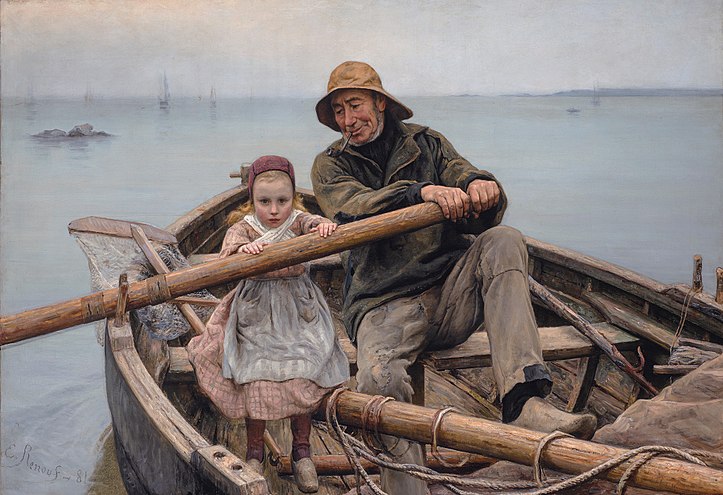
Grandpa, I’m afraid.
I’m right here beside you, my child.
Grandpa, this oar is too big for me.
Just keep your two little hands on the oar, Honey. And always remember, my big hands are on the oar with your little hands.
Our boat is so small, Grandpa.
It’s big enough for you and me and all we need for our journey.
**************************************************************************************
Grandpa, it’s so foggy.
Yes, it is, my child. Some days are foggy. Some are stormy. Some are rainy. Some are sunny. And some days can’t seem to make up their mind what kind of a day they want to be. But just remember, I am with you no matter what kind of a day it is.
Grandpa, I can’t see where we’re going.
That’s okay, Honey. I know these waters well… And I’ve already been where we’re going.
Grandpa, I think I want to go home.
That’s where we’re going, Honey. Home. You and me together. We’re on our way home. Trust me.
******************************************************************************************
I’m so glad you’re here beside me, Grandpa.
And I’m so glad you’re here beside me too!
Grandpa, I’m still afraid… a little.
Well, guess what. I have enough peace and love for the two of us. When you’re afraid, just scoot a little closer to me.
Grandpa, guess what.
What, Honey.
I love you soooooo much!
Why, thank you soooooo much! And guess what.
What?
I love you even more! In fact, I loved you first! And guess what.
What?
My love for you will never end!
*******************************************************************************************
Sit with the painting for a few moments. Does anything else in the painting catch your attention? If so, what?
Sit with the reflection for a few moments. Did any words in the dialogue resonate with you? If so, what?
Are there any pictures or paintings that you have used for your prayer? Would you recommend any of them for us?
PS: When I gave that retreat with the Medical Mission Sisters last week, I had the privilege of meeting Sr. Miriam Therese Winter, one of their sisters known for the many songs and hymns she has written. When I was a young nun, we sang many of her popular songs including “Joy Is Like the Rain,” “I Cannot come to the Banquet,” and “The Visit.” Perhaps some of you too are familiar with her music. Here is a picture of the two of us meeting:

Since today’s reflection focuses on the image of God as a grandparent, I chose a song that I’m dedicating to all of you who are grandparents or who might be missing your grandparents right now. It’s called: “Child of My Child: A Grandparent’s Prayer.” It’s put out by New Family Music and is sung by Jennifer.
I welcome you to comment below. We all enjoy hearing from you!