
Humor Time Again
If you’ve been reading this blog for a little while, you already know that one of my big pieces of advice is this: Hang on to your sense of humor! So today, here are a few items that I hope with bring a smile to your face. A few of these may make you groan—but that’s okay too!
1) My poor knowledge of Greek mythology has always been my Achilles’ elbow.
2) The older I get, the earlier it gets late.
3) Remember, if you lose a sock in the dryer, it comes back as a plastic lid that doesn’t fit any of your containers.
4) I run like the winded.
5) The lawyer opened the will of a deceased client and said to the eagerly awaiting heirs, “This is a surprise! He left it all to me!”
6) A boy went into a toy store, picked out a miniature car, took it to the cashier and handed him some Monopoly money. The cashier said, “This money isn’t real, Kiddo.” The boy replied, “That’s okay. Neither is the car.”
7) We’ve all heard that a million monkeys banging on a million computers will eventually produce the complete works of Shakespeare. Thanks to the internet, we know this isn’t true.
8) Did you hear the one about the roof? Never mind. It’s over your head.
Okay, okay I can hear some of you groaning. So let’s move on to a few funny definitions:
9) Synonym: a word used in the place of the one you can’t spell.
10) latte: Italian for “you paid too much for that coffee”
11) feet: a device used for finding legos in the dark.
12) immature: a word used by boring people to describe fun people
13) don’t try this at home: it means “try this at a friend’s house instead”
14) teenager: when you’re too young to do half the things you want to do and too old to do the other half
15) smile: a curve that sets everything straight

Now it’s time for some books. How about these culinary classics?
War and Peas… Lord of the Pies…
Animal Flan… Quiche 22… Pride and Prunejuice
And here’s a list of phrases we say today that (believe it or not) we owe to Shakespeare:
In a pickle… heart of gold… vanish into thin air… laughing stock…
dead as a doornail… good riddance…
send him packing… lie low… wear your heart on your sleeve…
brave new world… makes your hair stand on end… and wild goose chase.
And finally, here’s an answer to that questions we’re all asking: Are computers masculine or feminine?
A teacher gave that question to his class of adults. He then split them into two groups, women and men. They were to give their answer to the question and then give four reasons for their decision.
The women decided that computers are masculine because:
1) in order to get their attention, you have to turn them on.
2) they are full of data, but still clueless.
3) they are supposed to help you solve your problems, but most of the time they are the problem.
4) as soon as you commit to one, you realize that if you had waited a little longer, you could have had a better one.
The men decided that computers were feminine because:
1) no one but their creator understands their internal logic.
2) the language they use to communicate with each other is totally incomprehensible.
3) even your smallest mistakes are stored in their long-term memory for later retrival.
4) As soon as you commit to them, you spend half your disposable income on buying accessories for them.

Did you any of these make you smile or laugh? If so, which one(s)?
Under comments below, free to add something that you found funny…
PS: This past week I led a retreat in Philadelphia for about 50 Medical Mission Sisters and some of their associates. It was an enriching week for me personally. Many of these sisters have served all over the world. I heard comments like: … 51 years in Pakistan… 37 years in Ethiopia… 21 years in Peru… 14 years in Afghanistan… 9 years in Ghana plus 17 years in Uganda… I especially want to thank Sandy for all she did to make the retreat run smoothly. And thank you, Sister Elona, for recommending me to give this retreat for your beautiful congregation.
Our song today is “What Faith Can Do,” performed by the Christian rock group called Kutless, from Portland, OR. I liked the images as well as the words of this song. I guess we can say that faith can help us hang on to our sense of humor too…
I invite you to comment on this reflection below. We all love hearing from our readers!
Sr. Helen Prejean: “River of Fire”
(Please note: This week’s blog did not go out to my subscribers. I will not post a new reflection for the week of August 8. By then, I hope all of you who are subscribers, will receive this post. My next new post will be the week of August 15—I hope! I apologize for the inconvenience. And I thank you for your patience! SMelannie (8/6/’22)
You are probably familiar with Sister Helen Prejean, a Sister of the Congregation of St. Joseph. Her best selling book, Dead Man Walking, was made into an Academy Award-winning film by Tim Robbins (1995) and starred Susan Sarandon and Sean Penn. The movie tells the true story of Prejean who accompanied a condemned man to his electrocution in a Louisiana prison.
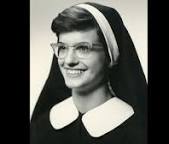
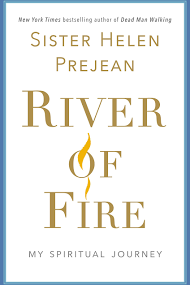
Prejean has written another book (2019) entitled River of Fire: My Spiritual Journey. This book is a prequel to Dead Man Walking. It tells the story of her childhood, her decision to enter the convent at age 18, her early years in religious life, her teaching in an all-white girls’ high school, the “earthquake” in her life caused by Vatican II and her higher education, and her eventual “awakening” to social justice issues—most notably, “the shocking brokenness of our criminal justice system.”
Prejean came from a Catholic upper-middle class family in Baton Rouge, LA. Her family had black servants. Her parents were very loving, and she enjoyed her siblings, Mary Ann and Louis. She is proud of her Catholic and Cajun background. In 1957 she made the decision to “enter the convent.” Though I entered in 1962, I could identify with her many stories about life in the convent “pre-Vatican II”: the strict silence, the highly structured prayers, the separation from “the world,” and practices such as asking for a pardon and performing practices of humility. Prejean also captures her youthful idealism, the beauty of religious services, the time for prayer, and the comaraderie among the sisters. One sister, Chris, a nurse, eventually became her best friend. Their friendship is inspiring.
For half her life, then, Prejean basically taught high school and did parish work. But in the early 1980s she attended a social justice conference, a conference that “permanently altered the trajectory of my life.” It was a “lightning bolt” experience for her. She says she went from praying to God to solve the world’s problems, to immersing herself in the struggles of poor people living on the margins of society. A year later she became a volunteer educator at a nearby all-black St. Thomas housing project where she still lives and works today at age 83.
The last two sentences in River of Fire are the first two sentences in Dead Man Walking: “When Chava Colon from the Prison Coalition asks me one January day in 1982 to become a pen pal to a death row inmate, I say, Sure. The invitation seems to fit with my work in St. Thomas.” Little did she know where her “sure” would take her.
Two more things stand out for me in what Mark Shriver called “this thought-provoking, informative, inspiring, and funny” book. (Yes, there is humor throughout.) While studying during the summer, Prejean meets a diocesan priest, William, from “out east.” They are immediately attracted to each other. Over the course of the next several years, she experiences the unique challenges of a celibate friendship between a priest and a nun. I appreciated Prejean’s willingness to share this part of her journey with such honesty.
And finally, at the end of the book, Prejean shares a letter she wrote to Pope Francis in January 2016. It’s entitled “An Appeal for the Catholic Church to Fully Respect the Dignity of Women.” It is clear she loves and respects Francis for all he is doing for the Church—especially his strong statements against the death penalty. But then she shares with him “the ache and sorrow” she experiences because of a deep “wound” in the Church: “the way the Church treats women.” She notes that women’s voices are absent in plenary synods, commissions, and tribunals. This policy, she says, “thwarts the dynamic effect we women could have on dialogue and decision-making” on Church policies and practices.
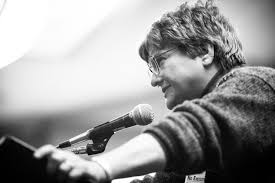
Prejean then gets personal. She has spoken to U.N. commissions, the U.S. Congress, governors, citizens in civic groups, and religious bodies all over the world. She has been invited by Protestant churches to preach the homily at their religious services. “Yet, in my own Church I am not permitted to preach a homily.” In fact, because she is a woman, she is not even permitted to read the Gospel at Mass. She says, “My voice is muted by my own Church, whom I love and have served all my life.” I, as another woman devoted to our Church, have great empathy for her ache and sorrow. (Note: her letter was written in 2016. Since then Pope Francis has initiated the Synodal process in 1921, inviting the whole church—especially the laity—to meet and converse with one another in order to discern what the Holy Spirit is saying to the Church today. In addition, the Pope has opened up some positions of authority in the Vatican to laymen and laywomen (nuns are laywomen.)
Let me conclude this brief review with what Father James Martin, S.J. says about this book: “River of Fire is a book to read and treasure, and Sister Helen’s is a life to celebrate and honor.” Amen to that!
For reflection:
Did anything stand out for you in today’s reflection? If so, what and why?
Have you read or seen Dead Man Walking? If so, what was your reaction to the film or book? to Sister Helen?
Have any of you ever ministered in a prison or corresponded with an inmate? If so, What was that experience like for you?
PS: Thank you for your prayers for last week’s retreat for the 2023 Golden Jubilarians of the Sisters of Notre Dame in the USA. Next week I will be leading a retreat for the Medical Mission Sisters in Philadelphia, PA. Their congregation, founded in 1925, now serves in 17 countries on 5 continents. Thank you for your prayerful support for this retreat.
Prejean is the first to admit that it is sometimes hard to fight for the dignity of individuals—some of whom have committed unspeakable crimes. But, as she asked Pope John Paul II once, “Does the Catholic Church defend only innocent human life? Or does the Church defend all human life?” … Our video for today is a song by Zach Williams, an American Christian rock artist from Arkansas who, as a young man, sometimes got into trouble with the law himself. This song is “Chain Breaker” which, in 2017, won the award for Pop/Contemporary song of the year. What makes this video unique is Williams is performing the song in Harding Prison in Nashville, TN. (There are no lyrics with this video, but I’ve attached another video with lyrics.)
The refrain in this song is: “If you’ve got pain, he’s a pain taker. If you feel lost, he’s a way maker. If you need freedom, saving, he’s the prison shaking savior. If you’ve got chains, he’s a chain breaker.” As you will see in the video, many of the inmates know this song by heart…
Here’s a version of the song with the lyrics:
I look forward to reading your comments on this reflection. Please respond below. Thank you!
Lowly Prepositions Aren’t So Lowly
I remember sitting in Sister Mary Luke Arntz’s “History of the English Language” class many, many, many years ago at Notre Dame College. Sister posed this question to us: “What part of speech do you think is the most important part of speech in the English language?”
We thought for a few moments and then gave our opinions. Some of us thought nouns were the most important because they name everything. Others said verbs were because they show action–or inaction. (I stood with the verbs.) Sister listened for a few minutes and then said gently, “Sometimes I think prepositions are the most important part of speech.”

“Prepositions?” we said incredulously. Sister explained, “Yes, because prepositions show relationships—and the way things are related to each other is very important in life.”
I learned that day that we don’t always give prepositions the respect they deserve. After all, so many of them are teeny weeny: on, in, of, to, by, at, up. Others are longer, but we seldom stress them when we speak: with, for, from, toward, under, into, over, across, through, within. There are over 150 prepositions in English! And yes, we know they’re significant. We know there’s a big difference between saying, “She is on the rock… she is under the rock… she is inside the rock.” But that may be as far as our appreciation goes.
I recalled Sister Luke’s class as I sat in a scripture class at Duquesne University many, many years later as my beloved scripture professor, Father Demetrius Dumm, spoke about the sentence, “God is with us.” He said, in English we use the preposition with. But the original meaning says much more than our word with conveys. That sentence also means God is for us… God is on our side… and even God is in our corner. In other words, God is more than simply with us. The original sentence conveys how God is with us.
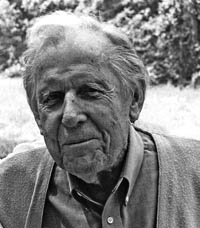
(1914-2006)
Father Thomas Berry wrote extensively on theological and ecological issues. In fact, he described himself not as a theologian; but a geologian. (When I just typed that word, my spellcheck alerted me that it wasn’t a word! Berry created that word to express more accurately who he was!) This sentence of his is one of the most important ones I’ve read from his vast writings: “We are not creatures on the earth, we are creatures of the earth.” The change of that teeny weeny preposition makes a profound difference in how we view ourselves in relationship to our entire environment! Are we merely on the earth OR are we of the earth, that is, intimately interconnected with everything else on this planet?

There are many other examples of how the prepositions we use are highly significant. Is the Kingdom of God in us… with us… or among us? Father Demetrius stressed among. That preposition connotes the fact that our faith is not a private affair… that the Kingdom begins here on earth… that no one has a monopoly on the Kingdom… that we must work with one another to bring about the reign of God. Here’s another example. In the past, I thought of my ministry mainly as working for God. But over the years, I’ve shifted my perspective. Now I view my ministry (whether writing or giving retreats or whatever) as working with God. That shift is more than mere semantics. It stresses my connectedness with God… my dependence on God… my acknowledgement that the work I do is God’s work and not solely mine… and how lucky I am to be able to have God’s help and strength in everything I do.
For reflection:
Is there anything in today’s reflection that caught your attention?
Can you give any other examples of the importance of prepositions?
Pay attention to the prepositions you encounter–especially as you read the scriptures or even the newspaper. Did you notice anything? Did you find any prepositions that you found particularly important?
PS: I request your prayers for a retreat this week for our SND USA Golden Jubilarians for 2023. There are four of us on the team leading the retreat from July 24 through August 2 at the Lial Renewal Center in Whitehouse, OH (near Toledo). All of us are grateful for the support of your prayers. Thank you!
Our video today is “The Creation Song. Written by Kate Simmonds and Mark Edwards, it is from their album “One Day.” Enjoy the incredible visuals. And hear Our Creator God saying these words to you today.
I welcome your comments below. Your responses are a vital component of this blog. Thank you!
The Grace to Paint: Interview with Sr. Maresa, SND
Sister Maresa Lilley is one of our Notre Dame artists. Her oil paintings can be found on the walls of our ND Center, on the internet (more about that later), and even in Guido’s Italian Restaurant in nearby Chesterland, OH. Four of her paintings also hang (drum roll, please!) in the 2021 movie Spider-Man: No Way Home. (Yes, she saw the movie and spotted her 16″ X 20″ painting on the wall in one of the scenes. But she must see the movie again to try to spot the other three.) I recently stopped into Sister’s studio here to see what she’s been up to lately. As soon as I walked in, I was in awe of the paintings I saw—including three horses, a portrait of a young woman in black, Jesus, two young women collecting shells on a beach, and a vase of yellow tulips.
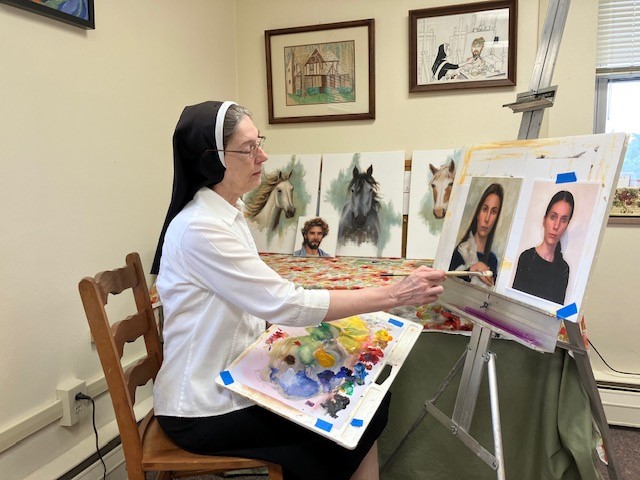
For two hours, Sister Maresa answered my many questions. Here are some of the things she shared with me. Even as a little girl, Sister was interested in art. When she was quite young, her mother bought her a paint-by-number of three ballerinas. That was the beginning of her art career. By age 12 she was taking a course at the Cleveland Art Museum and falling in love with Degas’ images of ballerinas. Back in those days, Sister worked mostly in chalk, but in 1980 (she was now a nun), someone gave her a set of oil paints. For a long time Sister was afraid to open them because, “I knew how expensive they were.” But, fortunately for the world, she eventually did uncap them and began to paint. She has worked primarily in oils ever since. “Oils are so forgiving,” she explains. In 1990 she took an oil painting course at the Cleveland Institute of Art and “soaked in everything they could teach me.” She also credits her subscription to The Artist’s Magazine for continual inspiration in the areas of images and techniques.

For years, Sister had to squeeze her art into her life as a full-time elementary teacher, a principal and administrator, and later as a novice director in the Philippines. But since her return back to the states in 2012, she has been painting full time.

I asked if she had favorite themes or subjects. She says she enjoys considerable freedom when it comes to what she paints. As expected, though, she leans toward religious art, describing her work as “traditional themes with a modern twist.” Many of her paintings are also commissioned pieces. People ask her to paint portraits of their loved ones, their pets, or something else they love—like barn swallows. Her works also include landscapes, flowers, children, couples, still life, Jesus, Mary and other saints.

Sister Maresa started a blog, “Grace to Paint” in 2012, the same time I started mine! (Sister Susan Wolf was instrumental in encouraging both of us to do this!) Her blog features not only many of her paintings, but also her commentary on some of them. Sister is also on Etsy, and her shop is called “Paintgrace.” The past several years she’s sold over 400 paintings on Etsy alone. I checked 130 reviews on her shop. All were 5 star ratings! Amazing!
For her blog, just google: Grace to Paint blog
For her shop, just google: Etsy paintgrace
You can also access her shop on her blog. Go to the top of the page and click on “Art Store.”
You can enjoy her many paintings on her blog and even subscribe to it is you wish. On Etsy you’ll find all the information you need to purchase an original painting of hers. Many sell for only $65. She also sells prints of her works as notecards, 5 for only $10. All sales include free shipping. (You can’t beat that!)

Why does Sister Maresa paint? I think I found the answer on her blog. She writes: “The gifts all around us, whether it’s a lowly lemon or the candid eyes of a child, hold an inner grace… I try to translate into oil paint the joy and beauty of being in this world.”
Enough words. Let me conclude this reflection with a few more paintings by Sister Maresa:


And I couldn’t resist…

For reflection:
Did anything touch your heart in this reflection?
Do any of Sister’s paintings speak to you? If so, which one(s) and why?
Take a few minutes with one of the paintings you are drawn to… feast on it… how does it make you feel… what does it say to you?
PS: Sister Maresa has told me I can post her email address and phone number, if you would like to ask her questions about ordering her paintings: [email protected] / 440-226-9446
Sister Maresa said that in her art she leans toward “traditional themes with a modern twist.” She also said in her paintings, she tries to capture some of “the joy and beauty of being in this world.” In a way, her words can apply to today’s video. It is a traditional hymn “How Great Thou Art.” But here it is sung not by a large choir in a huge cathedral with organ accompaniment. Rather it is sung by a country a cappella group of five men, (called “Home Free”) outside amid God’s majestic mountains. I think the hymn certainly captures some of “the joy and beauty of being in this world.” (There’s a brief clip at the end of the video where the group tells a little about their music.)

Once again, I’m posting this reflection on Sunday, July 17th so my subscribers might receive it earlier in the week… And, as always, you are invited to write a comment below. Your comments enrich my blog!
If I Were the Evil Spirit…
The great British writer C. S. Lewis wrote (in the midst of World War II) an intriguing book entitled The Screwtape Letters. The book, one of his most popular works, consists of letters written by a major devil, Screwtape, to his nephew devil, Wormwood. He advises the younger devil on how to best tempt a Christian man (referred to as the Patient) into sin and possibly even lead him into Hell.
Screwtape advises Wormwood to convince the Patient that religion is an internal spiritual thing rather than an outward way of being in the world. He should also persuade the Patient to believe that he is better than his fellow churchgoers. In addition, Wormwood should work hard to get the man to marry a woman who will have a very negative impact on his life and faith. I won’t tell you how the story ends. But the book made a deep impression on me when I read it as a college student many years ago.
Years later, with Lewis’ book in mind, I wrote a short reflection entitled “If I Were the Evil Spirit.” It was included in my book, Rummaging for God. Here are some excerpts from that reflection.

“If I were the Evil Spirit, I would work very hard to prevent good people from doing good things. What tactics would I use? I would make evil attractive. I would make it easy to do. I would make evil look natural and fun. On the other hand, I would make goodness look unattractive and difficult to do. I would make goodness look unnatural and boring.
If I were the Evil Spirit, I would be persistent. I would never give up. I would never leave good people alone. I would often make use of one of my most effective ploys: discouragement. If I couldn’t get good people to actually engage in evil acts, I would discourage them from engaging in good acts. How? By whispering in their ear things like this: “You are only one person, you know… what good can you do?… Christianity has been tried and it has failed… why waste your time with it?”
If I were the Evil Spirit, I would put in long hours convincing people to fear and mistrust everyone and everything. I would split good people into factions. How would I accomplish that? I would rely a lot on basic human insecurity and low self-esteem. These have proven effective throughout human history for unleashing all kinds of evil—even entire evil empires! I would also distract good people from doing good things. I would draw their attention to petty things. I would get them to focus more on their personal appearance than the poor in their midst. I would convince them that non-essentials were essentials, institutions mattered more than individuals, and personal freedom always superseded the common good.

If I were the Evil Spirit, I would convince people that God does not exist. If that proves impossible, then I would tell them that God is far, far away and is not interested in them at all. I would say to people, “Do you really think God cares one iota about your puny little life?” I would also argue that God holds grudges and never forgets the wrongs they have done. If they say, “But what about the parable of the Prodigal son?” I’d say, “It’s just a story. Nothing more than wishful thinking.” I would also convince people that they are alone in the world. I would whisper, “No one can possibly understand what you’re thinking and feeling.” Isolating people from one another is one of my most effective tactics.
If I were the Evil Spirit I would have my work cut out for me. My job would be difficult, yes, but far from impossible.”
C. S. Lewis said that writing The Screwtape Letters was “not fun” for him. Maybe reading this reflection was “not fun” for you. So let me close with this beautiful insight from the book. At one point, Screwtape and Wormwood reflect on God’s great love for humankind. Neither devil can comprehend why God loves human beings so unendingly and so completely. It’s ironic, I thought: The evil spirits seem to appreciate God’s great love for humans more than humans do! Amen.

For reflection:
Would any of the Evil Spirit’s tactics work on you?
What other tactics do you think the Evil Spirit uses?
PS: Once again I am posting this reflection on Sunday (July 10th) hoping it arrives to you by Monday or Tuesday.
As Christians, we believe Jesus sent us the Holy Spirit on Pentecost to be with us always. Let us conclude today’s reflection by praying these beautiful words to the Holy Spirit. The song is entitled simply, “Welcome, Hoy Spirit.” May the Holy Spirit, symbolized by the flowing water, bring you peace and courage this day.
I hope many of you will respond below to today’s reflection. Your simple additions and profound insights enrich my blog! Thank you!