Very Valuable Vinegar!
Do you have any vinegar in your house? If so, what kind is it? And what do you use it for? Over the years I have grown to appreciate vinegar and all the amazing things it can do for us—not only in our food preparation but also as a less expensive and more eco-friendly household cleaner. So today, let’s take a closer look at this fascinating human-made commodity. First, a definition: vinegar is a liquid composed mainly of acetic acid and water. The acetic acid is produced through the process of fermentation.
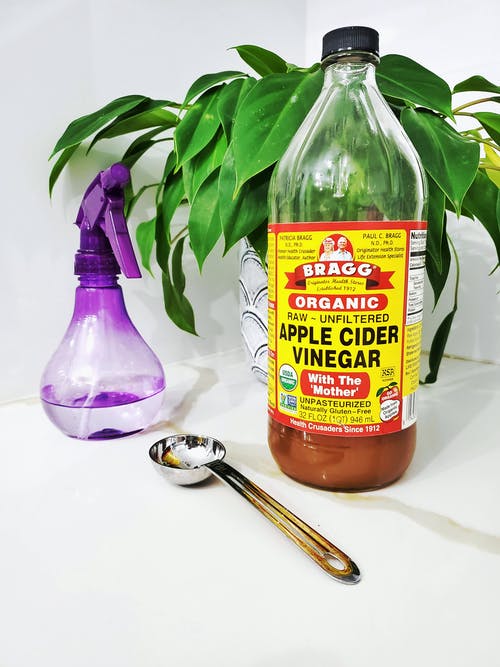
The word “vinegar” comes from the French vin aigre which literally means sour wine. How long has vinegar been around? The first documented use of vinegar comes to us from the Babylonians in about 5,000 B.C. Traces of vinegar have also been found in some of the urns of the ancient Egyptians. Called the poor man’s wine, vinegar was routinely carried by Roman soldiers as they marched along conquering the world. And we Christians remember how scripture says that the Roman soldiers offered Jesus vinegar (their wine) as he hung dying on the cross.
Vinegar can be made from a variety of things. From fruit such as apples, figs, pears, prunes, dates, strawberries and other berries. It can be made from vegetables such as potatoes, cucumbers, beetroots, and tomatoes. (I know, I know, technically tomatoes are fruits…) Vinegar can also be made from herbs such as thyme, oregano, basil, sage, garlic, mint. The most popular vinegar in the United States is cider vinegar made from apples. Consumers in the American south use more white distilled vinegar than any other region in the country. If you’re interested, you could visit the International Vinegar Museum in Roslyn, South Dakota. Roslyn even hosts an annual Vinegar Festival in June. You missed this year’s, but you can put it on your calendar for 2022.
Vinegar has a variety of industrial, medicinal, agricultural, culinary, and cleaning purposes. Discoveries during the Industrial Revolution enabled commercial vinegars to be produced more quickly. But even today, high quality vinegars (such as those made in Italy) continue to use a slow process of fermentation, aging the vinegar for years in wooden barrels.
What are some of the uses of vinegar? Some of the following uses have studies to back them up. Others not so much. Reader beware. Vinegar can be used:
+ To soothe a sore throat. Just mix together apple cider vinegar, water, and honey. (Many years ago, our switchboard operator, Sister Mary St. Mark Florence, always drank such a concoction and tried to get us, her young switchboard-operator-trainees, to drink it too. She swore it kept her voice clear and strong—and it prevented sore throats. I never tested her theory.)
+ To help regulate blood glucose levels.
+ To treat jellyfish stings and sunburn.
+ To get rid of dandruff. Simply massage a teaspoon of vinegar onto your scalp, rinse, and wash with regular shampoo.
+ To clean wooden cutting boards and butcher block counters.
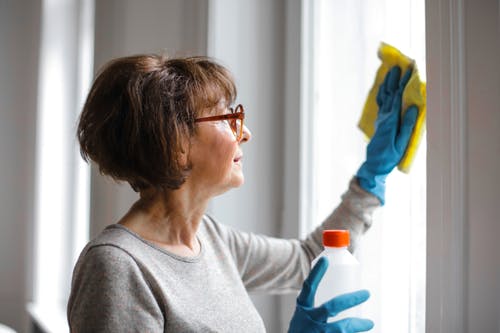
+ To wash windows.
+ To clean coffee machines. (I regularly run water with a little bit of vinegar through the small coffee maker in my bedroom).
There’s a certain magical power associated with vinegar. Most school kids know if you mix vinegar and baking soda you can create your very own do-it-yourself erupting volcano. Pearls will melt in vinegar, and egg shells will get very soft. Supposedly, if you put an open dish of vinegar in a room it will absorb paint smells.
Let me end this reflection on vinegar with two recipes for cleaning solutions made with vinegar:
Basic cleaner: mix 3 parts water with 1 part distilled white vinegar or apple cider vinegar.
Disinfectant: 1 part lemon juice, l part vinegar, 2 parts water. Put in a spray bottle. Replace nozzle and shake. Spray on the surfaces you wish to disinfect—especially in the kitchen and bathroom. “They” claim this solution can kill 99% of bacteria.
For more recipes for vinegar cleaning solutions, just go to WikiHOW vinegar solutions.
Did you learn anything new in this reflection?
Do you use vinegar? If so, how do you use it?
Can you think of any other ordinary thing you have hanging around your house that’s really pretty amazing? (Not including people, of course!)
*********************************************************************************************
The video today has little (if anything) to do with vinegar… Rather, it is a song to comfort those mourning the loss of a loved one. I chose this song because this pandemic has caused millions of individuals to lose their loved ones. The actual number of deaths world-wide is impossible to know. The wide-spread grief is impossible to fathom… So when I heard this song recently on my local Cleveland Christian music station (The Fish at 95.5 FM), I knew I had to share it with you. It’s called “Scars in Heaven” and it’s a new song by Casting Crowns, the same group that produced last week’s song. I dedicate this song to all of you who may be missing a loved one—whether that loved one passed away from Covid or from some other cause… and whether they died recently or years ago. I know when I’m missing someone special to me, I find myself saying some of the same words in this song: “If only I had known the last time would be the last time… What I’d give for one more day with you…” I hope this gentle and faith-filled song brings you (or someone you know) comfort and strength…
I invite you to respond to this blog and/or to this song below. We all love to hear from our readers like you!
What Do Priests Do?
What do priests do? You might answer: “They preside at Mass, consecrating the bread and wine… They preach, breaking open the scriptures for us… They administer the sacraments… They oversee our parishes.” Such answers are true—if you are speaking of ordained priests. But the Catholic Church also proclaims the belief in the “Universal Priesthood of all believers.” What does that mean?
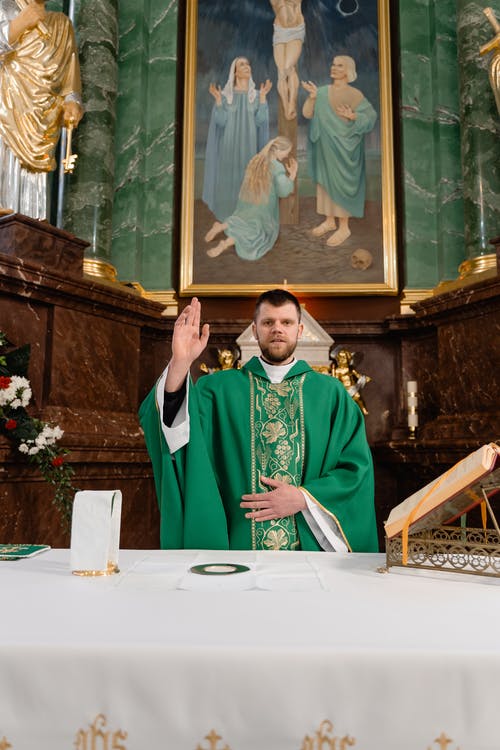
Briefly, it affirms that all believers are in a way priests. This means all believers have direct access to God. We can all offer intercessions, praises, and spiritual sacrifices to God. This belief is based on several passages in scripture—most notably 1 Peter 2:5-9. Verse 9 says, “But you are ‘a chosen race, a royal priesthood, a holy nation, a people of his own, so that you may announce the praises’ of him who called you out of darkness into his wonderful light.” Some of the Protestant reformers saw this passage (and others) as abrogating the need for ordained priests. The Catholic Church, however, maintains both the Universal Priesthood of all believers as well as the clerical priesthood achieved through the sacrament of Holy Orders.
Check out The Catechism of the Catholic Church (no, 1546) which says: “The whole community of the faithful is priestly. The faithful exercise their baptismal priesthood through their participation, each according to his/her own vocation, in Christ’s mission.”
Sometimes there is a tension between the ordained priesthood and the universal priesthood. At times we Catholics can think that only ordained priests have the answers to all questions about faith. (“Ask Father….”) At times we can even idolize certain clergy. (“Let’s canonize more priests and more popes!”) But more importantly, an exaggerated emphasis on the ordained priesthood can lead so-called “ordinary Catholics” to think that real ministry is reserved for clergy. Thus, we laity (Yes, nuns are part of the laity) can miss out on the depth of our calling as followers of Jesus.
Just ten days after he was elected pope, Francis did something that shocked many believers. It was Holy Thursday. On this day, most of the Popes before Francis used to wash the feet of twelve priests in St. John Lateran Basilica. But Francis surprised the world when he traveled to a juvenile detention center outside Rome and washed the feet of twelve prisoners—including two women and two Muslims! His humble expression of love and service modeled Jesus’ own example on that first Holy Thursday. As someone so aptly said: “At the Last Supper, Jesus tied a make-shift apron around his waist and redefined success.” He redefined priesthood too. Priesthood, whether ordained or lay, is essentially selfless service of others. It’s as simple—and as profound—as that.
So you and I exercise our priesthood every time we follow Jesus’s example of loving service of others. If that is true, then how can we answer that question, “What do priests do?” We could say things like this: They give birth to children… they change diapers… they pray every day… they serve as doctors, nurses, lawyers, CEO’s… they volunteer in homeless shelters… they teach catechism… they stock shelves, sweep floors, and serve tables… they pave roads and fix the plumbing problem… they serve on boards… they bake casseroles for the parish bereavement committee… they mow lawns… they coach kids’ soccer teams… they give haircuts… they care for the sick… they help with the parish RCIA program… they babysit their grandchildren… they look in on an elderly neighbor… and the list goes on and on and on.

Being a part of the Universal Priesthood means being a follower of Jesus. It means communing directly with God. It means being a person of hope. It means giving up all cynicism and instead, reaching for a basin of water and a couple of towels.
Reflective questions:
+ Did anything in this reflection stand out for you?
+ If you are not an ordained priest, when do your feel most like a priest? If you are ordained, when do you feel most like a priest?
+ Does Jesus’ washing of feet speak to you? If so, what does it say? If not, why not?
+ What other kinds of things do “ordinary Catholics” do that are priestly?
The song today is by Casting Crowns. It’s called simply “Follow Me.” The song is antiphonal. A particular person in the Gospel speaks to Jesus (the fishermen apostles… the woman caught in adultery… the “good thief” on the cross.”) Then Jesus speaks to each one of them. May the words of the particular person become your own words—especially when you are “at the end of yourself”… and may you hear Jesus speaking his words directly to you: “Just follow me.”
I invite you to comment to this reflection below. I’m always eager to hear from you!
Every House Is a Nest
A book I keep returning to again and again is Earth Works by Scott Russell Sanders, a professor emeritus of English at Indiana University (my alma mater!). The book is a collection of essays on a wide variety of topics. In one chapter, entitled “House and Home,” Sanders states that every house is really a nest in disguise.
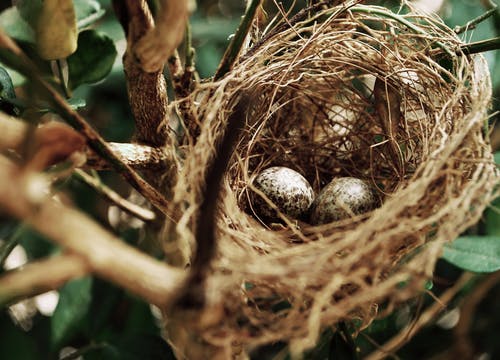
How do birds build their nests? They gather all sorts of things from nature: sticks, grasses, leaves, seeds. They make cement from mud or even spider webs to hold their nest together. Sometimes they fashion their nest inside a hole in a tree. You might be thinking, but our houses are made of some things not really drawn from nature. But is that true? Sanders argues that our houses are “still entirely derived from the land.” He says, “Unlike the birds, of course, we get our sticks from the lumberyard, we get our mud ready-made into bricks, we buy fibers that have been woven into blankets, curtains, carpets, mats.” The nails we use are refined from ore, the glass is made from sand, and even “the unavoidable plastic has been distilled from the oil of ancient swamps.”
But most of us don’t build our own houses, so we forget that our homes (like our bodies) are made of the earth. The first humans who settled in our country were much more aware of their oneness with the earth. They fashioned their huts and canoes from bark. They made their tepees from tanned animal hides. They kept themselves warm at fires of buffalo chips and brush. Even our early pioneers built their dwellings from logs stacked on top of each other. They constructed fireplaces and chimneys from stones they mined from their fields. Says Sanders, “Our technology has changed, but not our ultimate source. Even the newest ticky-tacky box in the suburbs, even the glitziest high-tech mansion, even an aluminum trailer is only a nest in disguise.”
But nature doesn’t stop with the construction of our houses. Nature “runs right through our yards and walls and bones.” Moss grows on our roof, mildew in our showers, mold in the refrigerator. Tiny maples sprout in our gutters, mice invade our kitchen pantry, spiders make their living in our attic, and water often seeps into our basement. Our dwellings demand constant maintenance or else they will die, that is, they will be reclaimed by nature. Says, Sanders, “Our shelter is on loan; it needs perpetual care.”
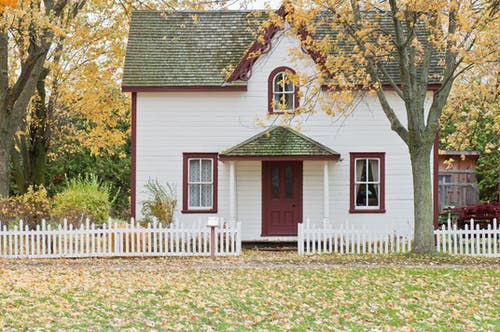
As Pope Francis keeps reminding us, our entire planet needs our care. If we want to grow in our reverence for earth, then we must be re-awakened to our intimate connection to the natural world. One way to do that is to appreciate our house and the things we use every day. Here’s a little exercise you might want to try. Go through your dwelling place (or even one room of it) and notice all the parts of it that are “on loan” from creation. Some things will be obvious: wooden doors and floors, glass windows, granite counter tops, metal appliances, bricks or stone, carpets, wooden furniture. Doing this will help you to be more aware of how you are being sheltered by “Mother Earth” every day. Then include the many other things you see or use regularly: dishes, utensils, tools, wall hangings, linens, etc.
For example, as I sit in my office and type this, I notice all the plastic that is surrounding me: my computer, pens, desk phone, a picture frame, highlighters. Then I see the marble window sill… books and paper everywhere… the wooden pencils with their graphite centers (graphite is a naturally-occurring crystalline form of carbon—I looked it up)… storage boxes… my clay mug… I also realize I don’t know what some stuff is made of—for example, all the electrical cords, the chair I’m sitting on, the clothes I’m wearing, my shoes, the mirror, the lamp shades.
Today, let us thank God for our “dwelling place”—not only our individual homes, but also our beautiful planet. We can use these words:
Beloved God, thank you for my house, my dwelling place. I am so lucky to have a place to call home… Help me to reverence my abode and never take it for granted… Give me eyes to see how this house connects me to our earthly home. On this day, make me mindful of those who have no home—those sleeping on our streets… those being evicted… those reeling from natural disasters… those fleeing war and persecution. May the appreciation I have for my own home cause me to ache for them and to help seek remedies for their dire situation. The psalmist says, “I shall dwell in the house of the Lord for ever.” In a way, I am already dwelling in such a house: this beautiful blue planet whirling in space among the other planets and stars. Thank you, my beloved Creator God, for such a gift, such a dwelling place. And remind me everyday that my ultimate shelter and dwelling place is you. Amen.
PS #1: A big thank you to all the people who came to my talk on hope for the First Friday Forum of Lorain County. What a responsive group you were. Thanks especially to Larry and Jack for inviting me. Thanks to Sister Sean for her special gift. It was wonderful meeting so many “old” friends again too!
PS #2: A Happy Labor Day to all of you!!!
I’m offering two short videos today. The first one shows a hummingbird building her nest all by herself. The second one shows a human being building a house all by himself.
Hummingbird video (2 1/2 mins.):
Video of one man, Shawn James, building a log cabin off the grid somewhere in the Ontario, Canadian forest. Notice he uses ordinary saws, hammers, chisels, and drills. He starts in June 2017 and finishes several months later. (5 mins.)
I think I gave you enough things to reflect on today. I hope you will share some of your thoughts, observations, and reactions below!
Forest Bathing
(Note: Pope Francis has declared September 1 as World Day of Prayer for the Care of Creation. He asks us to join with our Orthodox sisters and brothers on this day to thank God for the goodness of our world, to ask God’s forgiveness for our sins against the environment, and to reaffirm our vocation to be good stewards of the planet we call home. In honor of this day, I am devoting my reflection to the practice of “forest bathing.” At the end, I’m offering two short videos. One is on forest bathing. But the second one is a hymn I invite you to pray—especially for the current situation in Afghanistan.)
I’m lucky. Our SND property where I now live has a couple of small woodlands. One of my favorite “treats” is going into the woods, walking very slowly, and then just sitting down somewhere. A tree stump, a large rock, or a downed tree provide a place for me to park myself and then quietly take in the forest atmosphere. Just being in the company of the trees and other forest growth, plus the birds, chipmunks, and squirrels refreshes my soul.
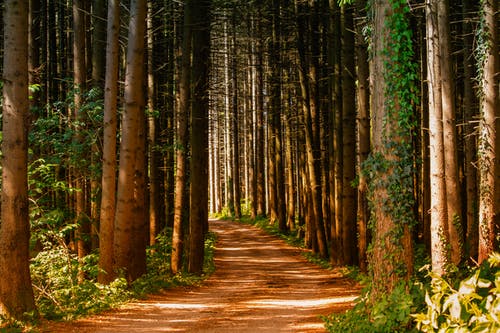
The Japanese have a name for this practice. They call it shinrin-yoku or forest bathing. I’m sure many of you are familiar with the term. It arose in the 1980s and describes the physiological and psychological exercise of spending time in a forest. For this blog I will be drawing from one of the popular books on this topic, Forest Bathing by Dr. Qing Li. He says that the purpose of forest bathing is two-fold. First, it offers “an eco-antidote to tech-boom burnout.” (Don’t you just love his choice of words?) Second, it can reconnect people to the forests in hopes of protecting these precious places.
Forest bathing is not the same as hiking or walking briskly through the woods. On the contrary, says, Dr. Li, “Aimlessness is advisable. The tree tonic works best with minimal effort.” (Again, I love his words!) The key to “unlocking the power of the forest” lies in the five senses. We explore the forest not only with our feet, but also with our ears, eyes, nose, mouth, and touch. We notice, for example, the beautiful patterns in the forest: the layering of the leaves.. the texture of the barks of the trees… the petals of the flowers… the seeds tucked inside the pine cones. We listen to the trees swishing in the wind, a squirrel scurrying along the forest floor, an unseen bird somewhere high up in a tree singing his distinctive song. It is when we use all our senses to connect with the forest that “the magic happens.” Says Dr. Li, “Immersed in the natural world, we can experience the miracle of life and connect to something larger than ourselves.”
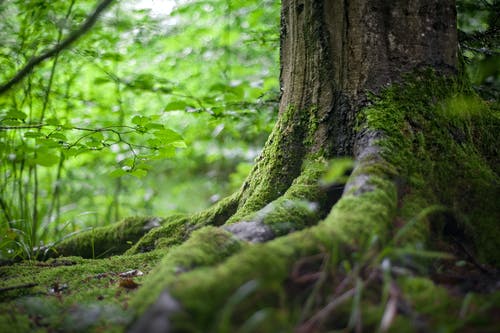
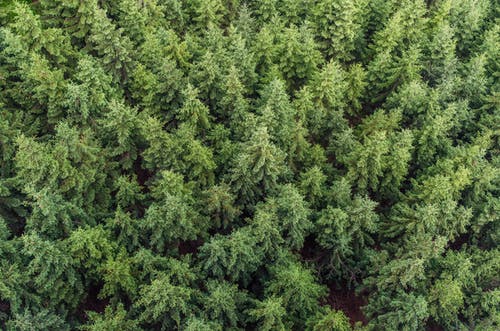
We don’t need a huge forest to practice forest bathing. A small clump of trees in a neighborhood park will do. But even if we don’t have a forest handy, we can still partake of nature’s magic. For example, there’s a courtyard outside my office window. When I’m writing at my desk, I sometimes pause and gaze out the window at the evergreens and other trees growing there. I am always amazed at the zillion shades of green I see even in this small place. I ask God, “Just how many shades of green do you have on your palette anyway?” Or maybe you have a tree or two in your yard or on your street. You can “tree bathe” simply by exploring a single tree. (If the tree belongs to your neighbors, you might want to ask their permission first before “tree bathing” with their tree!) Or if you have no trees nearby, you can interact with your houseplants to partake of nature’s healing powers. Tending them, admiring them, or even talking to them can bring calm into our lives. (As a child, I often heard my mother talking to her African violets as she watered them! She’d say things like this: “And how are you all today?… My, my, you’re getting bigger and prettier every day!… Here’s a nice big drink of water for you!”)
Dr. Li summarizes the importance of forest bathing with these words: “The forest in like our mother, a sacred place, a gift to us humans from the divine. It is a paradise of healing.”
Have you ever been forest bathing? If so, what was the experience like for you?
Do you have a favorite forest or a favorite tree somewhere? Tell us about it.
Have you ever experienced the healing power of nature in any other way? Where and how?
Do you like any of the pictures? If so, why?
PS: August 31 would have been my sister’s 82nd birthday. In honor of Mary Ann, I’m including a picture of her walking ahead of me in a small park in Willoughby Hills, OH. I snapped this picture without her knowing it. Now I have this little treasure which reminds me of all the times we went “forest bathing” together….

Our first video is a brief ( 2 1/2 min.) virtual experience of forest bathing. It also lists some of the benefits of this lovely exercise.
Our second video is the hymn “This Is My Song, O God of All the Nations.” The words of the song were written by Lloyd Stone in 1934. The music is Jean Sibelius’ beautiful “Finlandia,” written in 1899. It is credited with helping Finland develop a national identity in their struggle for independence from the Russian Empire. It has been called Finland’s national anthem. As our hearts ache for all people who are suffering—whether close to home or far away—we hold in special prayer our sisters and brothers in Afghanistan.
I welcome your comments below!
Reclaiming Our Sense of Interconnectedness
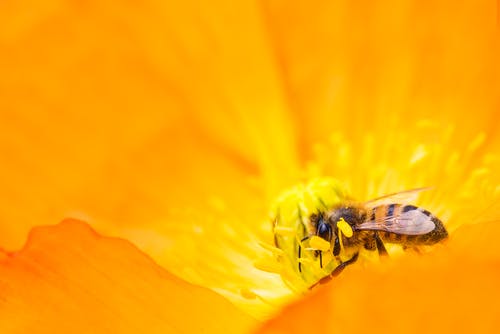
The Vietnamese monk Thich Nhat Hanh has said, “We are here to awaken from the illusion of our separateness.” He even invented a new word to describe our interconnectedness with the rest of humanity and, indeed, our interconnectedness with all of creation. He called this reality interbeing. This means what happens to a man in Hanoi can have consequences for a child in Peoria. It means the smoke from the wildfires in the western U.S. can affect the air quality far beyond its geographic borders. It means the death of millions of honey bees can have serious repercussions for all of humanity.
Interbeing. It is a thought I have been pondering a lot lately—especially as I experience our human community’s struggle with Covid. If there is one lesson this pandemic should be teaching us it is precisely this: our interbeing, that is, our oneness, our interconnectedness. Yet, I fear we are not learning this lesson—and it is having dire consequences. One major factor preventing us from acknowledging our interconnectedness—especially in the U.S.—is our exaggerated emphasis on individualism and personal freedom to the detriment of our sense of social responsibility. Yes, we have personal freedoms, and they are precious and vital. But they are not absolute. We must always balance our personal freedoms with concern for the common good.
These concepts of our oneness and the common good have been articulated over the centuries by diverse individuals and groups of people. The Lakota people expressed this belief in these words: Mitakuye Oyasin. “We are all related.” Fifty-eight years ago, in his commencement address at American University, President John Kennedy, uttered these memorable words: “Our most basic common link is that we all inhabit this planet. We all breathe the same air. We all cherish our children’s future. And we are all mortal.”
Martin Luther King, Jr. was keenly aware of our interconnectedness. He spoke of “the inter-related structure of reality,” saying, “Whatever affects one directly, affects all indirectly.” Some individuals are fortunate enough to experience this oneness of humanity in a dramatic way. In June 1985, NASA launched the Discovery Space Shuttle with a crew that included two non-Americans. One of them, the payload specialist, was Sultan Salman Abdulaziz from Saudi Arabia. After orbiting the earth for several days, he penned these significant words: “The first day we pointed to our countries. The third or fourth day we were pointing to our continents. By the fifth day we were aware of only one earth.”

More recently, other voices have articulated our oneness with others. Barbara Brown Taylor said it succinctly: “Wearing skin… brings me into communion with others.” And Joan Chittister, OSB, wrote: “To claim full human development, total spiritual maturity, outside the realm of the human community is to claim the impossible.”
Perhaps no one has said more about our interconnectedness and the common good than Pope Francis. His book, Let Us Dream: The Path to a Better Future, is a response to the various crises the world is currently facing—particularly the pandemic. He admits, “Sometimes when I think about the challenges before us, I feel overwhelmed. But I’m never hopeless.” Why? Because he believes “we are accompanied.” He reassures us that the Holy Spirit is with us offering us “an opportunity in this crisis to come out better.” But he warns that we can block the action of the Spirit in several ways: 1) by clinging to the myth of self-sufficiency, 2) by being obsessed with ourselves as individuals, 3) by suffering from “existential myopia” which focuses only on our family, our “clan,” or our country while forgetting the wider world, and 4) by getting so discouraged we are unable to act.
With all these thoughts in mind, let us pray together that we as individuals, as families, as small communities, as nations, and as one earth community may reclaim, embrace, and make decisions that flow from the sense of our oneness and interconnectedness with each other.

Let us pray: Creator God, give us a renewed sense of our oneness with all of humanity and all of creation… Awaken us from the illusion of our separateness… Help us to see that our oneness is ultimately rooted in You… and that everyone is our sister and our brother… May the crises we are currently facing dispel the myth of our self-sufficiency. May they urge us to broaden our perspective on life to include the wider world… Give us wisdom to build unity through humble prayerful discernment… Give us the courage to take decisive action, action that flows not from selfishness or fear but from faith and love… Give us a renewed appreciation of Jesus’ life and teachings—especially his example of selfless service of others… Give us a renewed sense of the presence of the Holy Spirit in our midst, a presence that engenders in us unfailing hope. Amen.
PS: Speaking of connectedness… I had two recent experiences of my connectedness with other people. On August 21st, my family celebrated the life of my Uncle Hank who passed away during covid. We met at St. Albert the Great Parish Hall and enjoyed seeing so many cousins again. The room had displays of old photographs and a big cake that said, “Happy Heavenly Birthday, Hank!” (The 21st would have been his 97th birthday). At all our family gatherings, Uncle Hank always played his accordion. We listened to an actual recording of his playing. It brought back so many memories and made us feel his presence in a special way. I also learned that several of my relatives actually read this blog. A big thank you to them! As I gazed around the room at all my “kin,” I thought: How lucky I am!
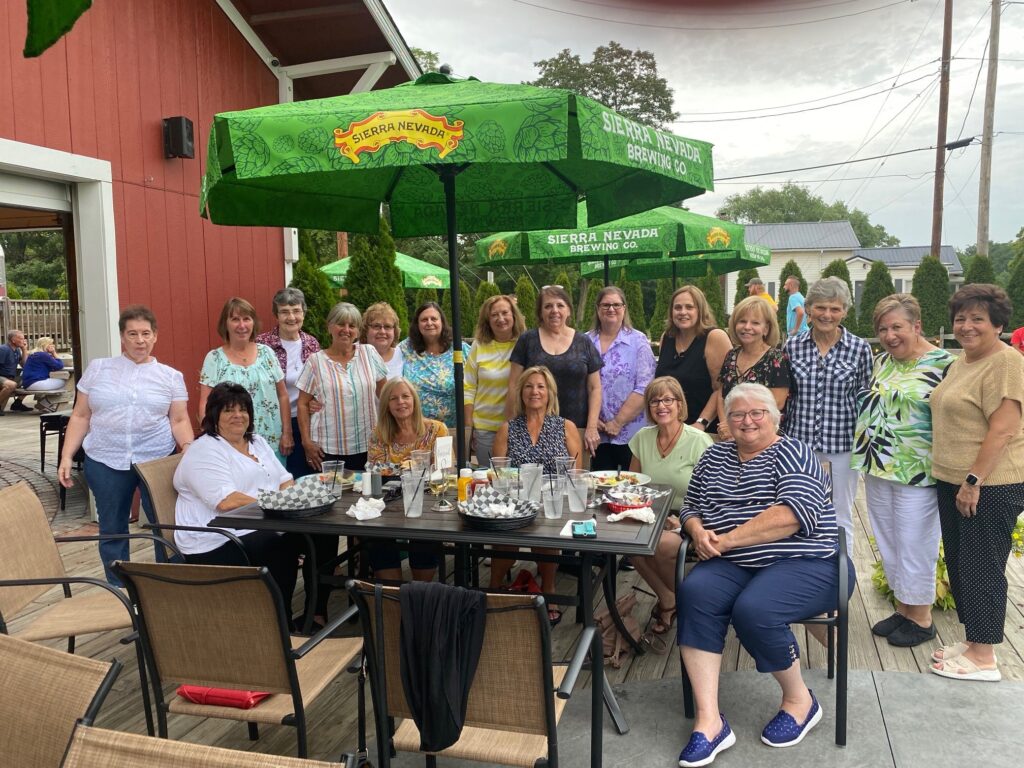
On August 17th, I connected with seventeen women from the class of ’72 from Notre Dame Academy (now NDCL) in Chardon, OH. I taught them when they were freshmen and seniors. Below is a picture of all of us: the seventeen of them plus two of their teachers: Sister Jacquelyn (Evarista) (back row, third from right) and me (back row, third from left). Our mini-reunion was a wonderful time of sharing memories and stories!
I have chosen an “old” song by Marty Haugen: “We Are Many Parts.” The first video is the original song, but without the lyrics. The second version with lyrics is sung by a parish. May we pray in earnest all the words of this song—especially these: “May the Spirit of love make us one indeed.”
The original version:
The version with lyrics:
I hope you might consider commenting below to anything in today’s blog: the words… pictures… prayer… or song. Or simply add another thought…