
Is It Time for Spiritual Cataract Surgery?
A few months ago I had cataract surgery. I had my left eye done right before covid-19 put a temporary stop to such surgeries. For seven weeks, there I was: left eye, no cataract. Right eye, cataract. It was a unique situation to be in.

When I closed my left eye, I saw the world as I was used to seeing it—as if looking through a grayish, brownish film. But when I closed my right eye and looked through my left, I saw a brand new world of amazing brightness. Colors were more vivid, my Kindle screen was brighter, and I could now see in the distance clearly. What was even more amazing, when looking through my left eye, some things had actually changed colors. My dull purple top was now bright purple. My blue plaid shirt was now a vivid turquoise plaid shirt. My blah gray gloves were now rich avocado green gloves!
And for years, I thought what I was seeing was reality. If someone would have said, “I like your green gloves, Melannie,” I would have corrected them. “They’re gray, not green.” I might have even added, “You’d better get your eyes checked.”
The lesson I learned from this experience was clear: We must not be quick to equate the way we see something—a person, a situation, a concept, an experience—as the real way, the right way, the only way. Sometimes we may need a new lens to see things more clearly. We might need eye surgery—or “I surgery.”

Ordinarily cataracts develop slowly. Mine took years to form before my doctor deemed them “ripe” enough for surgery. Our spiritual vision can become clouded over time too—imperceptibly. What factors impede clarity of vision? Familiarity can impede our vision. If we see something again and again we risk not seeing it at all. That’s why it’s good to have friends who help us to see familiar things in new ways.
Prejudice can also hinder our perception. If we have preconceived ideas against a certain group of individuals (of a specific race, gender, age bracket, occupation, political leaning, religious affiliation, etc.) we risk not seeing them for who they really are. And sometimes the very aging process can make us get set in our ways and not open to new insights, new ideas, new ways of seeing. If you ever catch yourself saying, “But I always thought…” That’s a good sign. Chances are it means you are on the verge of modifying something you always thought!

Let us pray: God of Perfect Sight, give me a share of your vision. Help me to become aware of the ways my perception is clouded. Give me the grace to appreciate the familiar—especially people in my life. Help me to lessen the prejudices I have against individuals, ideas, movements, and ways of being and doing. Do not let the natural aging process make me get set in my ways. Rather, help me to be open to new insights, new ideas, new ways of seeing, and new ways of doing things. I ask for these graces through Jesus who went about healing people both of their physical blindness as well as their spiritual blindness. Amen.
Did any words, phrases, or ideas in this reflection resonate with your own experience? If so, which? and why?
What are some of the ways you try to keep your vision alive and healthy?
Have you ever had the experience of seeing something in a brand new way? What factors led to this “re-visioning”?
PS: I want to thank all the people who made our retreat at King’s House Retreat Center in Belleville, IL last week. We had 72 participants–about 25 at the retreat center itself and the rest on Zoom. I really enjoyed “meeting” so many faith-filled individuals from all over the U.S. plus Canada and India! And I thank my “Sunflower Seeds” readers for the support of your prayers. And a special, special thank you to the retreat center director, Fr. Sal Gonzalez, OMI, who patiently taught me how to give a Zoom webinar retreat! I’m most grateful!
Today’s song is the 8th Century Irish hymn, “Be Thou My Vision.” This version is sung by Audrey Assad. By today’s standards, the song uses exclusive language. But hopefully we can see beyond that to the simple beauty of this ancient hymn.
Please feel free to respond below to anything in today’s blog! We love hearing from our readers.
Anatomy of Crabbiness
Sometimes I get crabby. When I do, I can often point to several root causes: the injustices I perceive in the world around me and in my personal life; the pain and sorrow of others as well as my own; the state of the economy, society, education, family life, the planet, and the church; my own sense of isolation or loneliness; or the plain old experience of uncertainty, lack of control, or things not going my way.
When I’m crabby, little things irritate me and I find myself thinking things like these: “Why can’t she be more patient?… why can’t he offer to help me?… this coffee is too cold… this lemonade is too warm… those birds are too noisy… she’s too doggone cheerful… wearing this mask is so uncomfortable… why is everybody so crabby?”

When I’m crabby, I’m ashamed of my crabbiness. I tell myself, “How can you be so crabby over these minor annoyances when so many other people are bearing such major loads in their lives?” This line of thinking sometimes makes me even more crabby!
My crabbiness led me to do a little research on crabbiness. I learned the root word crabby can be traced back to the Old English word crabba meaning to scratch or claw. Yes, it’s related to the crab’s tendency to painfully nip with its claws and hang on. Crabs also appear to walk sideways and even backwards, analogous to a difficult or uncooperative person. (Poor crabs! Too bad their name is associated with such negative qualities. Instead of saying, “You’re such a crab today.” Why don’t we say, “You’re such an otter today!—or such a chipmunk today!” We don’t—because otters and chipmunks are cute and fuzzy. But remember: all crabs are not crabs… and even otters and chipmunks can be crabs some days!)
Prior to the 18th Century, crabby meant crooked, gnarled, rough. In about 1776 there’s evidence that the meaning of crabby became what it essentially means today: disagreeable, sour, cranky, easily irritated, grouchy.
I firmly believe that everyone is entitled to a crabby day every now and then. But not every day. Not even 50% of the days–or even 10%. I can excuse some crabbiness, because we’re all human. Also, being pleasant takes a lot of energy, and sometimes our energy supply is low. Our crabbiness can also indirectly build community by calling forth virtues (such as patience) in the people who have to deal with our occasional crabbiness. And finally, crabbiness keeps us humble. It often requires that we apologize for our unpleasantness. (gulp!)

Was Jesus ever crabby? After all, he was human. I think there’s evidence in the Gospels that Jesus was crabby on several occasions. His encounter with that Syro-Phonecian woman shows him becoming very irritated by her insistence that he cure her daughter (Mk. 7:24-30 I wrote about her under “The Canaanite Woman” January 18, 2016). He gets impatient with his apostles—most notably Peter (Mt. 16:23) and Phillip (Jn. 14:8-9). Then there are all those interactions with the Pharisees…
How do you deal with your crabbiness? (Notice I’m assuming you are crabby—every now and then!) First I try to get some extra sleep… go for a leisurely walk… do something I enjoy doing—like reading a good book, calling a friend, solving a crossword puzzle, working on my blog, sitting by the lake and watching the red-winged blackbird shooing the blue heron away from the area where his nest is (like I did today!) I even take my crabbiness to prayer.

Loving God, I’m crabby. And I have some good reasons for being crabby too. But I ask you to help me emerge from this cocoon of crabbiness and become once again a more pleasant person to be with, live with, and work with. At the same time, allow my crabbiness to speak to me. It may be urging me to do something… to make a few changes in my life… to rearrange my priorities… to let go of something… to grow in patience and understanding of others… and to remember my absolute need for your love, strength, and direction in my life. Amen.
What makes you crabby? What helps you get over your crabbiness?
Does you crabbiness ever “speak to you” and cause you to change something, do something, let go of something, lead you to prayer?
PS: I ask your prayers for the zoom retreat I’m facilitating this week, sponsored by King’s House Retreat Center in Belleville, IL. We will have 71 individuals making this retreat from 15 different states, Canada, and India. The retreat begins Monday evening and concludes next Sunday morning. I will let the retreatants know you are holding them in special prayer. I’m sure that will mean a lot to them. Thank you so much!
Our song today is “Perfect Peace” by Laura Story. I like her gentle voice, the beautiful words, and the exquisite visuals. I hope you may hear God saying these words to you today…
I invite you to respond below to today’s words, song, or other readers’ comments…
A Kitchen Is a Holy Place
A kitchen is a holy place, as holy as any sanctuary.
What was the kitchen of your childhood like? When I was growing up, we had a bright yellow kitchen. It wasn’t very big, just large enough to accommodate a stove, a refrigerator, and a sink with counters and cupboards extending on both sides. Two windows were perched above the sink, facing east. They overlooked our spacious side yard with its wide ash tree, tall maple, and several pear trees. Our large kitchen table was in the center of the adjoining room, our dining room.

As a child, I saw the kitchen as a magical place. It churned out all kinds of good stuff: hot oatmeal for a winter breakfast, chicken noodle soup and baloney sandwiches for lunch, meatloaf and mashed potatoes for supper. On Saturday mornings, the kitchen produced those tantalizing aromas of Bohemian sweet bread (hoska), kolachky, cinnamon bread, and nut rolls. On Sunday mornings, after church, Mom would start brewing up Sunday dinner: pork (or goose), dumplings, and sauerkraut.
As I grew older, my mother shared some of her culinary magic tricks with me. She taught me to make cookies, brownies, and cakes—all from scratch. I eventually graduated to creating simple meals.

I can remember the kitchens of every convent I ever lived in. Some were huge industrial-sized kitchens that turned out three meals a day for 100 or more hungry sisters. Others were normal-sized convent kitchens where we sisters took turns cooking for six or so. In the “old days” we had “cook sisters” who toiled long hours preparing meals not only for our large convents but also for boarding schools, college resident halls, and maintenance personnel. Some of these dedicated women got up before the rest of us (and we got up at 5:00 am!) and after supper, they were often canning and freezing fruits and vegetables, sometimes late into the night.
And through it all, these cook sisters usually exuded joy, humor, wisdom, and prayerfulness. If I had a problem at school or in my family, I’d go to the kitchen and ask a cook sister to pray. I always assumed her prayers were more efficacious than mine.
In her book, Ordinary Places, Sacred Spaces, Sister Evelyn Mattern said this about kitchens: “Kitchens are obvious contemplative places. So many rhythmic and repetitive actions keep them humming: peeling potatoes, cutting up and grating vegetables, stirring sauces and soups, kneading bread, making coffee, washing dishes, feeding cats and dogs. These actions offer meditative possibilities, breathing moments in the midst of a hectic day.” (I wonder though, with today’s modern conveniences such as prepared foods, microwaves, and “Grubhub,” if we have lost these rhythmic and repetitive actions so conducive to contemplation…)
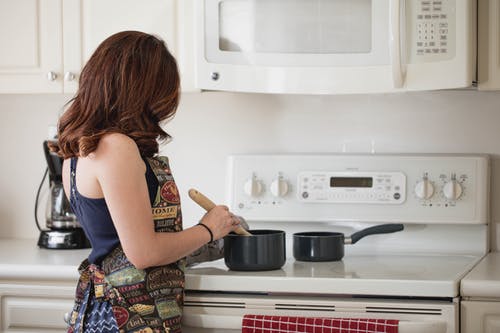
Kitchens exude a certain level of intimacy. Strangers or formal guests don’t usually get invited into our kitchen. We share our kitchen with family and close friends. Realtors know the importance of kitchens. One of their maxims is: kitchens sell homes.
When Jesus sent his disciples to get a room to celebrate the Passover, he must have known that a nearby kitchen was part of the deal. Da Vinci’s famous painting of the Last Supper, as beautiful as it is, did us a disservice. It made us think of this event as a quiet, private affair involving 13 men. I like some of the more modern depictions (by Bohdan Piasecki and Nora Kelly, for example) that include women and children. (I give a website to view these paintings below).
Writes Mattern: “As Jesus and the twelve reclined at the table to share these last, sacred intimacies, the women disciples were preparing food nearby and carrying it to the table. They made the bread, blessed it before it was blessed by the Lord, and—with this Lord—no doubt shared in the meal and the bread. In one sense, every time we share a meal, we share in the Eucharist.”
Yes, a kitchen is a holy place.
Do you have any memories of the kitchen of your childhood or your grandmother’s kitchen?
Is your current kitchen a “contemplative space”? Why or why not?
Do you agree or disagree: “Kitchens exude a certain level of intimacy”?
To see Piasecki’s and Kelly’s paintings of the Last Supper, go to We Are Church Ireland – Last Supper. What do you think?
I am offering two songs this week. The first is “One Bread, One Body” by John Foley. Many of you have probably sung this hymn at Mass. The words take on deeper meaning against current headlines. The second is a the Negro Spiritual, “Let Us Break Bread Together,” sung by Joan Baez–who is 79 now. Appropriately, she sings this song in her kitchen! This video was filmed only a few weeks ago. Baez explains her timely dedication to George Floyd and others.
“One Bread, One Body”:
Joan Baez: “Let Us Break Bread Together”
Do you have anything to say about any of this? Don’t be shy!
What Does Jesus Save Us From?
The name Jesus is derived from the Hebrew Yeshu which means to deliver, to rescue, to save. It’s good to ask ourselves: what does Jesus save us from?
The short answer might be sin or death. But I have found those two words a bit too general and vague. It can be more helpful to specify the kinds of bad habits, attitudes, addictions, or shortcomings we need saving from.
Over the years I have regularly reflected on this question. Today I’ll share six things I periodically need saving from. (I assure you there are more.)
What do I need Jesus to save me from?

+ From thinking I know it all. If I think I know it all, I am wrong, of course, for no one knows it all. I am also proud and I might even become bossy or domineering. Thinking I know it all leaves no room for wonder, for learning, for growth. Remember, some of the Pharisees knew it all. And Jesus had a really, really hard time with them. Why? Because they were not open to his message of hope and salvation. (A corollary to thinking I know it all is thinking I am always right.)
+ From haste. Speed is not bad. Fire engines speed. Good computers are fast. If you’re in pain, you want quick relief. But if we have the habit of racing through life, we miss out on a lot of good things that an ordinary human life has to offer. In our haste, we don’t really meet the people we see each day. Sometimes we may even push them aside in our rush to get somewhere. Haste also breeds superficiality. If we’re constantly running around, we miss the deeper goodness and more subtle beauties of everyday life. We have to slow down or (better yet) we have to stop to enjoy such things as a child’s hug, a whiff of honeysuckle, a sip of cold beer on a hot summer day, or the sight of a reddish-yellowish- orangish-purplish sunset.

+ From violence. If you’re reading this blog, you’re probably not an overtly violent person. But just because we don’t go around setting houses on fire, doesn’t mean we don’t commit subtle acts of violence. We can do violence by our tone of voice, by spreading gossip, by giving someone the silent treatment, by rolling our eyes when another speaks, by hogging a conversation, or by remaining silent when we should speak out. We even do violence to ourselves by succumbing to perfectionism or workaholism.
+ From cynicism. A cynic is someone who believes a better world is not possible. The cynic’s mantras are: “What’s the use?… It’ll never work…Nothing ever changes… People are inherently selfish… Give up already…” As someone remarked, a cynic is a person who is “prematurely disappointed in the future.” Jesus saves us from cynicism by his words such as, “The Kingdom of God is in your midst.” And by his promises such as: “Fear not, little flock… I call you friends… My peace I give to you… I will be with you always.”

From deadly seriousness. We can’t be smiling every minute. Some events and certain days demand sadness and even tears. Yet, we musn’t forget that our Christian faith is essentially Good News. The fact that Jesus saves lies at the heart of that good news. If we truly believe Jesus’ life and teachings, we will be essentially happy and upbeat people. We owe it to one another to maintain a good sense of humor—no matter what. Outsiders said of the early Christian community, “Look how they love one another.” And that’s great! I wish they also could have said, “Look how they laugh together on a regular basis!” (I have a hunch they did say this!)
+ From giving up my daily prayer. I’ve come up with three good reasons to give up my daily prayer: 1) I don’t have the time, 2) I don’t know what to say, 3) nothing happens anyway. Maybe you can come up with a few more reasons. But when I am tempted to give up praying, I always remember what the Trappist monk Thomas Merton said about prayer: it is “our daily appointment with Mystery.” That’s one appointment I want to keep! Then there’s the writer Jane Ubertino’s words, “We don’t pray to be effective. We pray because God is God and we are we, and therefore that meeting is the most important thing in our life.”

So, there you have it. Six things I periodically need Jesus to save me from. What about you?
Do you share any of these same things with me?
What other thing(s) would you add to this list?
PS: Last I heard, we have 32 people signed up to make that Zoom retreat July 13-19, sponsored by King’s House Retreat Center in Belleville, IL. I hope some of those participants are some of you!
Our song today is titled “Jesus Saves.” It is written and sung by Jeremy Camp.
I invite you to respond below to this reflection, video, or other readers’ responses. Thank you!
Prayer: Sniffing and Sifting for the Kingdom
I was thinking about prayer the other day. (I confess: it’s often easier to think about prayer than it is to pray!) And I was thinking about some metaphors for prayer. (Whenever I’m musing over metaphors, I’m in good company, for Jesus was a master of metaphor: “I am the vine… fear not, little flock… the kingdom of heaven is like a wedding banquet…”)

Anyway, here are two metaphors for prayer that I came up with—neither of which is original to me: sniffing and sifting. They are based on the fact that the Kingdom of God in our midst is not always obvious; God’s presence and action in our life is not always readily perceivable; truth, beauty, and goodness in our daily life are not always visible. So we must sniff out the kingdom. And we must sift through the stuff of daily life to find God–or (as the title of one of my books puts it), we must rummage for God in all the nooks and crannies of our lives.
Many years ago I heard a priest say, “We must all develop kingdom noses.” He meant we must go through life sniffing for God’s kingdom. To demonstrate, he walked across the stage with his nose up in the air, sniffing. It was an unforgettable sight! Though we may not actually see that Kingdom, we can catch its scent—and the scent alone can both sustain us and direct us.
Think of all the times you’ve detected the aroma of something you love. Perhaps as a child, you came into the house after a strenuous afternoon of playing, and you smelled chocolate chip cookies baking. You didn’t see the cookies, but the aroma was enough to bring a wide smile to your face. The scent alone may have even influenced your behavior. You thought you had to be good to be worthy of those cookies. And the aroma was a kind of promise too, of “perfect joy” in the future! So too, good prayer brings deep joy. It affects all our decisions and choices. It constantly reminds us of God’s promises.

Prayer, then, makes us more attentive to the aromas of goodness all around us: compassion, gentleness, courage, joy, beauty, loving relationships, heroic generosity. Prayer can also help us notice what “stinks” in life (greed, hatred, dishonesty, war, poverty, divisiveness, violence to our planet). But good prayer helps us detect the aromas that will eventually lead us to lessen or even eradicate life’s bad odors.
Then there’s prayer as sifting. When I was a little girl I liked baking cakes from scratch. That meant I had to sift the flour. When I asked my mother why I had to sift the flour (it seemed like such a bother), she said sifting would remove any lumps in the flour. And it would make the cake lighter. Similarly, prayer can remove the “lumps” in our lives. It can make our journey on earth a little lighter.
Another image of sifting comes from the old westerns I used to watch on TV as a kid. The cowboys sometimes sifted for gold. They’d pour the dirt on a screen and shake it back and forth. The dirt went through the screen leaving behind clumps of dirt and pebbles. But sometimes what was left behind was a bright gold nugget! Prayer helps us to find the gold nuggets of life—genuinely good people, kind acts of strangers, a line from scripture that speaks to our very soul, the incredible mystery and beauty of our earth community.

Today, let us pray for “kingdom noses.” May our sense of smell be like that of the little beagle who keeps his nose to the ground in hopes of picking up a “heavenly scent.” And let us pray for patience as we sift through all the “stuff” of our daily life in search of that precious Gold Nugget of Divinity.
Did either of these metaphors speak to you and your experience with prayer? If so, how?
What other metaphors for prayer do you like?
Jesus was a “master of metaphor.” Is there one of his metaphors that you especially like? If so, which one and why?
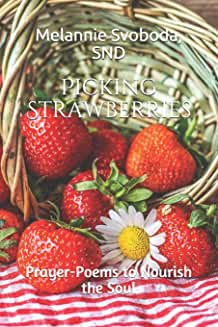
PS: My new poetry book is out! Titled Picking Strawberries: Prayer-Poems to Nourish the Soul. It contains 61 poems and it can be purchased from Amazon.com for $12.95. (I don’t have any copies to sell yet, but I’ll let you know when I do.) I want to thank Kathleen Glavich, SND, for formatting and publishing the book for me. She is an incredible writer and editor–and a dear friend!
PPS: I’m giving a Zoom retreat July 13-19 entitled “How Can I Keep from Singing?” It consists of 12 conferences. For more information, go to: www.kingsretreatcenter.org or call (618) 397-0584. This is the Belleville, IL retreat center that is sponsoring this retreat.
Our song today is Carrie Newcomer’s exquisite song, “Holy as the Day Is Spent.” In simple word and picture, the song underscores the theme of this reflection: daily prayer keeps us in touch with the sacredness of the ordinary and the everyday…
I invite you to respond below to the reflection, readers’ comments, pictures, or video. We love hearing from you!