Lessons I Learned from My Old Bank Book

I was going through one of my bulging files labeled “Blog Ideas” to get an idea for this reflection. In it, I found an old bank book of mine, the one I used from first to fifth grade at James A. Garfield School. That school, which included grades 1 through 6, was a fun place to learn. We did some nifty things there. For example, we banked our real money regularly at school. We all got bank books with our names typed on the front. On banking day, we brought our books and dimes and quarters, filled out our deposit slips, went down to the cafeteria, and stood in line waiting for the next teller–just like a real bank. In fact, it was a real bank: The Cleveland Trust Company with a branch in Willoughby, Ohio–only it was in our school. The older students were the tellers. They sat at the cafeteria tables looking very official. They recorded our deposit and took our money. The teachers were walking around in case there was any problem.

My bank book was labeled “School Savings Passbook.” Certain regulations were listed on the back: “When making deposits or withdrawals always present this book… If this book is lost, notify your teacher at once… Accounts may be opened with twenty-five cents or more.” I opened my account Feb. 2, 1951. I was in first grade and I deposited a quarter. Now as I studied the little gray book further, I noticed some curious things:

I usually deposited a quarter. I received my first interest in January 1952. I got $.01! This raised my total to $3.31. I checked: a penny in 1952 is worth 12 cents today! I made a $1 deposit in third grade. That was big money back then. In fifth grade I made other “big” deposits of $2, $3, and even $5. That was probably babysitting money. At 50 cents an hour, I was making big bucks. Throughout those five years at Garfield, I never withdrew any money. Said the bank book: “Withdrawals are made at the bank–never in school.” But on June 29, 1956, I withdrew all my money: $55.20. Today that would be worth $659.15! I closed my account because I was leaving dear old Garfield. Our parish, St. Felicitas, opened their school that year, and my parents made me go to that Catholic School–a difficult move for me because I was leaving all my friends. In my fifth grade, only 2 boys (Frank and Buddy) were Catholic and they switched to St. Felicitas too. But none of my girlfriends were Catholic. In time, however, I made new friends at St. Felicitas, and I even kept in touch with one of my girlfriends from Garfield until she passed away a few years ago.

Further thoughts:
By banking at school, we were being taught some important lessons in life. One main lesson was “delayed gratification.” Why do we put money aside? Because we are saving up to get something we need or want. Most children, psychologists say, learn this lesson by the time they are six: “Eat your peas and you can have a piece of apple pie.” Make the sacrifice now, and you’ll be rewarded in the future.” I wonder, how do parents and teachers teach this important lesson to their children today?
Secondly, we were learning responsibility in a host of different ways: Remember, tomorrow is banking day… don’t lose your bank book… making even a small deposit is good (my smallest was $.15)… fill out your deposit slip properly….wait your turn in line.

Third, we were learning about time. It takes time to earn money and to save it… it takes time to plan for the future… it takes time to put money in the bank… over time the value of money changes.
For reflection:
Did anything stand out for you in this reflection?
Did you have banking at school? Or, how did you learn to save money as a child?
How did you learn the lesson of delayed gratification? How have you taught that lesson to your children or grandchildren?
What “nifty” things do you remember from your early years in school?

PS: Thanks again for your prayers during my retreat. I’ll share more about my retreat in a future post!
Several weeks ago, our U. S. Mint produced the last penny. Yes, starting now, we in the U.S. won’t have any new pennies although the billions in circulation will still be around for a while. (I personally will miss seeing Abe Lincoln on the penny. We need his image more than ever these days. I’m grateul he’s still on our $5 bills!) In honor of the “noble penny,” I chose for our song today, “Pennies from Heaven.” Released in 1936, this song was written by Arthur Johnson and Johnny Burke. It was a cheerful little song for people struggling through the Great Depression. In essence it was saying, “There is goodness even in the darkness and storms we’re going through.” I hope you enjoy this song and even sing along with this easy jazzy version by Paul Anka and Michael Buble.
I welcome your comments below. I always enjoy your insights!
Advent Reflection 2025

The season of Advent is all about time: the past, the present, and the future.
Advent proclaims: Jesus came! Yes, he came over 2,000 years ago, born of a young Jewish woman named Mary in the small town of Bethehem. For about 33 years or so, he walked the dusty roads of Galilee in sandaled feet, living and healing and teaching a message of love, service, forgiveness, and trust in God.
Advent announces: Jesus comes! Not only did he come into the world of first-century Palestine, he comes into our world right here, right now! He walks among us still. How? Here are just a few ways: in the scripture that is proclaimed at every Mass and that we ponder throughout our lives… in the believing community gathered together in prayer and service of one another… in the Eucharistic Bread we receive at every Mass. Other ways where Jesus is present include: in the poor and needy in our midst… in the loving relationships we form with each other… in the service we give to one another… in the beauty, mystery, and power of creation… in the tears and laughter we share with one another.

Advent also promises: Jesus will come again! This man from Galilee, this Emmanuel, will return in the fulness of time, drawling all things unto himself. And before that ultimate return, Jesus will come for each one of us as we transition from this earthly life, through death, and into heavenly glory.
These three comings of Jesus can give us a framework for our prayer this Advent. First, let us take time to reflect on the mystery of the Incarnation, that is, the mystery of God himself becoming a human being. We might ask ourselves, Why did God become a human being? Ultimately, the answer is love. As we read in John 3:16: “God so loved the world that he gave his only Som, so that everyone who believes in him might not perish but might have eternal life.” But as we look around at the world today, we still see so much pain, sorrow, violence, hatred, injustice, and cruelty. The Incarnation did not take away the ugliness of sin in our world. Rather the Incarnation gives us the power to burrow deeply into our world and find the love and beauty and goodness present there. More importantly, the Incarnation gives us the strength, courage, and hope to add our own little bit of love, goodness, and beauty each day.
Second, let us reflect on the ways Jesus comes into our lives. We find Jesus primarily in the people we relate to–those we are bonded to in love and friendship as well as casual neighbors, co-workers, acquaintances and even strangers who enter our lives “by chance.” May we take time to really see people… to listen to them… to respect them… to encourage them … learn from them … and find ways to serve them.

And third, this Advent we might take a little time to reflect upon our own death–whether we think death is near or far in the future. We can do this by raising questions such as these: Are there things I still hope to do before I die? What’s preventing me from doing them now? Are there individuals I would like to see again, have a good conversation with, write a letter to, ask questions of, or be reconciled with? Is there something I’d like to give away before I die?
Advent celebrates the three comings of Jesus. May we find ways to ponder those comings as we prepare for the Celebration of Christmas 2025. Happy Adventing to all of you!
For reflection:
Did any words stand out for you in today’s reflection?
Does Advent mean anything special to you?
Is there any practice you would like to do during these few weeks before Christmas?
**************************************************************
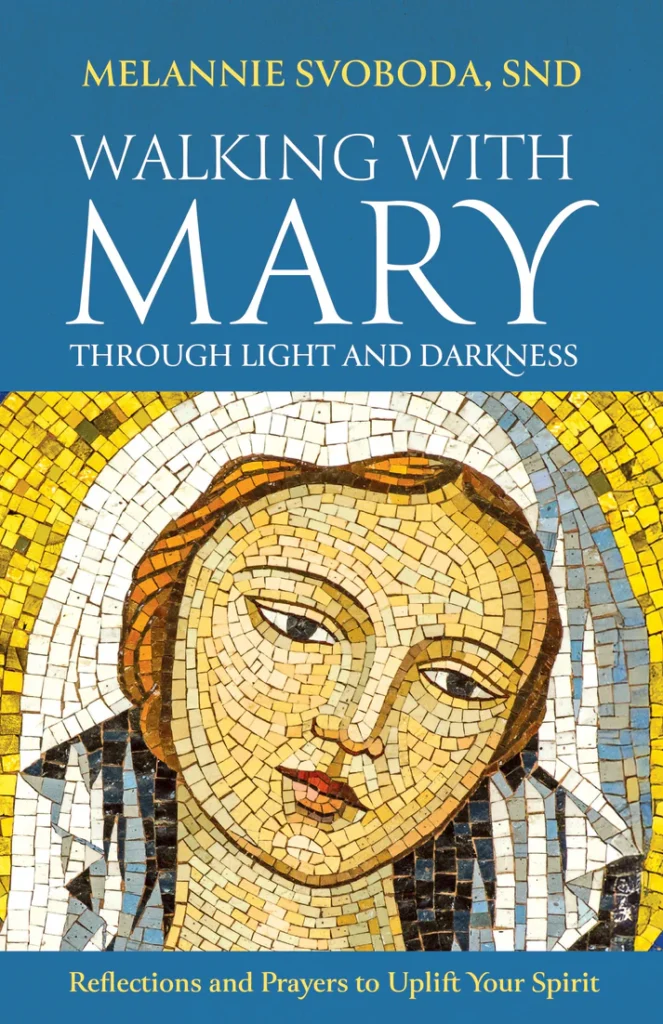
ANNOUNCING: My new booklet, Walking with Mary Through Light and Darkness, is now available at Twenty-Third Publications and Amazon. The 32-page booklet is a collection of reflections on Mary’s life with questions for reflection, prayers, and suggested videos and art work. It’s listed for $2.95, but lower bulk rates are also available. Hopefully, this booklet will help us to appreciate Mary as “one of us,” and Mary as our mother, sister, companion, and fellow disciple of Jesus. To order contact twenty-Third Publications: 1-800-321-4011 or [email protected]. Also available on Amazon.com.
Our video today is the Advent song, “Beyond the Moon and Stars” by Dan Schutte. It is based on Ps. 84:3: “Even the sparrow finds a home…a place near your altars, Lord, God Almighty.” Some of the phrases that touched me are these: “so great our hunger, Lord, to see your light… We place our hopes and dreams within your hand… You chose to dwell with us in flesh and bone…” For me the song captures the deepest longings of our hearts…
As I spend this week in retreat, I carry all of you in my prayers and in my heart… And, as usual, I invite you to respond below with a comment of your own.
Impediments to Gratitude: A Thanksgiving Reflection

This week, we in the United States celebrate Thanksgiving, a beautiful holiday on which we traditionally pause to thank God for the blessings we have received–especially family, friends, and nature’s bounty. I begin by wishing all of you a very Happy Thanksgiving! This wish is coupled with a big THANK YOU for reading this blog. And a thank you for your many comments which expand what I offer each week.
I thought it might be appropriate today to say a few words about thanksgiving or gratitude as seen on the Gospel. This reflection is based on the story of the Jesus’ cure of the ten lepers found in Lk. 17:11-19.

One day, as Jesus was entering a certain town, he was met by ten lepers who “stood at a distance from him.” They cried out, “Jesus, Master, have pity on us!” Jesus said to them, “Go show yourselves to the priests.” They did as he said, but on their way, they were all suddenly cured. But that’s not the end of the story. Of the ten lepers, only one eventually returned to Jesus, fell on his knees, and thanked him. Says Luke, “And he was a Samaritan.” This fact did not go unntoiced by Jesus. In fact he asked, “Where are the other nine? Has none but this foreigner returned to give thanks to God?” And to the man, he said, “Stand up and go; your faith has saved you.”
It’s a short passage. Only nine verses. But there’s much food for thought here. For example, it’s easy for us to assume that if we had been one of those cured lepers, we certainly would have returned with the “foreigner” to say thank you. Right? Why didn’t the other nine lepers return? What could possibly have prevented them from doing the polite thing and say “thank you”? Here are some possible reasons I came up with. While doing so, I realized, “Sometimes I’m not so different from those nine lepers who didn’t give thanks.”

Reasons I didn’t return to give thanks:
1) I coudn’t find Jesus. He was always on the move. I didn’t know where to look.
2) I couldn’t afford the time. I had already wasted many years of my life debilitated by this awful disease. I couldn’t waste one precious minute of my new life in a posture of gratitude.
3) I wanted to put my leperous life behind me. Returning to give thanks would have reminded me of my terrible, desperate needs back then. I wanted to forget all that and move on.
4) Truth be told, I was afraid of this man Jesus. I figured, if he had such power to heal me, what other powers could he possess that might not be so benevolent towards me.
5) Jesus seemed to be a pretty sensitive guy. I figured he knew how grateful I was. I didn’t have to say the words. Besides, he was so busy.
6) I was afraid of what he would have asked of me as payment for this miraculous cure. No one bestows such a marvelus gift without demanding something big in return, not so?

7) I didn’t want to be associated with this Jesus guy. I had heard that the religious and political leaders were against him. Some even wanted him dead. I felt the safe thing to do was to keep my distance from him.
8) I began to doubt if it was Jesus who actually cured me. After all, he didn’t say any magic-holy words or touch me. In fact, I wasn’t even in his presence when I was healed. Who says I owe Jesus anything?
9) I forgot.
For reflection:
Those are nine reasons (excuses) for not giving thanks–not only to God, but to other people who bless us with gifts every day: our spouse, children, parents, grandchildren, friends, neighbors, the people we serve, the people who serve us, a co-worker, the clerk in the grocery store, etc. Can you find yourself in any of these excuses?
Can you come up with any other excuse we might have for not saying thank you? If so, can you share it with us below?
Why not make a list (even a mental one) of 5 things you are especially grateful for today. You might want to say “thank you” (text, quick call, in person) to someone who’s responsible for something on your list.
*****************************
PS: I will be making my annual retreat from Sunday, Nov. 30 to Sunday, Dec. 7. Could you please say a little prayer for me during this week? I worked ahead and so I will post a reflection as usual next Monday, Dec. 1. It will be an Advent reflection. Meanwhile, know that I will hold all of you in my prayer next week, thanking God for your unique and special presence in my life!
********************************
For our video today I chose the old Thanksgiving Hymn “For the Beauty of the Earth,” here sung by Audrey Assad. Feel free to sing along.
I invite you to add your thoughts below. I love hearing from you!
Schedule a Humor Break

We schedule all kinds of things: A doctor’s appointment, a dental check-up, a trip to the grocery store, lunch with a friend, our housework, an oil change, and even a time to go to church. As important as these appointments are, there is another appointment that deserves our regular attention: a humor break. Hopefully, today’s “reflection” will provide such a break for you. Notice, I’m posting this humor break the week before Thanksgiving in case you want to lighten up the conversation around your Thanksgiving dinner table.
Let’s begin with animals… Can you guess which annimal would be good for these jobs?
1) A hotel bellhop?
2) A political consultant?
3) An acupuncturist?

4) A daycare provider?
Answers: 1) kangaroo, 2) hamster–he’s good at spinning, 3) porcupine 4) goat–she’s great with kids.
Okay, let’s hop along… Certainly we can do better than that…
A boy is sitting down with his parents for dinner. All three are holding their cellphones. Says the mother to her son, “Sammy, please text grace.”
From a middle school exam: Question: What is hard water? Student answer: Ice. (If you were the teacher, would you give that student any credit for that answer?)
A woman asked her travel agent: Can you make sure I don’t get a window seat on the plane, because I just had my hair done?
An actual newspaper headline in a Massachusetts paper: “Committee Appoints Committee to Appoint Committee.”

Back to animals… What are the collective nouns for these groups of animals?
What do you call a group of owls?… a group of sharks?… a group of hummingbirds? …giraffes?… rhinocerous?… hedgehogs or porcupines?… penguins?
Answers:
Owls: A parliament… sharks: a shiver… hummingbirds: a charm… giraffes: a tower… rhinocerous: a crash… hedgehogs or porcupines: a prickly… penguins: a colony… a waddle… or a raft.
(How many did you get right? Before I looked them up, I got ony 3 right: owls, rhinos, and penguins. I guessed a colony! I didn’t know about waddle or raft!)
November 8 was Pun Day. Sorry I’m late with these. Get ready to groan:
Police were called to a daycare where a three-year-old was resisting a rest.
Small babies may be delivered by a stork, but heavier ones need a crane.
I used to be a banker, but I lost interest.
A frantic woman tells her husband that moose are falling from the sky. The husband says, “No, it’s reindeer!”
“I need a pencil sharpener,” said Tom bluntly.
Need an ark? I noah guy.
Geology rocks, but geography is where it’s at!
Stay out of hot water when brewing a pun. It’s best to use subtle tea.
Words about advancing in age:

The older I get, the earlier it gets late.
At my age, “drink responsibly” means don’t spill it.
I had my patience tested. I’m negative.
By replacing potato chips with grapefruit you can lose 90% of what little joy you still have in life!
When you ask me what I am doing today, and I say “nothing,” it does not mean I am free. It means I am doing nothing.
When I ask for directions, please don’t use words like “east.”
Don’t bother walking a mile in my shoes. That would be boring. Spend 30 seconds in my head. That will really freak you out.
When you do squats, are your knees supposed to sound like a goat chewing on an aluminum can stuffed with celery?
My cardiologist’s diet for me: If it tastes good, spit it out.
Here’s something comedian Will Rogers said many, many, many years ago. Do you think it’s still true?
“We could certainly slow the aging process down if it had to work its way through Congress!”

Miscellaneous:
Some people eat snails. They must not like fast food.
What did the green grape say to the purple grape? “Breathe, man! Breathe!”
What’s the easiest way to get straight A’s? Use a ruler.
Which rock group has four guys who can’t sing or play any musical instruments? Mount Rushmore
Wife: I’ll admit I’m wrong if you admit I’m right.
Husband: Okay. You go first.
Wife: I’m wrong.
Husband: You’re right!
A man walks into a library and asks the librarian for books about paranoia. She whispers, “They’re right behind you!”
A man once said to Mark Twain, “I want to save my money, travel to Mt. Sinai, stand on that mountain, and read the 10 Commandments aloud.” Said Twain, “Why don’t you just stay home and live them!”
And last but not least: Life is like a roll of toilet paper. The closer you get to the end, the faster it goes!
For reflection:
Did you enjoy any of these?
Would you like to add a joke, pun, or funny remark below? I welcome your additions!
Here’s an “oldie but goodie” that some of you might remember: “High Hopes” sung by Frank Sinatra and some kids. Sing along if you remember the words!
I welcome your comments below!
“The Art of Pausing”

The Art of Pausing is a fascinating little book. The subtitle is Meditations for the Overworked and Overwhelmed. I thought, those words “overworked and overwhelmed” is how I feel at times. How about you? The book is essentially a collection of 99 haikus written by three authors “who inhabit very different worlds.” Brother Paul Quentin is a Trappist monk at Gethsemani. He’s a talented writer and photographer. Michael Bever, a retired educator, is an ordained Disciple of Christ minister “who was drawn later in life to Catholic traditions.” And last, there’s Judith Valente, a broadcast journalist for PBS-TV, writer, and retreat leader. Happenstance brought them together and they began exchanging haikus. Eventually they decided to write a book together, a book of haikus based on the 99 names of God referred to in sacred texts.
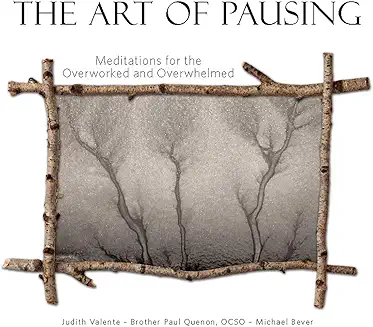
I’d like to share three of their haikus with you. They all follow the classic English-language haiku: three lines of five, seven, and five syllables. The first haiku, by Judith Valente, focuses on “God, the Designer”:
Neutrons seek protons
they hold the world together
for what, if not love?

Valente says that what she finds fascinating is “how all things, from protons to planets, collaborate, like the components of a perfectly calibrated watch.” She likes to think that “it is the universe’s love for us that holds things together in such a delicate balance.” As for me, I like to think that everytime I am attracted to someone (a friend, a stranger, a tree, a puppy) or something (a poem, an ocean, a concerto, a pizza) I am participating in the great dynamic of seeking–a seeking which permeates the universe–a seeking which eventually leads us to one another and ultimately to God, the Greatest Seeker of them all!
****************************************
The second haiku, by Michael Bever, is entitled “God, the All-Aware.”
Redbud branch in breeze
pale enticing afternoon
erases thinking.

Bever says there are many forms of prayer: the liturgy, the recitation of the psalms, the rosary, to name a few. But some people, like Thomas Merton, believed that the deepest prayer “needs no verbiage.” He maintained that there is so much talking that is “utterly useless. It is in the sky, the sea, the redwoods that you will find answers.” Says Bever, “I am grateful for those lazy afternoons when I can slow down long enough to notice a redbud tree’s branches swaying in the wind. A time of thinking about not thinking.”
*******************************************
The third poem is by Brother Paul Quenon, OCSO. It focuses on the day in Jesus’ life when the religious elders brought him a woman caught in the act of adultery. It’s called “God the Utterly Just”:
At a cruel moment
Jesus stooped, scrawled in dust
Best haiku ever—

Says Brother Paul, “To this day, no one knows exactly what Jesus wrote.” Whatever it was, it was enough “to send the crowd slinking away.” Brother Paul sometimes imagines that “Jesus wrote a short poem, perhaps even haiku-like, that struck at the heart of our human propensity for condemnation and judgment.” Jesus’ simple gesture has the power “to open up a wider vision of the world–one shaped by forgiveness and a divine judgment utterly new to our understanding.”
********************************************
For reflection:
Did any of these haikus speak to you? Is so, which one and why?
Have you ever had experiences that “erase thinking”? Describe one of those experiences and how you felt afterwards.
Do you think God is the “Greatest Seeker of them all”? If so, what leads you to believe that? If not, what leads you not to believe that?
I invite you to try your hand at writing a haiku below. It can be about anything you want. And it doesn’t have to be perfect. When I taught high school, I’d sometimes make myself do the assignments I gave my students–to remind myself of how challenging an assignment could be for my students. So I thought I would do this suggested “assignment” I just gave you! Here’s my haiku:
“Blogging”
Hard work coupled with
the Spirit’s inspiration:
joy-filled partnership.
**************************************
PS: A BIG thank you for all you planned and attended and prayed for the “SHINE Women’s Summit” in Toledo, Ohio last Thursday, sponsored by the Sisters of Notre Dame. This year’s event, with the theme of creativity, honored five women in the area who S – support, H – honor, I- inspire, N – nurture, and E- empower others in a wide variety of ways: as art educators, media experts, advocates for the performing arts, professionals at the Toledo Museum of Art, and internationlly recognized artists. I was privileged to be one of the panelists who shared ideas on the importance of creativity in our lives. I came away from the event inspired, encouraged, and with a deep sense of renewed hope! Special thanks to the Advancement Office staff–especially Kerri–and the three SND’s who provided me with their gracious hospitality, Carol, Sally, and Karel.
*****************************************
Michael Bever spoke about wordless prayer. So today’s music video (5 min.) has no words. And there are no lovely nature pictures in the background to “distract” you from the piano solo. There’s only pure pure sound… pure music… pure song. In this case it’s Chopin’s “Nocturne in E Flat Major (Op. 9, No. 2). You might be fascinated by “seeing the sound”on the video. I know I was… or you might want to close your eyes and just let the pure sound enter into yourself…
I invite you to respond to this blog below. I hope a few of you will write your very own haiku… don’t be shy…