Incredible Goodness from Horrific Evil
Sometimes incredible goodness comes from horrific evil. This true story from Brian Doyle’s book, Eight Whopping Lies, illustrates this important truth.
On the morning of September 11, 2001, 83 employees of the investment firm Sandler O’Neill & Partners were working in their company’s office on the 104th floor of the World Trade Center’s south tower. Sixty-six of those men and women died that day leaving behind 76 children.

In the days that followed that awful event, Sandler O’Neill & Partners made several extraordinary decisions concerning the families of those who died. The company decided to pay those employees their full salaries and bonuses to the end of that year. In addition, their families would receive full employee benefits for the next ten years. And, within a week, the firm started a foundation to pay for college for all the children of those deceased employees.
I was deeply touched when I read what the company did—especially when I read the last one. After all, I am still a teacher. Doyle talked to the company about those children and learned that 54 of them had graduated, their tuitions paid in full. Twenty-two were still eligible for the free college tuition. The 54 that already graduated attended a wide range of colleges and universities—from community colleges and technical institutes to Princeton, Yale, Notre Dame, Fordham, Georgetown, Boston College, to name a few. (Boston College was the alma mater of 24-year-old employee Welles Crowther, who saved 11 people from death in the South Tower that day. The last time he was seen, he was running back up the stairs to save more people.)
Dozens of people have donated millions of dollars to this college foundation. Those who run the foundation receive no salaries. One of those men remarked, “You wouldn’t believe some of the letters the recipients have written in appreciation. They appreciate that we have remembered their mom or dad this way. Many of them hardly knew their moms and dads.” (The youngest of the 76 children was born six weeks after September 11.)
Doyle interviewed Jimmy Dunne, one of the surviving partners of the investment firm, and asked him, “Why did you decide to do this generous and extraordinary thing?”
Dunne gave several answers:
“Because I knew that how we conducted ourselves in those first hours and days would define who we are and what we were about.”

“Because I knew this was the critical hour, and if we just got by without being honorable, then we stood for nothing.”
“Because I wanted to show (those who did this terrible deed), that we were people who lived and worked with honor. And that meant taking care of our people and their children with respect and reverence.”
As we begin a new year, it is good to remember this: Sometimes we human beings get it right. (Sometimes even Big Business or Corporate America gets it right.) Sometimes we human beings rise to the occasion. Sometimes we choose to do the right and honorable and loving thing. And sometimes horrific evil can give birth to incredible and far-reaching goodness. Amen.
Today I chose a song from the musical Rent. The song is called “525,600 Minutes.” That’s the number of minutes in a year. The song raises some good questions: how do you measure a year? How do you measure a man or a woman? The answer: measure them in love!
Do you have anything you’d like to share with us as we begin this new year together?
I want to wish each of you a very Happy and Blessed New Year! And thank you for reading my blog!
My Christmas Card to You
Dear Readers All,
Here is my Christmas card to you. It is “Angels We Have Heard on High” by “The Piano Guys.” This is a group of four (sometimes five) men from Utah who use the piano (and other instruments) in creative and lovely ways. In this video four of them play the same piano at the same time. I find their music beautiful, inspiring, and fun. (I used this song a couple of years ago, I know… It’s so good, it bears repetition!)
My wish and prayer for all of you is this: May you have a Christmas filled with love, peace, and joy–plus beauty, inspiration, and fun!
Thank you for reading my blog!
Lovingly in Jesus,
Sister Melannie
God bless you all!
A Christmas Reflection: All Was not Calm, All Was not Bright
At Christmas time, we sing the beautiful hymn, “Silent Night.” In it we say, “All is calm, all is bright.” But if we read the story of the first Christmas, we will see that all was not calm, all was not bright.
All was not calm. When the angel Gabriel appears to Mary, what is her reaction? Luke says, “She was greatly troubled at what was said.” Greatly troubled. That doesn’t sound like calm to me. Mary must have been afraid too and showed it. Why else would Gabriel have said to her, “Do not be afraid”? Being afraid is not the same as being calm.
 Then there’s Joseph. When he realizes that Mary is pregnant, he is not calm either. He tosses and turns in bed at night because he knows the child is not his. He’s in turmoil and distress trying to decide what to do: have Mary stoned or divorce her quietly? He decides on the latter until an angel appears and directs him to take Mary as his wife and raise the child as his own.
Then comes another major disturbance in their lives: Caesar’s edict. They must journey from Nazareth to Bethlehem and be counted for the Roman census. That’s a journey of 97 miles on today’s highways! But what did the trip entail back then? And then, when they finally get there, they learn there’s no room for them in the inn. So they are forced to seek shelter in a cave or stable. Mary gives birth not in a sanatized environment, but among farm animals. The calm is disrupted again when Joseph’s “dream angel” returns and warns him to pack up his family and hightail it to Egypt, a foreign country.
All was not bright. The Christmas story reminds us that sometimes all is not bright. Instead we walk in darkness, in  fog, in confusion. Mary’s “yes” at the Annunciation was a yes of faith—not certainty. Gabriel did not give her a manual on how to raise a Messiah. She knew little, if anything, of what lay ahead for her. As we have seen, Joseph too walked not in clarity but by faith. Mary and Joseph did not have a crystal ball in which they could see the future. Rather, they had “only” their faith, trusting that God would be with them no matter what the future held for them.
The lessons of the Christmas story are many. I have outlined two lessons here. First, we must not expect our lives to be calm simply because we are trying to be good people. Nor can we expect to walk in brightness and clarity simply because we are Christian. Sometimes God’s presence in our lives is accompanied by deep disturbances or periods of intense darkness. When this happens, may we follow the example of Mary and Joseph, entrusting our lives in faith to Emmanuel, God-with-us.
The song today is a beautiful one entitled “Somewhere in Your Silent Night” by Casting Crowns. As we listen to the song may we hold in our hearts those who are mourning the loss of a loved one this Christmas, those separated from family and friends, those in pain or distress of any kind, or those in dire need.
When have you experienced a lack of calm and clarity in your life? Did you have a sense of God’s presence during that time?
I invite you to share a response to the reflection and/or song below.
PS: A few readers have told me they are not receiving my blog even after they subscribe. Two suggestions. First, check your junk mail. Then after you subscribe, you should receive a verification notice. You have to verify that you have subscribed to my blog before you will start receiving it automatically. And finally, my “tech people” say that, from now on, my blog should arrive in the wee hours of Monday morning.
Next Monday, Christmas day, there will be a posting: a song only—which will be my Christmas card to all of you!
Martin Sheen: Actor, Activist, Pilgrim on the Way
I have just finished reading Sr. Rose Pacatte’s book, Martin Sheen: A Pilgrim on the Way. I have admired Sheen both as an actor and a social activist. This book reinforced my admiration.
Sheen was born Ramon Gerard Estevez on August 3, 1940 in Dayton, Ohio. 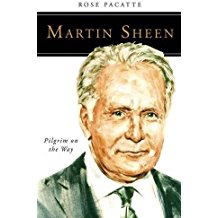 His father Francisco was born in Spain in 1898, growing up very poor. He entered the United States via Cuba in 1919 and got a janitorial job at the National Cash Register Company (NCR). Sheen’s mother Mary Ann Phelan was born in County Tipperary, Ireland in 1903. She came to the United States via Ellis Island in 1921, moving in with relatives in Dayton. Francisco and Mary Ann met while taking citizenship classes. They were married Sept. 5, 1927.
Their first two children (a girl and a boy) died in infancy. Then they had seven sons. The seventh was Ramon, the future Martin Sheen. During birth, his left arm was crushed by forceps, leaving it two inches shorter than the other. He managed this challenge gracefully throughout his life. A daughter Carmen was born in 1942 followed by two more sons. The Estevez house was lively, disciplined, and thoroughly Catholic. All the children attended Catholic schools for twelve years. Later on, all the children also struggled with alcohol.
Sheen’s mother died suddenly in 1951 of a cerebral hemorrhage, leaving Francisco with eight children still at home, the youngest being five. Without Mary Ann, an air of sadness pervaded the house. Sheen’s father wanted him to attend the University of Dayton, but Sheen was determined to become an actor despite his father’s objections. In high school, he entered a local talent contest reciting the poem “The Creation” by James Weldon Johnson. He won the grand prize: a trip for two to New York City and an audition at CBS television headquarters. Afterwards Sheen moved to New York and began to get some small acting roles. He quickly learned that having a Hispanic name did not open doors for him. So he changed his name to Martin (after a friend at CBS) and Sheen (after the famous TV televangelist Bishop Fulton J. Sheen.)
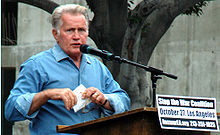
As an aspiring actor, Sheen had very little money. A friend introduced him to Dorothy Day’s Catholic Worker movement where he got free meals—and became acquainted with her work. Eventually he earned better roles on TV shows including Route 66 and The Defenders. In 1960 he met his future wife, Janet Templeton, a Southern Baptist. They were married in 1961 and had four children: Emilio, Ramon, Carlos (known as Charlie Sheen), and a daughter Renee. All four eventually went into acting. (The Sheens now have 10 grandchildren and one great-grandchild.)
Sheen’s acting career began to take off. At the same time, he ceased practicing his religion. In addition, his problems with alcohol became more obvious. Sometimes he would show up drunk on the set. At age 36, while making the award winning film, Apocalypse Now, Sheen suffered a heart attack and a nervous breakdown. After weeks in recovery, he finally admitted: “I am an alcoholic” and joined AA. At the same time, he came back to his Catholic faith saying, “I needed Catholicism… Coming back wasn’t about fear, it was about love and commitment.”
His Catholic faith rekindled Sheen’s interest in social justice. He adheres to the consistent ethic of life, opposing all forms of violence, including war, nuclear weapons, the death penalty, racism, sexism, and abortion. His acts of civil disobedience got him arrested about 65 times. Says Sheen, “While acting is what I do for a living, activism is what I do to stay alive.”
Sheen knew and/or worked with people like: Robert Kennedy, Martin Luther King, Jr., Dorothy Day, Mother Teresa, Cesar Chavez, Nelson Mandela, Dan and Philip Berrigan, Elizabeth McAlister, Sr. Helen Prejean, Mike Farrell (star of M*A*S*H), John Dear, Archbishop Desmond Tutu, to name a few.
From 1999 to 2006 Sheen starred in the acclaimed TV series, West
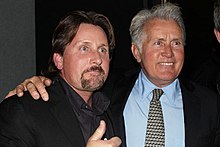
Wing, in which he played Josiah Bartlet, the president of the United States. Many groups tried to convince him to run for a political office in real life, but he always declined. Over the years he was nominated and won countless acting awards. His son Charlie Sheen has made the news with his own struggles with alcohol and HIV. Sheen says of him, “He is a loving, deeply sensitive man trying to find his way in a very dark corridor. We, his parents, will be waiting at the end of the corridor with a lit candle.”
Let me end with two quotes by Martin Sheen: “I love to ponder the mystery of God’s presence in the world, this huge demented inn that has no room for him, yet Christ comes, uninvited. Think of it—how much God loves us, to come uninvited.”
And: “Receiving the sacraments is such a joyful experience. I just give thanks and praise. That’s all I can do. I am just so happy to be alive.”
Is there anything that stands out for you in this reflection about Martin Sheen?
How does your personal faith overflow into actions for others?
I reached back into history for today’s song. It’s “We Shall Overcome,” which has been called the anthem of the Civil Rights Movement. This version is sung by folk singer and activist, Pete Seeger. It’s a song of hope for all individuals, like Martin Sheen, who work for peace and justice in our world.
Is there anything you’d like to say about this reflection or song? If so, please do so below.
The Story behind Adopt-a-Highway
James “Bobby” Evans was a young highway engineer in East Texas in the 1980s. One of his jobs was keeping 3600 miles of highway in good repair. For thirty years he had given hundreds of talks and film presentations against littering. But nothing seemed to work. As he drove the highways, he was dismayed to see the roadside littered with beer cans, fast food cartons, empty cement bags, old tires, and even disposable diapers. At that time Texas was spending nearly $25 million a year to collect such trash, and the cost was going up annually.
That’s when Evans got an idea. He challenged civic clubs to adopt one of the highways and to pick up the litter on a regular basis. His idea received  little enthusiasm. Later when he spoke with a co-worker, Billy Black, they came up with an additional idea: why not give credit to the volunteer organization by posting a sign with the groups’ name on it? Thus was born the Adopt-a-Highway program that eventually spread to 49 states (Vermont’s program is called “Green Up”), Puerto Rico, Canada, New Zealand, Australia, and Japan.
Here’s how it works. Volunteer groups make a two-year commitment to clean a segment of the highway a certain number of times a year. The Highway Department provides safety training, reflective vests, and trash bags. The department also picks up the bags of litter afterwards. Each volunteer group is acknowledged with a bold sign marking their adopted segment of highway.
But some groups or organizations did not have the personnel to pick up 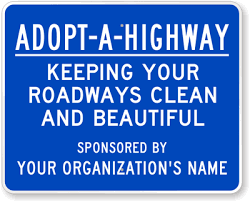 litter. In addition, some highways were just too dangerous for “amateurs” to do the cleanup. Thus, Sponsor-a-Highway came into being. In this program, organizations sponsor a segment of a highway, that is, they pay professionals to pick up the litter. In return, the organization gets a nice sign acknowledging their commitment to cleaning up our roads.
The Sponsor-a-Highway program appealed to companies and organizations for it provided low cost advertising for them. Billboards cost thousands of dollars. The Sponsor-a-Highway sign costs only a few hundred. Someone even figured out the cost for advertising per 1,000 views: the daily newspaper was $28; broadcast TV was $22.30; online advertising was $13.00; radio was $7.80. But Sponsor-a-Highway advertising cost only $.20 per 1,000 views! In addition, the signs cast the organizations in a positive light. The signs were good for Public Relations.
There have been a few “speed bumps” along the way. In one state, the KKK adopted a segment of a highway. Many people were outraged when their sign appeared. In fact, the sign was vandalized several times. What could be done legally? The highway department decided to dedicate that highway to Rosa Parks, the famous Civil Rights figure. When her sign was posted, the KKK stopped cleaning up the highway, so their sign was removed.
Researchers say that the Adopt-a-Highway program has actually reduced the volume of trash along our highways. They say that once you pick up litter yourself or even see other people picking it up, you are less likely to throw trash along the roadside. The program also demonstrates the power of two individuals (Evans and Black) to come up with a creative solution to a serious problem. It also gives evidence of how many ordinary citizens are accepting responsibility for the beauty of our common home.

Does anything in particular in this reflection speak to you? If so, what?
Have you ever participated in the Adopt-a-Highway program or a similar project to beautiful our common home? If so, could you briefly share your story with us?
I chose a song by Michael Card for today. It’s called “Joy in the Journey.” It celebrates the “wonder and wildness” of our earthly journey, a journey made more beautiful by the love we share for one another and for our common home.
We’d love to hear from you. Please respond below!
PS: A special thank you to everyone who attended our Advent day of prayer at the Marillac Center in Leavenworth, Kansas this past Saturday. I enjoyed meeting all of you—especially readers of my blog. (A few of them even crossed the Missouri River to attend!) And thank you to all the readers who prayed for this event. My next presentation is at St. Paschal Church, Highland Heights, OH on Monday, December 11 from 7:00 – 8:00 pm. The talk is entitled “Unwrapping the Gifts of Advent: Courage, Love, and Hope.”