Come and Slow Me Down: An Advent Prayer
Next Sunday is the First Sunday of Advent. It’s that time of the year when the Church calls us to slow down and reflect on the great gift of Jesus’ coming into our world over 2,000 years ago—and his continued presence in the people, events, and circumstances of our world today. Yet, ironically, this season of slowing down is often the most hectic time of the year as we rush madly around to prepare for Christmas. (This Advent might be more hectic than ever since Advent is the shortest it can be. The Fourth Sunday of Advent is Christmas Eve this year! I feel I’m getting gipped!)
With all of this in mind, I am offering a simple Advent prayer today that reminds us to pause amid the Christmas rush to remember what Christmas (and life!) is really all about. Jesus was a very busy man, yet even he slowed down on a regular basis. The prayer is called “Come and Slow Me Down.” It is from my book, Just Because.
Come, Lord Jesus,
You who took time to notice lilies bobbing,
Birds soaring, and bread rising,
Come and slow me down.
You who took time to dine with acquaintances,
Go fishing with your apostles,
And barbecue breakfast on the beach for your friends,
Come and slow me down.
You who took time to play with children,
Listen to people’s stories,
And share their joys and sorrows,
Come and slow me down.
When my mind is crammed with plans,
When my “to-do” list is pages long,
When I feel carried away by conflicting concerns,
Come and slow me down.
Give me the grace to stop and to be—
With you, with others,
With my own hopes, fears, questions, and dreams.
Help me to bear you slowly but surely into the world,
A world languishing and lovely,
Dark and delightful, sinful and saintly.
I ask these things of you,
Through Mary, the pondering disciple,
Your mother and mine.
Come, Lord Jesus, come! Amen.
Do you like the season of Advent? Why or why not?
How might you slow down this Advent? Any ideas you could share with us?
Here are two versions of “O Come, O Come, Emmanuel.” The first is by Enya. It is sung in English and Latin. The second is the traditional choir version with lyrics. Listen to either or both!
Enya’s version:
The traditional version:
Any responses to this reflection and/or song?
PS: Please pray for the Advent Retreat I’ll be leading this Saturday, December 2, at the Marillac Center in Leavenworth, Kansas. Thank you!
Personal Rituals
When we think of the word “ritual,” we often think of certain religious practices: blessing ourselves with holy water before entering a church, the Mass itself, praying grace before meals. But, chances are, we have other rituals that may not be specifically religious. These personal rituals play an important role in our lives.
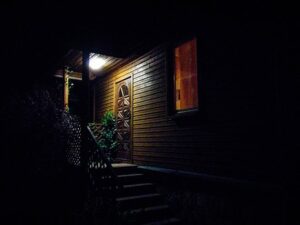
Here’s one of my mother’s personal rituals that I recall from my childhood. My dad was a tool and die maker. Often he left for work very early in the morning while it was still dark. My mother would kiss him goodbye (that was part of their ritual!) and he would walk to the garage in the back. A few moments later, he would drive out the driveway that ran beside our side porch. My mother would stand by the side door and, as he drove past, she would flick the porch light on and off a couple of times. It was her personal ritual for saying goodbye to the man she loved.
Many of us have rituals we perform regularly. For example, do you have any morning rituals or evening rituals? When I get up in the morning, I always make the sign of the cross as I crawl out of bed. At the end of the day when I crawl back into bed, I make the sign of the cross too. Sometimes I make the regular sign of the cross. Other times I simply trace a cross on my forehead. It’s my way of marking the beginning and ending of each day.

My morning rituals also include a cup of coffee while I pray, a shower, dressing, and stepping outside to retrieve the morning paper. If it’s still dark, I check out the moon and the stars. I usually eat a bowl of cereal for breakfast, check my email, and leave the house at 7:15 to walk to church for Mass. My rituals for ending my day include the playing of soft music and reading a little before crawling into bed.
We can have weekly rituals too: cleaning, shopping, watching sports games. We can have annual rituals too. How do you celebrate birthdays, graduations, or anniversaries in your family? How do you celebrate Christmas, Thanksgiving, the Fourth of July? Rituals can include favorite recipes, songs, certain decorations, even stories. If you ever find yourself saying, “It wouldn’t be Thanksgiving without ___,” you are identifying a ritual.
Writer Judith Valente says, “Our personal rituals are holy.” Why are they holy? Rituals mark the passage of time. This is important because we can take time for granted and live with the illusion that we have all the time in the world. Rituals hallow or bless our time.
Rituals help us celebrate relationships. My mother’s porch light celebrated
her love for my Dad. Rituals also steady us. No matter what is happening in our life, no matter what mood we’re in, our rituals have a way of centering us. When I’m out of town giving a retreat, my personal rituals are often disrupted. My coffee might not be available at 5:00 am. The setup of my room is different. My breakfast is not my usual one. When I return home, I always enjoy getting back to my personal daily rituals again. Can rituals be counterproductive? Yes, if we become slaves to them. Healthy personal rituals always leave room for growth and spontaneity.
What are some of your personal rituals?
What are some of your rituals for celebrating special days or special events?
Since Thanksgiving Day is this Thursday (in the U.S.), what are some of your rituals for celebrating this day?
In honor of Thanksgiving, I chose this “Thanksgiving Medley” for today’s song. It’s my way of saying Happy Thanksgiving to all of you!
Would you like to respond today? We would love to hear from you!
On Our Way to Becoming a "We"
In his book, What Is the Point of Being a Christian? Dominican Father Timothy Radcliffe tells the story of a famous rabbi who received a letter from a man in deep distress. “I ask for your help,” the man wrote. “I wake up every day sad and apprehensive. I can’t pray. I find it impossible to concentrate. I keep the commandments, but I feel no spiritual satisfaction. I go to the synagogue, but I feel alone. I don’t know what life is all about. I need your help.” The rabbi returned the letter to the man, underlining the most prominent word in each sentence: I, I, I, I, I, I, I, I, I, I.
The writer Alice Camille says that we humans sometimes have an “I problem.” We focus too much on ourselves in isolation from the rest of humanity and the rest of the world. “I” statements can be adversarial, she says. If there is an “I,” then “there has to be a ‘you’ on the other side of the table.” Camille concludes: “The cure for ending the battle between ‘you’ and ‘I’ is finding the way to ‘we.’”
Finding the way to we… That phrase really touched me. Aren’t some of the critical issues today really an “I-You” problem? If we’re racist, it’s because we separate a particular race from ourselves. We “I’s” against you “you’s.” If we’re sexist, it’s because we separate one gender from another. We hold one gender superior to the other. If we’re ultra-nationalistic, then it can be we Americans (or we Canadians or we Australians) against you the rest of the world.
It seems to me that the great challenge is to “widen our we.” We are called to become more and more inclusive in our awareness and in our love. Every now and then, we have experiences that show us we are not separate “I’s” and “you’s.” We are all one. Sadly, it is often tragedy that dispels the illusion of our separateness. A devastating hurricane, a mass shooting, a flu epidemic—all can unite us in the shared experience of human vulnerability, suffering, and pain.
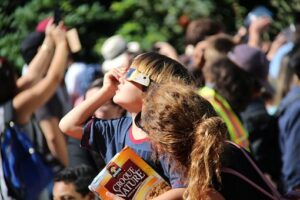
Fortunately there are positive events that can dispel the illusion of our separateness too. A couple of months ago vast parts of the U.S. experienced a total eclipse. Millions of people witnessed this incredible phenomenon firsthand or via TV or the web. Huge groups of people (and I!) were united in awe at the great mystery we were experiencing. Some people clapped and cheered. Some even wept. All those “I’s” had become a “we.”
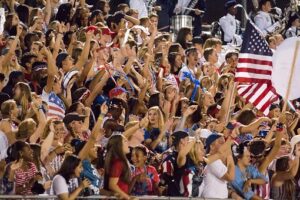
Other experiences can makes us more appreciative of our “we”: a wedding, a birthday party, a concert. A sporting event can be a powerful experience of our “we-ness,” where total strangers hug and high-five each another, united in their shared devotion to a team.
On a deeper level, how do we encourage our awareness of our oneness? As Christians we celebrate the Eucharist every Sunday. Pope Francis has said, “The Eucharist is the sacrament which brings us out of our individualism.” We gather together to worship. Says Camille, when a person says, “I don’t get anything out of Mass,” one reason is they are attempting to do the unlikely: “to have a solitary experience in the midst of a party.”
At Mass, I am often aware of our “we.” The welcoming usher, the robed presider, the altar server with her bobbing pony tail, the reader with the mellow voice, the talented organist, the lively choir, the 100-year-old woman sitting in the first pew, the toddler asleep on his father’s shoulder—we are one with each other. We are all “I’s” on our way to becoming a “we.”
When do you experience your oneness with others, with all of creation?
St. Mother Teresa of Calcutta once said the primary “illness” in the United States is loneliness. What are some ways we can help ourselves and/or others who have this “illness”?
Today’s song is “One Bread, One Body” written by John Foley, SJ. It is based on: 1 Cor 10:16-17; 12:4, 12-13, 20; Gal 3:28; Eph 4:4-6.
I welcome your responses to this reflection and/or song!
PS: Thank you for your prayers for my two presentations in Thousand Oaks, CA. I really enjoyed interacting with the faculty and staff of La Reina High School and Middle School. What great people! And on Saturday we had 50 SND’s, their associates, friends, and a few other sisters at our mini-retreat on “Wonder, Courage, and Hope: Three Essentials of the Spiritual Life.” I really enjoyed my time with them too!
My next presentation is on Dec. 2: “Unwrapping the Gifts of Advent” at the Marillac Center in Leavenworth, Kansas. Check the website for the Sisters of Charity of Leavenworth for more information.
On Our Way to Becoming a “We”
In his book, What Is the Point of Being a Christian? Dominican Father Timothy Radcliffe tells the story of a famous rabbi who received a letter from a man in deep distress. “I ask for your help,” the man wrote. “I wake up every day sad and apprehensive. I can’t pray. I find it impossible to concentrate. I keep the commandments, but I feel no spiritual satisfaction. I go to the synagogue, but I feel alone. I don’t know what life is all about. I need your help.” The rabbi returned the letter to the man, underlining the most prominent word in each sentence: I, I, I, I, I, I, I, I, I, I.
The writer Alice Camille says that we humans sometimes have an “I problem.” We focus too much on ourselves in isolation from the rest of humanity and the rest of the world. “I” statements can be adversarial, she says. If there is an “I,” then “there has to be a ‘you’ on the other side of the table.” Camille concludes: “The cure for ending the battle between ‘you’ and ‘I’ is finding the way to ‘we.’”
Finding the way to we… That phrase really touched me. Aren’t some of the critical issues today really an “I-You” problem? If we’re racist, it’s because we separate a particular race from ourselves. We “I’s” against you “you’s.” If we’re sexist, it’s because we separate one gender from another. We hold one gender superior to the other. If we’re ultra-nationalistic, then it can be we Americans (or we Canadians or we Australians) against you the rest of the world.
It seems to me that the great challenge is to “widen our we.” We are called to become more and more inclusive in our awareness and in our love. Every now and then, we have experiences that show us we are not separate “I’s” and “you’s.” We are all one. Sadly, it is often tragedy that dispels the illusion of our separateness. A devastating hurricane, a mass shooting, a flu epidemic—all can unite us in the shared experience of human vulnerability, suffering, and pain.
Fortunately there are positive events that can dispel the illusion of our separateness too. A couple of months ago vast parts of the U.S. experienced a total eclipse. Millions of people witnessed this incredible phenomenon firsthand or via TV or the web. Huge groups of people (and I!) were united in awe at the great mystery we were experiencing. Some people clapped and cheered. Some even wept. All those “I’s” had become a “we.”
Other experiences can makes us more appreciative of our “we”: a wedding, a birthday party, a concert. A sporting event can be a powerful experience of our “we-ness,” where total strangers hug and high-five each another, united in their shared devotion to a team.
On a deeper level, how do we encourage our awareness of our oneness? As Christians we celebrate the Eucharist every Sunday. Pope Francis has said, “The Eucharist is the sacrament which brings us out of our individualism.” We gather together to worship. Says Camille, when a person says, “I don’t get anything out of Mass,” one reason is they are attempting to do the unlikely: “to have a solitary experience in the midst of a party.”
At Mass, I am often aware of our “we.” The welcoming usher, the robed presider, the altar server with her bobbing pony tail, the reader with the mellow voice, the talented organist, the lively choir, the 100-year-old woman sitting in the first pew, the toddler asleep on his father’s shoulder—we are one with each other. We are all “I’s” on our way to becoming a “we.”
When do you experience your oneness with others, with all of creation?
St. Mother Teresa of Calcutta once said the primary “illness” in the United States is loneliness. What are some ways we can help ourselves and/or others who have this “illness”?
Today’s song is “One Bread, One Body” written by John Foley, SJ. It is based on: 1 Cor 10:16-17; 12:4, 12-13, 20; Gal 3:28; Eph 4:4-6.
I welcome your responses to this reflection and/or song!
PS: Thank you for your prayers for my two presentations in Thousand Oaks, CA. I really enjoyed interacting with the faculty and staff of La Reina High School and Middle School. What great people! And on Saturday we had 50 SND’s, their associates, friends, and a few other sisters at our mini-retreat on “Wonder, Courage, and Hope: Three Essentials of the Spiritual Life.” I really enjoyed my time with them too!
My next presentation is on Dec. 2: “Unwrapping the Gifts of Advent” at the Marillac Center in Leavenworth, Kansas. Check the website for the Sisters of Charity of Leavenworth for more information.
Three Poems by Bishop Bob Morneau

Bishop Robert Morneau is Auxiliary Bishop of Green Bay, Wisconsin. He is also pastor of Resurrection Church there. A loyal Packers’ fan, he is also a good friend of mine. If that’s not enough, Bishop Bob is a poet. His poetry is simple yet profound. It is rooted in daily life and in his great love for God and God’s people. Here are three short poems of his: about a cluttered desk drawer, a war far away, and a cathedral brick. I hope you enjoy them.
“Revelation”
I just opened my desk drawer:
a shoe horn stared at me
as did scattered paper clips, a dead watch, rubber bands awaiting use,
a defunct checkbook,
a golf tee,
a library card,
an ancient passport.
I just opened my heart:
staring at me a barrel of fears,
riotous affections seeking order,
a small flame, quivering,
dreams of expansiveness,
a hunger for the infinite.
I quickly closed my cluttered desk drawer
and did the same with my troubled heart.
Today has enough worries of its own.
* * * * *
“The War”
It was a distant war,
thousands of miles from our homeland,
a long, long way from the heart.

But yesterday the war drew near.
a young soldier,
from a neighboring village,
was killed in a helicopter crash.
The battle now has a face
and the moans of a grieving family.
No war is distant
though miles silence the sound of weapons.
We are one family, and
every war wears the face
of grieving humanity.
* * * * *
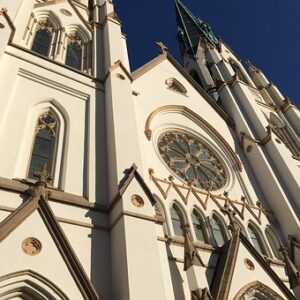
“A Cathedral Brick”
“Add your brick to the cathedral of life,”
they say.
But brick upon brick makes no home,
event upon event piled high, no life.
A design is needed,
a game plan—a life plan.
Our vocation is architecture,
a double calling to envision and execute.
Our vocation is to align our mission,
to place our brick
into the hand of the Master builder.
It is in this submission
that Chartres becomes a reality.
Bishop Bob Morneau will retire Dec. 31. Let us keep him in our prayers. May he continue to write poetry with his pen and with his life.
Did any of these poems speak to you? How? Why?
Today’s song is Amy Grant’s “Better than a Hallelujah.” It celebrates honesty in prayer, saying “honest cries of a breaking heart” can be the best prayer of all.”
PS: I ask your prayers for two upcoming talks. On Thursday Nov. 9 I’ll be speaking to the faculty at La Reina High School in Thousand Oaks, CA. On Saturday Nov. 11 I’ll do a presentation on “wonder, courage, and hope” for the SND Sisters, their associates, and other Sisters. Thank you for your support!
Would you like to share a thought with us about this reflection and/or song? Please do so below!