Pain and the Call to Transformation
For Holy Week, I would like to share a few thoughts on pain. Some of this comes from my book In Steadfast Love, chapter 16. I will include some reflection questions throughout this post.
Everyone experiences pain. No one is exempt from it. No one has the perfect health, perfect family, perfect friends, perfect job, perfect government, perfect church, perfect living conditions. Remembering that everyone experiences pain can prevent us from falling into a “victim mode.”

Richard Rohr tells of a woman who was obsessed by an injustice she suffered years ago. By her own admission, she had turned into an angry and negative person. At one point she blurted out, “My pain is my ticket.” Rohr says it was at that moment that he realized her pain had become her very identity. “Playing the victim gave her a kind of power, a moral superiority over almost everybody.” Playing the victim also excused her from having to do anything about her pain: “She didn’t have to grow up, let go, surrender, forgive—all the things the great religions of the world deem necessary for spiritual growth.”
Do I ever play a victim? Do I think my pain is so unique and so terrible that it sets me apart from everybody else? Do I assume that nothing can be done about my pain? Has my pain ever called me to “grow up, let go, surrender, forgive”?
God can use our pain to lead us to greater wholeness or even transformation. Kathleen Norris writes, “We human beings learn best how to love when we’re a bit broken, when our plans fall apart, when our myths of self-sufficiency and safety are shattered.” Isn’t this precisely what the Covid-19 pandemic has done to us? It has dramatically disrupted what is normal. It has heightened our awareness of how little control we have over life. It has separated us from our loved ones. It has caused many grave financial hardships. It has challenged us to find new ways to love—and new individuals to include in our loving.

What have been some of the greatest pains of this pandemic for me personally? Do those pains teach me anything about myself? Did Covid-19 challenge me to find new ways of loving? If so, how? Did the pandemic challenge me to include new people in my love? If so, who?
No one has the definitive answer to the questions, “Why is there pain in the world” Or “Why do innocent people suffer?” But we Christians have a person: Jesus. We believe in a God who became a human being like us and who knows and understands our pain firsthand. As Madeleine L’Engle has said, “Terrible things are not God’s will, but God can enter them with redemptive love. That is the promise of the Incarnation.”
John Shea reminds us that Jesus “lived without anesthesia. He was numb neither to the joy and pain of the world. He never developed defenses to keep both happiness and sorrow moderate.” He experienced the pain of loneliness, misunderstanding, overwork, estrangement from family members, rejection by religious leaders, and betrayal of his closest friends. We reverence his most painful hours every time we reverence his image on the crucifix.
This week is the perfect time to reflect on the sufferings of Jesus. We can do this simply by gazing upon a crucifix or reading an account of the passion or attending (even if virtually) the beautiful Holy Week services. As we do this, let us be amazed not only at what he suffered, but also let us be amazed at how much he loved. And how he did not return hatred for hatred or violence for violence. And how he forgave those who were putting him to death. And how he entrusted all to Abba, his Father.
At the same time, let us reflect on the sufferings of the Body of Christ, God’s people in today’s world. Who is carrying a cross that I might help shoulder? Who is being persecuted, bullied, denied their dignity and rights as children of God? How might I get involved to help them? Who in my family or neighborhood could simply use my attention or my appreciation? How might I express these?

I want to wish all of you and very blessed Holy Week…
Our video is Deborah Govenor’s beautiful “Remember Me.”
Thank you for reading “Sunflower Seeds”!
Venerable Pierre Toussaint
None of the 11 saints associated with the United States are of African descent despite the presence of Black Catholics in the U.S. since the 18th Century. But here is one individual who could very well become one of the first Black Saints in our country, Pierre Toussaint (1776-1853).
Toussaint’s story is a fascinating one. Born into slavery in what is now Haiti, he was the property of a very wealthy French family headed by Jean Berard. Toussaint was spared the horrific conditions of harvesting the sugar crop on the huge Berard plantation. Instead he was chosen to be a “house slave.” This meant he received not only a good education, he was also taught a lucrative skill: hairstyling.

But when a slave rebellion seemed eminent on the island, Mr. Berard took his wife, family, and five slaves (including Toussaint and his sister Rosalie) to New York City for safety. Berard apprenticed Toussaint to one of the finest hairdressers in the city, under whose direction Toussaint became one of most popular stylists in the area. Then Berard returned to Haiti where he died of pleurisy. His sugar plantation was destroyed during the rebellion, leaving his wife and family in New York virtually penniless.
It was Toussaint who used his skill as a hairstylist to discreetly support the entire Berard household. Even the grieving Mrs. Berard didn’t know the full extent of his financial generosity. He cultivated a large clientele, sometimes working 16 hours a day creating fancy, highly-stacked hairstyles for his wealthy customers.
Mrs. Berard eventually married again. Several years later, on her deathbed, she gave Toussaint his freedom. Toussaint then bought freedom for his sister Rosalie and another slave, Juliette Noel, whom he married in 1811. Both Juliette and Pierre had a deep compassion for those in need. They eventually opened their home as an orphanage, credit union, employment agency, and refuge for travelers. They never had children of their own, but when Rosalie died of tuberculosis, they adopted her daughter Euphemia. The couple also fostered a succession of children in their home, teaching them a trade so they could support themselves. Toussaint even found them jobs through his many connections in the city.

Toussaint was not only an excellent hairdresser, he also had a knack for investing and fundraising. When Mother Seton wanted to build a Catholic Orphanage in New York in 1817, for example, Toussaint helped her financially by donating not only some of his own savings, but also by soliciting large donations from his clients. He also had empathy for the sick. During a yellow fever epidemic in the city, he went into barricaded neighborhoods to aid the sick, places most people were afraid to enter. So expansive was his charity, that Toussaint has been called “The Father of Catholic Charities in New York.”
Toussaint was preceded in death by his daughter Euphemia and his wife Juliette. He died at the age of 87. In a highly unusual move, several of the New York newspapers of the day wrote about his passing, praising him for all he had done for the poor of the city. Although his ghostwritten memoir was published in 1854, he was relatively unnoticed until, in 1968, Cardinal Cooke introduced his cause for canonization.
Toussaint suffered much during his life. He was a slave for over 40 years. Once emancipated, he had to endure the racism of his day. When he went to his clients’ wealthy homes, for example, he often had to walk there since Blacks were banned from riding the horse-cars of his day. Toussaint was one of the main fundraisers for the original St. Patrick’s on Mulberry Street, but when he tried to enter the church for the dedication ceremony, he was turned away by an usher because he was Black. Fortunately, another usher recognized him and escorted him to one of the places of honor.
During his day, there was also a lot of anti-Catholicism. Yet this humble and devout man still managed to attend daily Mass for over 60 years and was devoted to the rosary. When he died, he was buried in the cemetery at St. Patrick’s Old Cathedral. But in 1990, Archbishop John O’Connor had his body moved to the present location of St. Patrick’s on Fifth Avenue. He is the only layman to be buried in the crypt of that famous church.

Toussaint kept working well into his 80s. Friends asked him why he didn’t retire. After all, he had enough savings to live on. He replied, “I have enough for myself, but not for others.” One publication said of him, “Helping others, regardless of ethnicity, was a constant theme in his long life.” Pope John Paul II declared him venerable in 1996.
Let me close with these simple words of Pierre Toussaint: “I have never felt I am a slave to any man or woman, but I am a servant of the Almighty God who made us all.” Let us pray for his canonization. We need his powerful and inspiring example more than ever in our world today.
Is there anything in this reflection that stood out for you? If so, do you know why?
What lessons do you derive from the story of Pierre Toussaint?
If you go to the website for St. Patrick’s Cathedral, there is a section on Toussaint which includes his biography and a short video on the Pierre Toussaint Guild.
PS: Thank you for your prayers for last week’s zoom retreat with the Sisters of the Precious Blood in Dayton, OH. What a beautiful group of women they are! I want to thank especially Sisters Nancy and Judy for helping to make the retreat run smoothly.
I think this song by Marty Haugen reflects the life and spirit of Pierre Toussaint. It’s called “All Are Welcome.”
Thanks again for being a part of our “Sunflower Seeds” community!
Who Is God to You?
I’m reading a book entitled God Is No Laughing Matter by Julie Cameron. The title is misleading, because very early in the book Cameron says that she thinks God has a “pretty good sense of humor.” She cites two proofs: octopuses and those baboons with rainbow colored fannies.
But if God is very serious to you, Cameron suggests you explore why. She gives several exercises to explore your concept of God. I did a few of these while I was on retreat last month and found them very worthwhile. Even fun.

First, Cameron suggests we answer this question: What was your childhood religion like—(if you had any)? You can break that down by describing the “spiritual atmosphere” in your house… Or answering: What did you learn about God from your mother? What did you learn about God from your father? Then she suggests you describe your childhood God using ten adjectives. And finally, write a letter to your childhood God.
Let me share a few memories of my childhood religion. Mass every Sunday… the painting of the Last Supper in our dining room… crucifix in every bedroom… After a visit to our grandparents, as we pulled into our driveway, Mom would say, “And we thank the good Lord for a wonderful day and a safe journey”… A “Kitchen Prayer” was tacked between the two windows above the kitchen sink… Ashes on Ash Wednesday. We came late to our public school on that day, but we were excused. All day the other kids asked us about our ashes. They seemed envious. I was proud… Catechism classes… Hearing about the three children at Fatima and wondering if Mary was going to show up as we four kids had to pick strawberries… Being in the forty Hours Procession… Mom was in charge of Bingo at our Church bazaar, so we worked there and had a lot of fun… I remember a few times going out into the field by myself, sitting in the tall grass, and just thinking about God…

I hope the previous paragraph jump starts your own reflection on your childhood religion.
Next, Cameron suggests to reflect on your current concept of God. How is it different and/or like your childhood concept of God? Describe your ideal God using at least ten adjectives—maybe more. And finally, set aside a half hour. Take yourself out of the house if possible—even if it means sitting on your back porch. Do something “small and festive.” Sing along to a favorite song… Dance… Go for a walk… Drive to a favorite place… Get a cup of coffee and a donut in a drive-thru… Be alert to everything around you while doing this. Then ask: Did I encounter God in any form?
When I lead retreats, I sometimes pass out a sheet with peoples’ concepts of God. I’ll close this post with a few of those:
+ “We stand in a world completely penetrated by the Living God, the abiding Source and Sum of Reality.” (Evelyn Underhill)
+ “God is greening power.” (Hildegard of Bingen)
+ “God is bread…water… a harbor. God is a father, mother, my sister, my brother, my leader, my guide, my comforter, my friend… God’s my all in all, my everything.” (Thea Bowman)
+ “God is mercy within mercy within mercy.” (Thomas Merton)
+ “God is sheer, exuberant, relational aliveness.” (Elizabeth Johnson)

PS: I wish a very Happy St. Patrick’s Day to all of you on the 17th! And I wish all of you a very Happy Feast of St. Joseph on the 19th! And thank you for your prayers for this week’s retreat for the Sisters of the Precious Blood in Dayton, OH!
Our video is called “Gratitude” by Louie Schwartzberg with Brother David Steindl-Rast, the author and narrator of the words. I chose this video because I have always believed that when we are grateful, we are very close to God.
I am grateful for having you as one of my readers!
Cause for Concern, Cause for Hope
(Please note: Last week I accidently posted TWO reflections. When I realized my mistake at 5:30 am, I immediately took the first one down and reposted it for today Mar. 8. So, you might have read this reflection last week… or you couldn’t open it and wondered why. Well, here it is. Secondly, my blog emailed another reflection on Tuesday last week. It’s one that I posted in December! I have no idea how or why that happened. So, I apologize for the confusion. When my congregation gets our new website up and running soon, hopefully, such errors won’t be occurring! Meanwhile I thank you for your patience!)
Recently, I came across two articles that touched me… in different ways. The first I entitled “Cause for Concern.” The second, “Cause for Hope.”
Cause for Concern: The Journal of Environment International recently reported that scientists have discovered microplastics in human placenta. Kathleen Bonnette wrote about this in America (Feb. 2021). She writes that the particles were residue of “paints, coatings, adhesives, plasters, polymers and cosmetics and personal care products.”
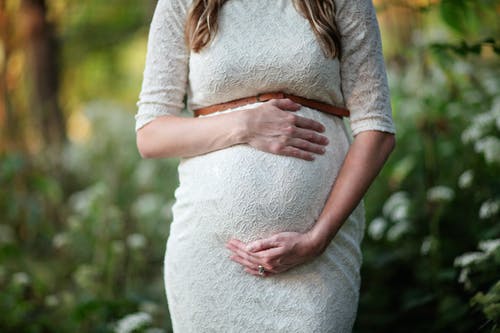
Scientists are very concerned about this finding. They worry that microplastics “may alter several cellular regulating pathways in the placenta,” which could interfere with the implantation of the embryo, with fetal development, and with maternal-fetal communication.
Apparently there is no place on earth that is not inhabited by these microplastics. They have been found on Mt. Everest as well as in the deepest trench in the ocean. But now, says Bonnette, it is alarming to learn “that our children are being formed in wombs infused with inorganic material.”
“With the discovery of microplastics in human placentas,” she says, “we can no longer look at environmental degradation as separate from, or tangential to, pro-life issues.” We are faced not with two separate crises–one environmental and the other social. Rather, in the words of Pope Francis in “Laudato Si,” we are faced “with one complex crisis which is both social and environmental.” In Let Us Dream, the Pope says we must allow “the principle of ecological regeneration to shape the decisions we take at every level.”
How does the principle of ecological regeneration shape your decisions on every level–such as what foods you eat, what articles you read, what clothes you wear, what you choose to do for entertainment, etc?
Through the miracle of ultrasound, the 4 and 1/2 minute video below shows the development of the baby in the womb. This video is sponsored by Pregnancy Chat, so there’s a short ad at the end.
A Cause for Hope: This story is told by Deacon Greg Kandra in the book A Stranger and You Welcomed Me, edited by Deacon Jim Knipper. If you’re looking for Dr. Jim Withers in Pittsburgh, PA in the evening, you’ll seldom find him in the ER or OR. Instead, he’s usually in the back alleys of downtown Pittsburgh with his stethoscope around his neck. His waiting room is under a bridge, in a gutter, or on a heating grate. His patients include the unemployed, the elderly, the addicted, former prisoners, mental patients, veterans, and people suffering from depression or post-traumatic stress disorder.
Withers practices in a growing field called “Street Medicine” through a group he founded over 20 years ago called Operation Safety Net. It is funded in part by the Sisters of Mercy of Pittsburgh. This network now has programs in 85 cities in 15 countries and in five continents. Withers sees what he does not as a job, but as a calling. He feels called to care for those our health care systems have forgotten. His inspiration was Mother Teresa who saw Jesus in the disguise of the poor. Deacon Kandra suggests that, to his patients, perhaps Dr. Withers is the disguise of Jesus too.
Here is a 3 minute video from CNN about Dr. Withers:
Did anything move you in either of these videos? If so, what?
PS: I ask your prayers for a Zoom retreat I will be leading for the Sisters of the Precious Blood in Dayton, OH, March 14-19. Thank you—and thank you too for reading “Sunflower Seeds.”
Movement and My Exercise Class
Some people exercise during Lent. I’m lucky. I already have an exercise class up here on the third floor where I live with 58 other sisters. It meets at 9:00 am Monday through Friday for about 40 minutes. About eight of us show up pretty regularly. There’s no pressure to come every day.
We exercise along with a DVD called “Stronger Seniors,” a workout program led by Anne Pringle Burnell. We like her. We also like the ladies behind her who do the exercises with her. They are not young and skinny—although young and skinny is good, of course. Instead, they are more mature and matronly—like us! Mature and matronly is good too!
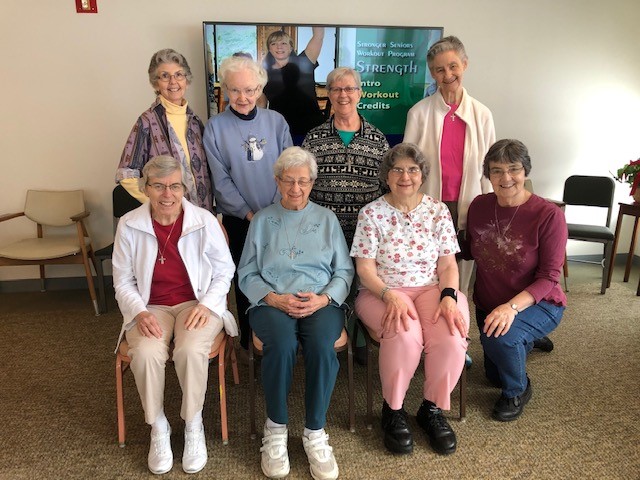
We do all our exercises while sitting in a chair. Now, before you smirk, let me tell you that there are three parts to our routine: warmup, aerobics, and weight lifting. We do a lot of stretching and slow movements with our arms, legs, and shoulders in the warm up section. In the aerobics section we run, swim, box, dance the tango, and even do jumping jacks—all while sitting in our chairs. In the weight lifting part, we do all kinds of things while holding our 2 lb. weights. We stow our imaginary luggage in the imaginary airplane overhead bin, we pour drinks, we start a lawn mower, we saw wood. By the end of class, we are pretty worn out.

Why do we exercise? The cover on the DVD case tells us why: “to develop strength and enhance the ability to function in daily life.” In other words, we exercise so we can keep moving. And movement is a beautiful thing.
In my book, The Grace of Beauty, I have an entire chapter dedicated to the beauty of movement. I begin with the fact that we are always moving even if we’re sitting still. As you sit and read this, for example, the earth is rotating 1,040 miles per hour—and it’s taking you along for the ride! In addition, the earth is rotating around the sun at (hang on to your hat!) 66,500 miles per hour! Every cell in our body is also in constant motion. So is every single atom that composes every single cell, tree, rock, raindrop, whale, beetle, and blueberry. Movement lies at the heart of our universe.

Does movement also characterize God? The great medieval mystic, Mechthild of Magdeburg thought so. She wrote that God is a moving God, a “restless” God, an “overflow… which never stands still and always flows effortlessly without ceasing.” The contemporary writer Steven Bevans, SVD, agrees. He writes: “I’ve begun to think of God as a Movement, an Embrace, a Flow—moving through the cosmos and history, embracing wounded and suffering creation, flowing through the smallest subatomic particle as well as complex organisms.” Bevans goes even further to say that all of creation is engaged in a cosmic dance that God is leading—maybe a dance like the conga.
Jesus too was a mover. Even as a young boy, Jesus “advanced in wisdom and age.” Advancing implies movement. During his public ministry he was always on the go, mostly on foot, never settling down. When he encounters the sick he was also moved with compassion. When he loses his friend Lazarus, he is moved to tears. His interior growth and understanding were always advancing too as he learned to follow the new dance steps Abba and the Spirit were teaching him.
His entire life was a movement toward Jerusalem, toward Calvary, toward death. Isn’t this what we commemorate during Lent? And don’t we also focus on our own participation in that movement of Jesus? But his story does not end with the stillness of death on Calvary. No, because on Easter morning Jesus sprang out of the darkness of the tomb and danced his way into the brightness of everlasting glory.
For reflection:
What role does movement play in your daily life?
Does movement play a role in your prayer? your work? your leisure?
What are some of your favorite forms of moving—for example, walking, dancing, swimming, driving, flying? Why?
PS: This past week I was making my annual retreat—for 2020! (I’m a little behind with my life…) I just want you to know that you, my Sunflower Seeds readers, were in my prayers every day in a very special way!
Our video today is called “Breathtaking View of Nature” by Eredus. It captures the endless and the beautiful movement found in the natural world. I hope you enjoy it!
Thank you for reading my blog!